
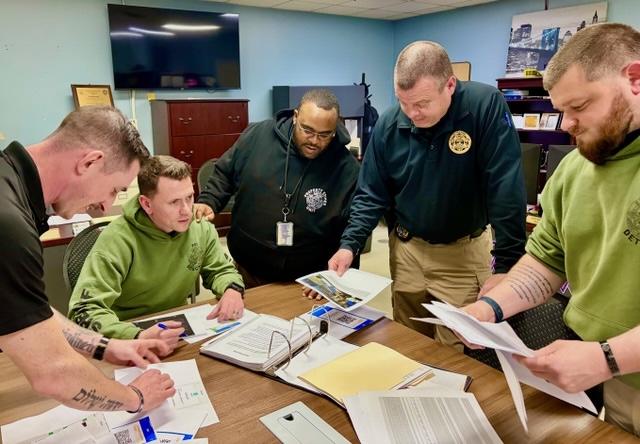
Knox County Sheriff’s Office (KCSO) Det. Wayne Doster recently solved the biggest case to ever land on his desk, involving a crime that ruins many lives – scams. The case involves two local businessmen who lost a combined $500,000 in a Bitcoin cryptocurrency hustle that began when they clicked on a slick-looking Facebook advertisement.

Det. Wayne Doster
One victim lost their life savings of $375,000, and the second man lost $175,000, which he secured through a bank loan. That $500,000 is gone, vanished through the web of the Internet. One click by each man was all it took. And they are but one of hundreds of thousands who fall for such scams.
Take a look at the most recent hard numbers about scams from the Federal Trade Commission’s (FTC) latest report in the U.S. from 2024. This is big, big business in the global criminal world.
- Consumers reported losing more than $12.5 billion to fraud in 2024, a 25% increase over 2023.
- In 2023, 27% of people who reported a fraud said they lost money, while in 2024, that figure jumped to 38%.
- Most people (70%) reported a loss when contacted on a social media platform — and lost more money overall — $1.9 billion.
- Consumers reported losing more money to investment scams –$5.7 billion — than any other category in 2024. That amount represents a 24% increase over 2023.
- The second highest reported loss came from imposter scams, with $2.95 billion lost.
- In 2024, consumers reported losing more money to scams where they paid with bank transfers or cryptocurrency than all other payment methods combined. People reported losing more money through a bank transfer or payment ($2 billion), followed by cryptocurrency at $1.4 billion.
Doster, 33, a detective for only three years and Our Town Hero for his work, spent several months and many hours investigating this case, pulling together the disparate pieces of this puzzle from Malaysia to the U.S. His work led to the arrest of Lee Kah Poh, 29, a Malaysian national who flew here to collect the money and try to extend his scam operations. Poh is now in the Knox County Detention Center under a $1 million bond.
“This was a very sophisticated cryptocurrency investment scam run by a group or syndicate in Malaysia, and it’s the most broad-reaching case I’ve ever worked,” said Doster, a 2013 graduate of Powell High School and a 12-year KCSO veteran. “It has been and is a very complex case. They used texts, emails, texting apps like Telegram and WeChat, and social media, and when I opened his phone, everything on it was in Chinese, which we had to have translated by a woman in Tri-Cities who works with law enforcement at all levels.”
It was sustained, tedious investigative work at its best by Doster.
During the investigation, Doster also discovered pictures of approximately 500 passports on this man’s phone and quickly realized that the Malaysian group was heavily involved in the human trafficking business, moving people from China and into Malaysia and then to Thailand. That discovery pulled Interpol into this web. He also discovered that the same scam he was investigating was happening concurrently in six other states – Georgia, Oklahoma, Texas, Connecticut, New York, and California. And that led Doster to share and collect information with law enforcement investigators in each state.
Doster says Poh’s victims here and elsewhere reported losses totaling $1.6 million. Poh came to the U.S. through California, then spent time in New York, and flew to Knoxville on July 31. Detectives tracked his movements, made contact with him, and set up a meeting. That July 31 meeting was in the parking lot of the Food City in Halls, where Poh thought he was collecting another $300,000 from the Knoxville victims. There, Doster arrested Poh.
Poh is facing two counts of fraud, two counts of theft by deception, and two counts of conspiracy to commit a financial crime. He also attempted to bribe Doster, which led to another charge of the attempted bribery of a public official.
When one of the victims contacted the FBI, the FBI contacted the KCSO, and Doster’s work began.
We hear and read many stories about the vulnerable elderly being scammed. Not so in this case. Doster says the victims in this scam were in their 60s and 50s. “The ad they clicked on made it all look believable, and the click on the ad takes you to a very fake and very professional-looking and legitimate website to convince you to invest in Bitcoin cryptocurrency,” he explained. “Most anyone could be sucked into this scam from the website.”
Doster lays out for us exactly how the scam worked: “… The scammers would create a Facebook ad for cryptocurrency investing. The victims would then click on the ad, and they would be directed to a website. The scammers would then reach out to the victims after acquiring their information on the website. The scammers would provide the victim with 500 USDT at no cost. They would invest the 500 USDT for the victims, and the victims could then see their investment live, like watching the stock market. Once the return reached around $5,000 worth of USDT, the scammers would pull it and wire them $5,000 in U.S. Currency to the bank of their choosing. The victims then would be asked if they wanted to invest more, and once they had “invested” more money, the scammers would put that “investment” onto their website.
“For example, the victims from Knoxville invested $500,000 of U.S. currency, which on the website the scammers said showed a $46 million return. When the victims attempted to cash out their investments, the website (owned by the scammers) would not allow them to access their money. The company then contacted the victims and advised them that they had to pay taxes before receiving their money from the ‘investment’. The scammers would then attempt one more cash pickup in order to deprive the victims of more. To obtain money from the victims, the company sent couriers to pick up their cash. The victims would set a date and location to meet the couriers, and then were sent a picture of the serial number on a U.S. $1 bill. Once contact was made with the courier, the victims were then presented with an actual U.S. $1 bill, and the victims were told to compare the serial number of the physical bill with the picture of the serial number they received. If the serial numbers matched, then the victims knew they were giving their cash to the right person.”
That’s what happened in the Food City parking lot when Doster arrested the courier. He didn’t get the cash. Just the handcuffs.
The hard work of investigating this complex case is over. Now the case moves through the legal system and eventually to a courtroom, unless he pleads guilty and is sentenced. If it goes to trial, Doster will for sure testify at some point after the prep work with the Knox County District Attorney’s Office.
Doster and his wife, Kaci, and their four sons live in Halls. Their sons are ages 8, the twins are 5, and the youngest is 1. And tomorrow night the KCSO will meet for its semi-annual Officer & Detective of the Month awards dinner at the Jubilee Banquet Facility where Doster will be honored for his work on this major scam case. And the whole family will be there!
We asked KCSO Chief of Detectives David Amburn to share his thoughts about Doster’s work on this case. “Detective Doster has always been one of those people who puts in the necessary work and then some. He’s patient, passionate about assisting victims, and will stay the course to get justice. I have enjoyed watching him flourish in the Property Crimes Division. He has a bright future, and the Knox County Sheriff’s Office is fortunate to have him.”
And Knox County is happy to have this young man as well.
Tom King has been the editor of newspapers in Texas and California, and also worked in Tennessee and Georgia. If you have someone you think we should consider featuring, please email Tom at the link with his name or text him at 865-659-3562.
Aubrey’s Restaurants sponsors our Town Hero.

