As we continue to move toward our nation’s semiquincentennial, I’m still focusing on elements of the Revolutionary War effort of attaining independence and the related contributions and connections of families of the Fork, the Knox County lands between the French Broad and Holston Rivers.
Last week, we saw how my Fork family line goes back from my grandparents Jesse James and Jocie Caldonia (Oakley) Loveday through Jocie’s maternal line to Revolutionary War soldier John Webb. Today, we’re zeroing in on Jesse’s grandmother Talitha (Hurst) Loveday’s Revolutionary War ancestor, “Mill Creek John” Hurst.
I just love Bible names in my family tree, but sometimes I have to look twice and think a little longer when researching individuals. For instance, our Sevier County Loveday progenitor Edward’s daughter “Darkus” Loveday on the census record is actually Dorcas, as in the woman in Acts 9 who was “abounding in good deeds and gifts of mercy.” And then on another census, there’s “Etter,” whom I always knew as “Aunt Estie.” She was actually named for Esther, who was “born for such a time as this” and became the queen of Persia. Of course, the men’s names are equally as interesting and complex, such as “Kie,” whose birth name was Hezekiah, after the righteous king of Judah. On the other hand, my grandfather, Jesse James Loveday, and his brother, Dalton, were born in the 1890s at the height of fascination with Wild West outlaws. We keep it real, friends, and we like a little sass along with our Bible lessons.
I say all that to explain how my uncle thought his grandmother’s name was “Liza.” She died about 30 years before he was born, so he had only heard her name on occasion as a young boy. His relatives were actually saying “Litha,” which is how she was sometimes listed on census records. It was short for Talitha, as in the Aramaic term for “little girl” mentioned in Mark 5:41. (Multiple family members recalled that she had a sing-song way of spelling her name, but no one could remember how it went.) Talitha Hurst’s daddy was Sevier, named for our state’s legendary frontier leader and governor, who was filled to the brim with sass. Just ask the Tiptons.
Sometimes names were repeated so many times in a family that individuals were known by a place or a trait. For instance, last week’s Revolutionary War subject was actually called “Smoking John” Webb, because he evidently liked tobacco more than the other relatives named John Webb. To distinguish our John Hurst from all the others by the same name in the family, he was known as “Mill Creek John” because of the nearby creek where he first lived near Luray, Virginia. He was born in 1735.
Mill Creek John Hurst married Nancy Ann Nunn in 1759 in the Shenandoah Valley and enlisted during the Revolution in 1781 under Colonel Michael Rader and Captain George Prince. John’s son Henry first served in John’s place, and then John served a term for his son when Henry became ill. By 1789, Nancy had died, and John remarried. He eventually had 17 children. A lot of documented information about the Hursts can be found in A Hurst Family History: 1600 to Present 1988, housed at the Sevier County Library.
Sometime before 1796, Mill Creek John Hurst moved to Elks Bend of the Powell River, about seven miles northeast of Tazewell in Claiborne County. The family’s early presence there qualifies their descendants for the First Families of Tennessee. John died at Elks Bend in 1817 at age 82 when a tree fell on him.
John and Nancy’s son, George (born between 1760 and 1770), married Martha “Pattie” Breeden (“Breeding”) in 1789, lived in Wythe County, Virginia, for a while, then near his dad in Claiborne County, and moved to Sevier County by 1803. George and Martha’s son Sevier died during the Civil War in 1864, when the foothills of the Smokies were filled with rampaging deserters, bushwhackers, and renegades. It was the same year that another Sevier County ancestor, Dillard Lee Williams, was put on a horse, taken up the road, and shot. The Hurst family was too afraid to take Sevier’s body to the nearby cemetery, so they buried him outside the home with the intentions of moving the grave when the war ended. But the war raged on for another year.
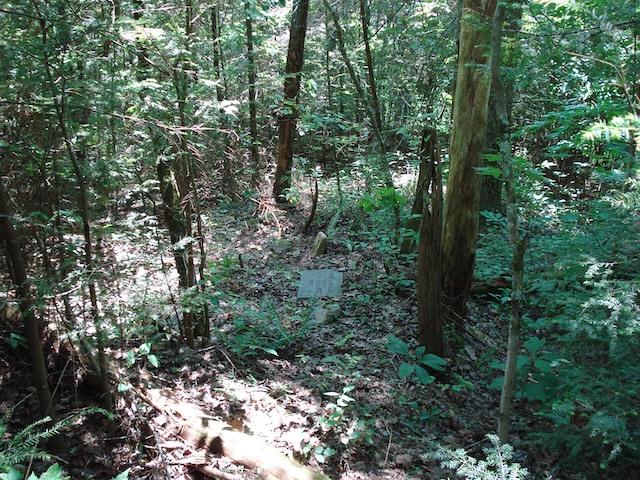
Sevier Hurst’s 1864 grave, which remains in Sevier County woods beside where the homeplace once stood, was eventually marked by Rev. Hezekiah Hurst.
Sevier’s daughter, Talitha, married Noah Loveday, who had a son named Eli. Love those Bible names. Eli was Jesse James Loveday’s father. As stated in my previous articles, during the Great Depression, Jesse James came to Knox County to work in the quarry, where his ancestor “Mill Creek John” Hurst’s Revolutionary War service has been forgotten in the Fork.
Jan Loveday Dickens is an educator, historian, and author of Forgotten in the Fork, a book about the Knox County lands between the French Broad and Holston Rivers, obtainable by emailing ForgottenInTheFork@gmail.com.
Follow KnoxTNToday on Facebook and Instagram. Get all KnoxTNToday articles in one place with our Free Newsletter.


“Mill Creek John Hurst married Nancy Ann Nunn in 1759“
I’m a descendant of Nunns from Lenoir County, NC. At some point, Davy Crockett fits into the picture.
Do you know much about Nancy Ann?
Thanks, David, for reaching out! I don’t know much about Nancy, but I’d sure like to! Feel free to email me at the address in my bio. Let’s exchange info!