
As we continue to look toward our nation’s semiquincentennial, I am focusing on the Revolutionary War effort of attaining independence and the related contributions and connections of families of the Fork, the Knox County lands between the French Broad and Holston rivers.
Whew. Sometimes it’s tough to find stuff on these folks. When I was recently given the Sons of the American Revolution (SAR) application papers of the Rev. Homer Cate from 1978, I thought, “Easy-peasy; it’s all laid out.” But no. I couldn’t find his Patriot in any of the Revolutionary War papers I was accustomed to utilizing. Despite various combinations of keywords, he just didn’t show up. There were several records for multiple men named John Cate(s), but they didn’t match the details in the SAR application. Frustrating.
However, after many attempts to validate the SAR information, I eventually found that he DID show up. He showed up to serve and do what needed doing in 1782 and 1783 from Hillsborough in Orange County, North Carolina. Hillsborough is just west of Durham near the Eno River and was the site of the 1781 surprise attack by Loyalists known as “the most brilliant exploit of any group of Loyalists in any state throughout the Revolution.” I don’t know whether that event spurred John to enlist or what he did as a Patriot military man, but he earned three payments for his service.
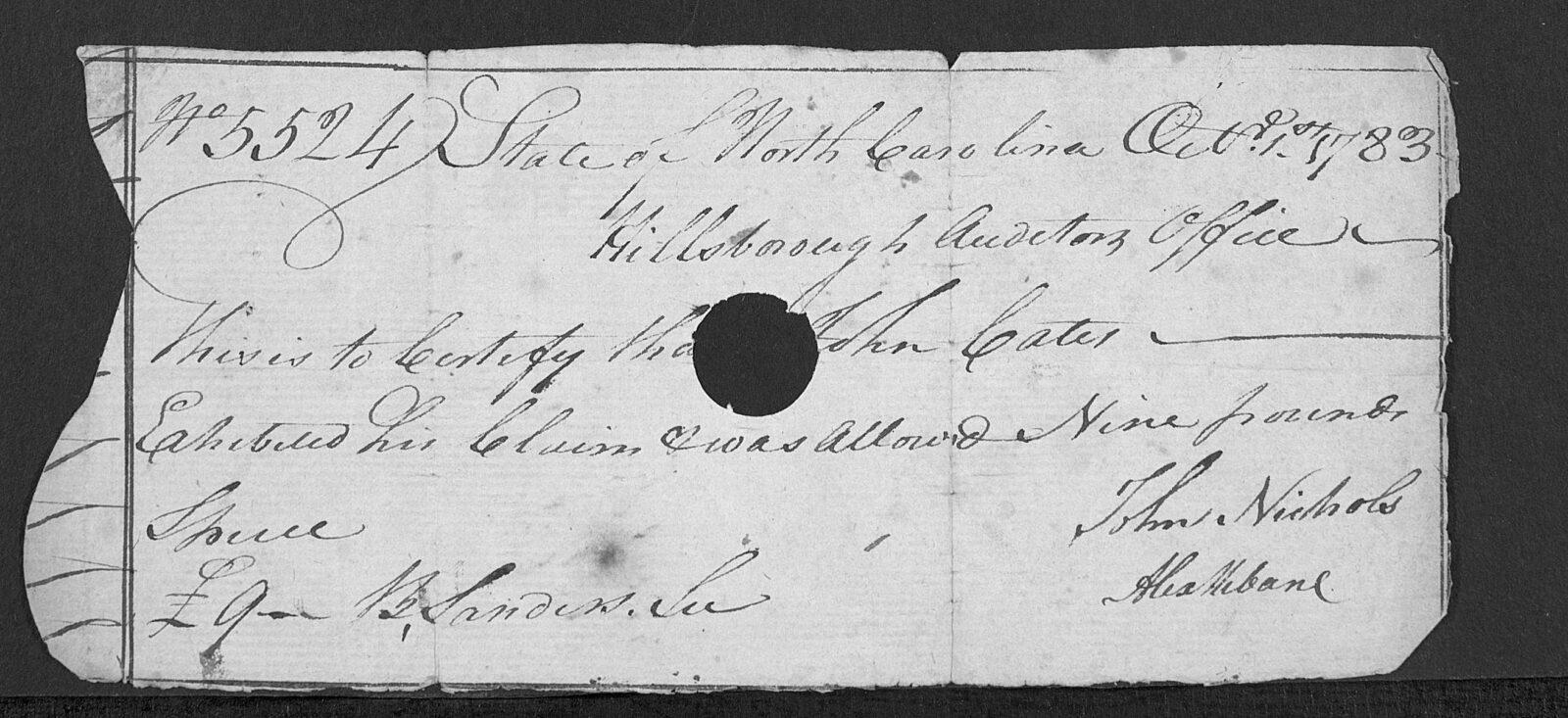
John Cate’s North Carolina Revolutionary Pay Voucher
Although I doubt that it’s the same man, I found this statement in Patriot spy James Fraley’s pension papers about a 1781 Cherokee attack near the Clinch River: “They also killed the wife of John Cates and four of his children and set the house on fire and burnt them up in it.” He might not have been Homer’s John Cate(s), but he was somebody’s John Cate(s). I don’t blame the Cherokee for trying to defend their lands, but the struggle was brutal on both sides. It just goes to show the kind of trials and atrocities endured during the effort toward our nation’s establishment.
The Patriot spy James Fraley, mentioned above, served out of Virginia under the command of Col. William Campbell (though it’s spelled “Camel” in his pension papers) of Kings Mountain fame. John Cate’s father apparently was Ezra Cate, a Quaker who moved his family from Virginia to Hillsborough, North Carolina.
So, what is John Cate’s connection to the Fork? Although he is buried at Dumplin Cemetery in Jefferson County, his descendants migrated by generation down through Dumplin Valley to Knox County, where several served as ministers or in other leadership positions at various Fork churches.
According to Homer’s SAR records, John Cate’s son James Cate was born about 1790 in Virginia and married Elizabeth Lindsey, also of Virginia. Their son Joshua was born in Jefferson County, Tennessee, in 1815 and died in Knox County in 1881. His wife Elizabeth (Tankersley) was from Chucky in Greene County; she died in Knox County in 1893. Their son Isaac (Homer’s grandfather) is buried in Thorn Grove Cemetery in the Fork community where Homer served as pastor of that Baptist Church, as well as others. More than 70 Cate(s) family members are buried at Thorn Grove. Although Homer was an active SAR member, John Cate’s service toward our nation’s establishment has been forgotten in the Fork by many of his descendants.
Jan Loveday Dickens is an educator, historian, and author of Forgotten in the Fork, a book about the Knox County lands between the French Broad and Holston Rivers, obtainable by emailing ForgottenInTheFork@gmail.com.
Follow KnoxTNToday on Facebook and Instagram. Get all KnoxTNToday articles in one place with our Free Newsletter.


JohnCate is my fourth Great Grandfather .
So glad to make the connection! Do you know anything more about his military service?