
When household budgets tighten in East Tennessee, the effects rarely appear first in official reports. They show up at food pantries. A rent increase, a car repair, or a temporary lapse in public benefits can shift a grocery budget just enough to create a gap.
Across Knox County and 18 surrounding counties, the organization designed to fill that gap is the Second Harvest Food Bank of East Tennessee.
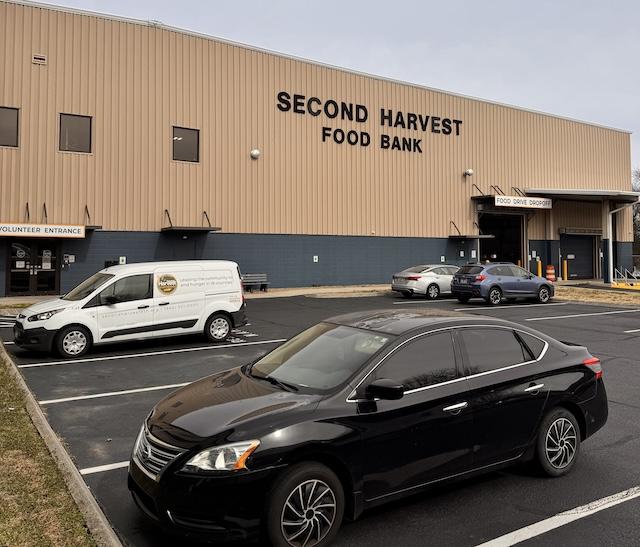
From its distribution facility in Maryville, Second Harvest serves an 18-county region through a network of more than 700 partner agencies. Chief Operating Officer Rachael Ellis said the mission is focused on consistency rather than visibility.
“Second Harvest exists to close the gap between food availability and food access,” Ellis said in an email interview. “We define success by how effectively and consistently we can move food through our network so neighbors can access it without disruption.”
The work is primarily logistical. Food enters the system through donated retail and manufacturer products, federal commodities, and bulk purchases. It is received, inspected, and stored before being distributed in bulk to partner agencies throughout the region. Those agencies, not the food bank itself, provide groceries directly to individuals and families. Second Harvest also operates mobile pantries in communities with limited access points.
Ellis said confusion between food banks and food pantries remains common. A food bank aggregates and distributes at scale. Food pantries interact directly with clients. She also said another misconception is that food banks distribute only surplus or expired products. A significant portion of the organization’s inventory consists of fresh produce, purchased staple items, and donated goods.
Demand increased sharply during the pandemic and has not returned to pre-2020 levels. The organization monitors client visits, pounds distributed, mobile pantry attendance, and school participation in its Food for Kids program to track trends across Knox County and the surrounding counties it serves. While emergency pandemic assistance has tapered off, household expenses remain elevated, keeping demand higher than it was five years ago.
Policy shifts can quickly affect pantry traffic. Adjustments to SNAP benefits, school meal programs, and other public assistance often influence demand at partner agencies. When benefits are reduced or delayed, Ellis said the change is reflected in increased visits.
That sensitivity became visible in November 2025. Knoxville Mayor Indya Kincannon partnered with United Way of Greater Knoxville to provide $200,000 in emergency funding to local food pantries after a lapse in SNAP benefits contributed to food shortages. The city approved $100,000, matched by $100,000 from private donors.
The funding helped stabilize local agencies during a short-term disruption. It also underscored a structural distinction within the region’s hunger response system. Emergency dollars can address immediate shortfalls, but moving food consistently across 18 counties requires standing infrastructure, warehouse capacity, refrigeration systems, transportation contracts, and compliance oversight. Second Harvest operates that infrastructure every day.
Operational pressures remain constant. Transportation logistics, fluctuations in product availability, and refrigerated storage capacity across partner agencies can create bottlenecks. Inflation reduces purchasing power. Fuel costs increase transportation expenses across a geographically large service area. Labor market pressures affect staffing in warehouses and logistics.
During periods of increased demand, allocation decisions become more complex. The organization must distribute equitably across counties while maintaining enough inventory to sustain operations over time. Ellis said food safety standards are not negotiable and that all products are inspected and handled in accordance with established guidelines, with traceability and quality control systems in place.
Volunteers remain essential to the model. They sort, pack and prepare food for distribution at the warehouse level, and partner agencies rely heavily on volunteer labor as well. A sustained decline in participation slows operations and increases costs, affecting overall distribution capacity across the region.
Need spans both urban and rural areas. Rural communities may face additional transportation barriers that compound food access challenges. Children and seniors remain consistently represented among those seeking assistance across Knox County and the surrounding counties.
Ellis described food banks as supplemental within the broader safety net. “We support, but do not replace, public nutrition programs, wages or long-term economic solutions,” she said.
The Maryville warehouse reflects economic shifts in real time. Even modest tightening of household budgets can produce measurable increases in demand across the region. Second Harvest does not set wage policy, housing costs or federal benefit levels. It responds to their consequences, providing a distribution backbone that operates regardless of which economic pressures are driving need.
For most residents, that system remains largely unseen. Its performance, however, determines whether a temporary disruption becomes a prolonged shortage. Across East Tennessee, the ability to move food efficiently and consistently has become as important as securing the funding to purchase it.
Det. Brandon Burley (Ret.), M.P.A., is a freelance writer for KnoxTNToday. Follow Detective Burley on Facebook.
KnoxTNToday is partnering with Second Harvest Food Bank of East Tennessee, and you can too through donations or volunteering as an individual or a group.
Follow Second Harvest Food Bank of East Tennessee on Facebook and Instagram.
Follow KnoxTNToday on Facebook and Instagram. Get all KnoxTNToday articles in one place with our Free Newsletter.

