
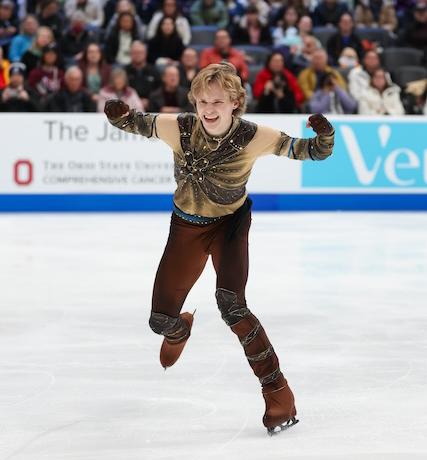
Every four years, many of us settle in for hours of Olympic figure skating—team events, ice dance, pairs, women’s, and men’s. It’s beautiful, dramatic, and sometimes baffling. What’s an Axel versus a Lutz? Why did that landing look “off”? What kind of spin was that?
Here’s a quick, friendly guide to the basics—enough to help you watch with some level of confidence. If you really want to level up, spend a little time on YouTube: look up highlights from past figure skating competitions or last month’s U.S. Championships in St. Louis.
For an easy jump overview, click on U.S. Olympic men’s champion Adam Rippon’s Instagram tutorial.
The Events (What You’re Actually Watching)
Pairs skating: big, dramatic overhead lifts and throws, larger side-by-side jumps, and more time skating apart. Pairs also have a real element of danger: speed plus height plus two people is a thrilling combination.
Ice dance: smaller lifts, intricate footwork, lots of speed, and very little time apart. You’ll see step sequences, turns, and “twizzles” (fast traveling rotations). Big jumps are not part of ice dance; the focus is rhythm, precision, and connection. Contrary to pairs skating, there are limits on the height of lifts.
Team event: introduced at the 2014 Sochi Winter Games, this is figure skating’s opening act. A team includes one man, one woman, one pairs team, and one ice dance team from each qualifying nation, combining scores across disciplines.
Singles (Men’s and Women’s): the jump-and-spin highlight most people think of first, and the one where a few basic viewing tips can help the most.
Singles: Three Things to Watch For (Even as a Beginner)
1) Flow – After a jump, does the skater glide out smoothly—or do they look like they hit a patch of glue? Do they spray ice? Great skating keeps moving.
2) Control on the landing – A clean landing is one strong foot on the ice, steady upper body, and a confident glide. Deductions come from step-outs, two-foot landings, a hand touching down on the ice, or visible wobbling.
3) Rotation quality – You don’t have to count rotations (most of us can’t), but you can spot trouble when a landing looks “short” and the skater has to scramble, twist early, or fight to stay upright. A smooth takeoff and a smooth landing say it all.
Jumps: The Simplest Way to Understand Them
The easiest way to classify jumps is by the takeoff: edge jumps launch from a clean skating edge—no toe-pick assist. Toe jumps use the toe pick (the jagged teeth on the front of the blade) to “plant” and help the skater get airborne.
A simple viewer trick: If you see a quick toe “stab” right before liftoff, it’s probably a toe jump. If the skater rides a deep curve and springs up without that toe plant, it’s probably an edge jump.
In general order from easiest to hardest, you’ll often hear the jumps listed as:
toe loop, salchow, loop, flip, lutz, Axel.
If you learn nothing else from this Olympics, remember this: the Axel is the only jump that takes off going forward. Yes, it’s capitalized. It’s named after Norwegian skater Axel Paulsen, and it’s the one jump even casual viewers can learn to recognize.
The Edge Jumps: Axel, Salchow, Loop – Edge jumps are about riding the curve of the blade and letting that edge “spring” the skater upward. How do you know an inside vs. outside edge? Look at your foot: it has an inside and an outside—so does a skate blade.
*Axel (edge jump)
It’s the oddball and the legend. It takes off forward (from a forward outside edge) and lands backward—so it includes an extra half rotation automatically. That means: double Axel = 2½ rotations; triple Axel = 3½ rotations; quad Axel- 4½ rotations. That extra half rotation is why it’s so difficult. What to look for: the skater takes off forward.
*Salchow (edge jump)
It takes off from a back inside edge and lands backward on the opposite foot. It’s often one of the first major jumps skaters master. What to look for: takes off on one foot, lands on the other.
*Loop (edge jump)
This one takes off from a backward outside edge and lands on the same backward outside edge. When it’s done well, it looks like the skater simply “popped” straight up from the ice.
What to look for: lands on the same foot.
The Toe Jumps: Toe Loop, Flip, Lutz – Toe jumps use the toe pick of the skate to plant into the ice—more of a punctuated “stab-and-go” takeoff.
*Toe loop
This is the most straightforward toe jump, and extremely common in combinations because it tacks neatly onto other jumps. What to look for: a quick toe pick plant right before takeoff.
*Flip vs. Lutz
These two are famously similar because both use a toe pick plant, but the main difference is the edge used on takeoff. Even longtime skating fans sometimes mix them up. They are difficult to tell apart. What to look for: both have that toe-pick “plant,” and both are usually set up with a long approach.
Spins: The Human Gyroscope
Spins are the sport’s “how are they doing that?” moment. Judges reward speed, centered balance, and clear positions. A basic scratch spin is the classic fast upright spin that tightens as the skater pulls arms in. Watch for two things: do they accelerate quickly? Do they stay centered in one spot? To check that, look at the ads/signs on the inside of the rink. Are the skaters moving or staying in one place? Spins that travel across the ice are usually a mistake and judges notice.
Basic spin positions are easy to identify because they resemble their names: upright spin, sit spin, camel spin. Then come the crowd-pleasers: flexible variations like the Biellmann, named after Swiss skater Denise Biellmann, where the skater pulls the blade overhead. Another fan favorite is the layback position—what many people describe as the “dying swan.” What to look for: a strong arch, clean line, and no obvious wobble or struggle to force the position.
Do skaters get dizzy? Yes, at first. Years of practice train the brain to reduce dizziness by adapting to spinning and balance signals. Skaters also learn techniques like fixing their gaze (“pointing”) and keeping head alignment consistent.
-
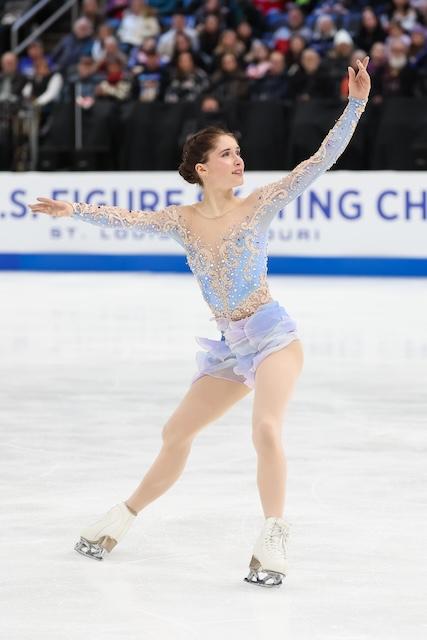
- Isabeau Levito, US Olympic Team Women’s bronze medalist performs an outside edge spread eagle. Photo by Melanie Heaney, US Figure Skating
-
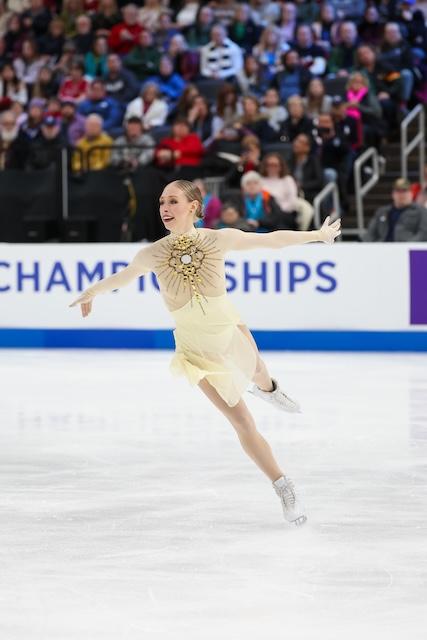
- US Olympic Team Pewter champion, Bradie Tennell, prepares for a double Axel with a front take-off. Photo by Melanie Heaney, US Figure Skating
-

- US Pairs champions Alisa Efimova and Misha Mitrofanov perform an overhead lift Photo by Melanie Heaney, US Figure Skating
One More Thing: A New, Eye-Catching Move
U.S. men’s champion Ilia Malinin, “the Quad God,” has introduced a flashy new move nicknamed the “raspberry twist.” It’s hard to describe on paper, but it looks like a sideways spin in the air—one of those moments that makes people on the couch sit up and say, “Wait… what was that?”
Now you’re ready. Add in the glamour, costumes, nerves, and Olympic-level drama, and you’ll get the full experience—and you’ll actually recognize what you’re seeing.
Melanie Staten is a public relations consultant.
Follow KnoxTNToday on Facebook and Instagram. Get all KnoxTNToday articles in one place with our Free Newsletter.

