
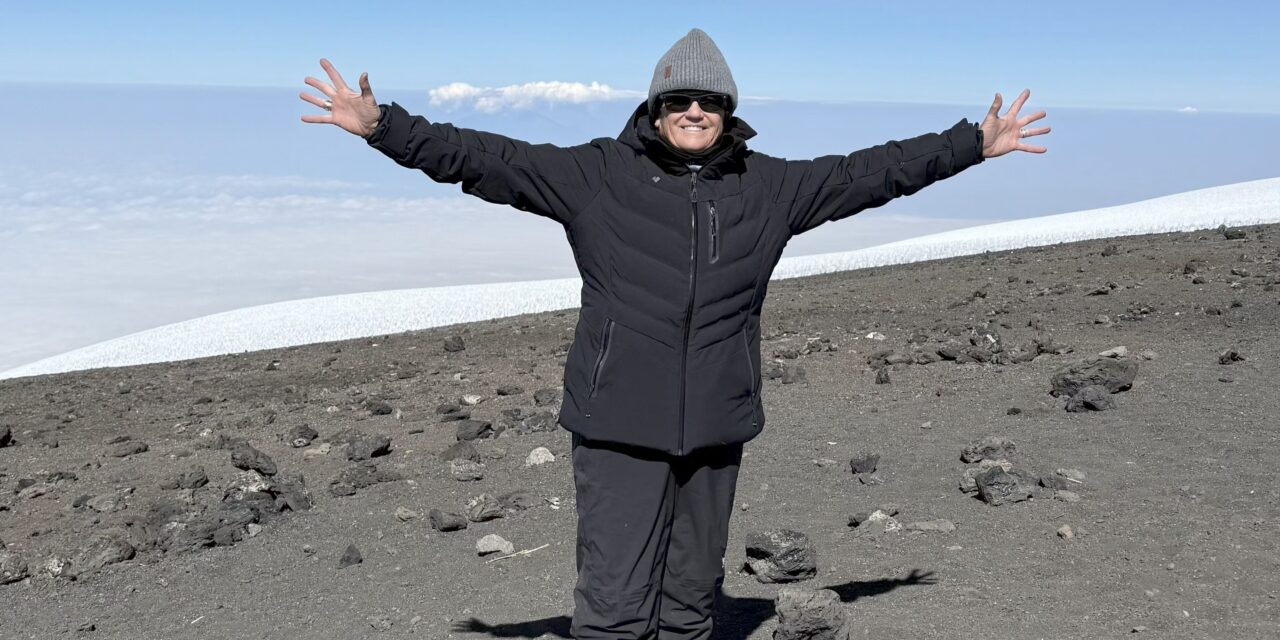
Holly Warlick, who is finally officially retired, made good use of her spare time by hiking to the top of Mount Kilimanjaro at the age of 67.
Warlick made the trip with six other people last September and added safari and wildlife adventures before returning to Tennessee.
“I’ve always wanted to do it,” Warlick said. “I hike a lot, and so I’m like, ‘You know what? I’m going to hike Kilimanjaro.’ ”
Warlick, a former Lady Vols player and coach, entered broadcasting after her final season at the helm for Tennessee in 2018-19 and has continued to stay active. Warlick dedicated 38 years of her life to Lady Vols basketball with four as a player, 20 as an assistant coach, seven as associate head coach – all with the late Pat Summitt – and seven as head coach.
She started the specific training last January in East Tennessee to prepare for the adventure in Tanzania.
“I did a lot of hills with weighted vests,” Warlick said. “It’s different because it’s Zone 2 training.”
The point of Zone 2 training is to maintain a specific heart rate zone and intensity level during exercise. It’s intended to condition the body for a lengthy but steady hike and not a race to the top.
“You’re not going until you get to exhaustion,” Warlick said. “You keep your heart rate at a certain level. It was different for me because I’m not used to that kind of training. I did a lot of breathing exercises.”
Warlick’s longtime travel agent, who is in Atlanta, also wanted to hike Mount Kilimanjaro, so six people made the trip with her, including Jackie Ansley, CEO and owner of Performance Training Inc. (PTI) in Knoxville; Jared Lawrence, an experienced and longtime athletic trainer at PTI and director of development and marketing; Amanda Sutton, who is engaged to Lawrence; Lara Fleming; and travel agent Lauren Gunnels and her husband, Damon Gunnels.
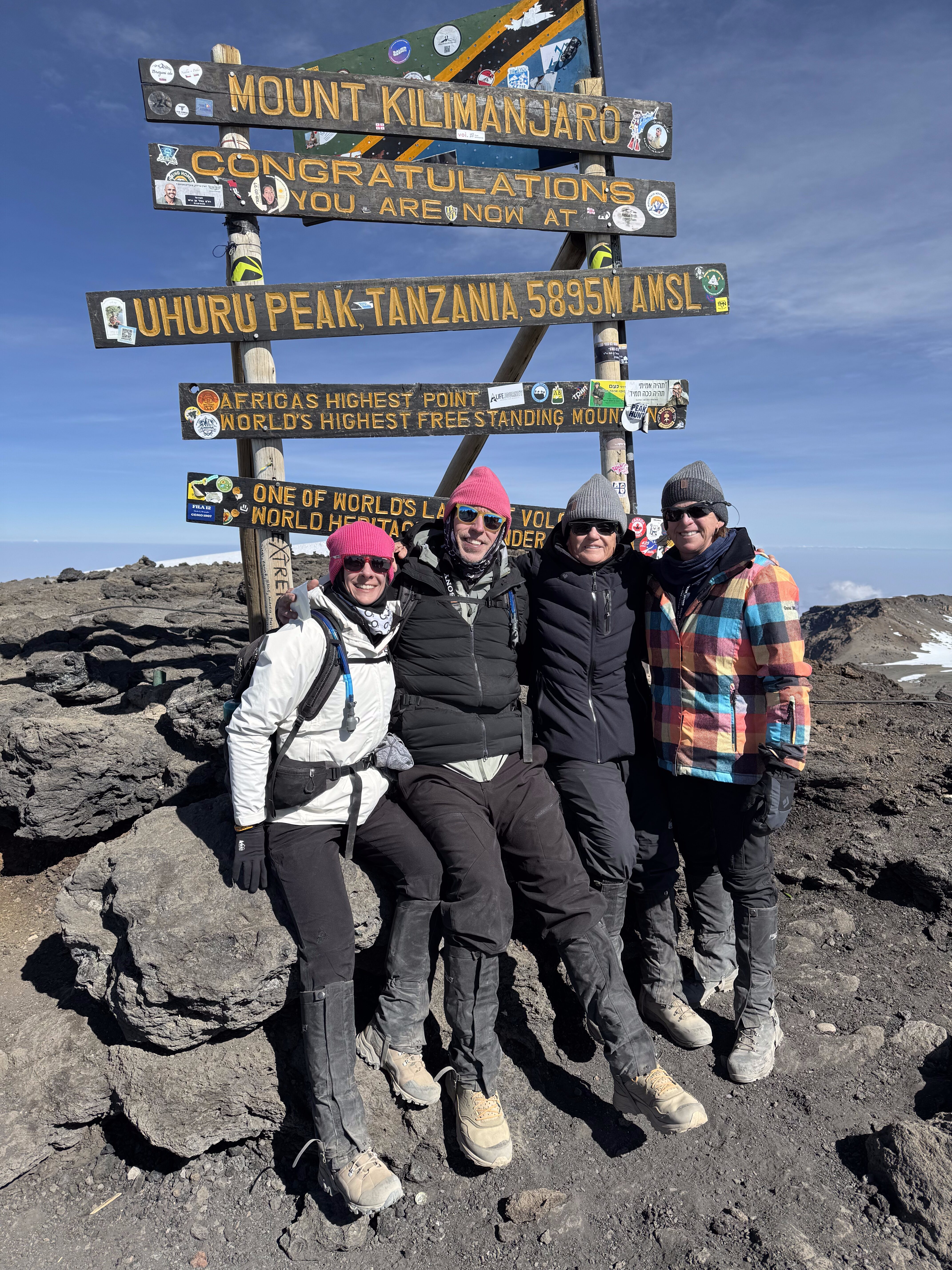
Amanda Sutton, Jared Lawrence, Holly Warlick and Jackie Ansley.
The trip was arranged by Beyond, which is based in Atlanta and operates in Arusha, Tanzania, as Africa Beyond.
“They’re fantastic,” Warlick said. “They had a 98% success rate, and they know what they’re doing.”
The group selected the Machame Route, which is rated as one of the most difficult to summit, but also one of the best choices because by gradually increasing the elevation, the body has sufficient time to adapt to the low oxygen environment. The journey takes seven days – 5.5 to reach the top and 1.5 to get back down – and is ideal for those with extra time because of the acclimation process.
“The key was to get you acclimated to the altitude as you go up. It got us acclimated,” Warlick said.
The total trek to the top is 37 miles, and the hikers spent the first two days in a rainforest. That emerges onto heathlands with the majestic mountains visible in the distance. Once the hikers leave the heathland, they begin the ascent of Lava Tower, before circling below the South Icefield, a route to the summit known as the southern circuit.
On the final day, the group left basecamp at midnight and reached the summit at 8:30 a.m.
“I made a mistake,” Warlick said. “I looked up, and the final climb, it has a lot of switchbacks and looked like a Christmas tree. I went, ‘Oh, my God. Why did I do that?’ I had to see how far up we were going to go. The sunrise helped me, because then it was light. You knew you were close to the top and when the sun rose, that was beautiful. You think of things at home. You think of anything but climbing up the mountain.”
The support crew was critical to the group’s success and another reason Warlick sought a reputable outfit with extensive experience of getting people to the top of Kilimanjaro.
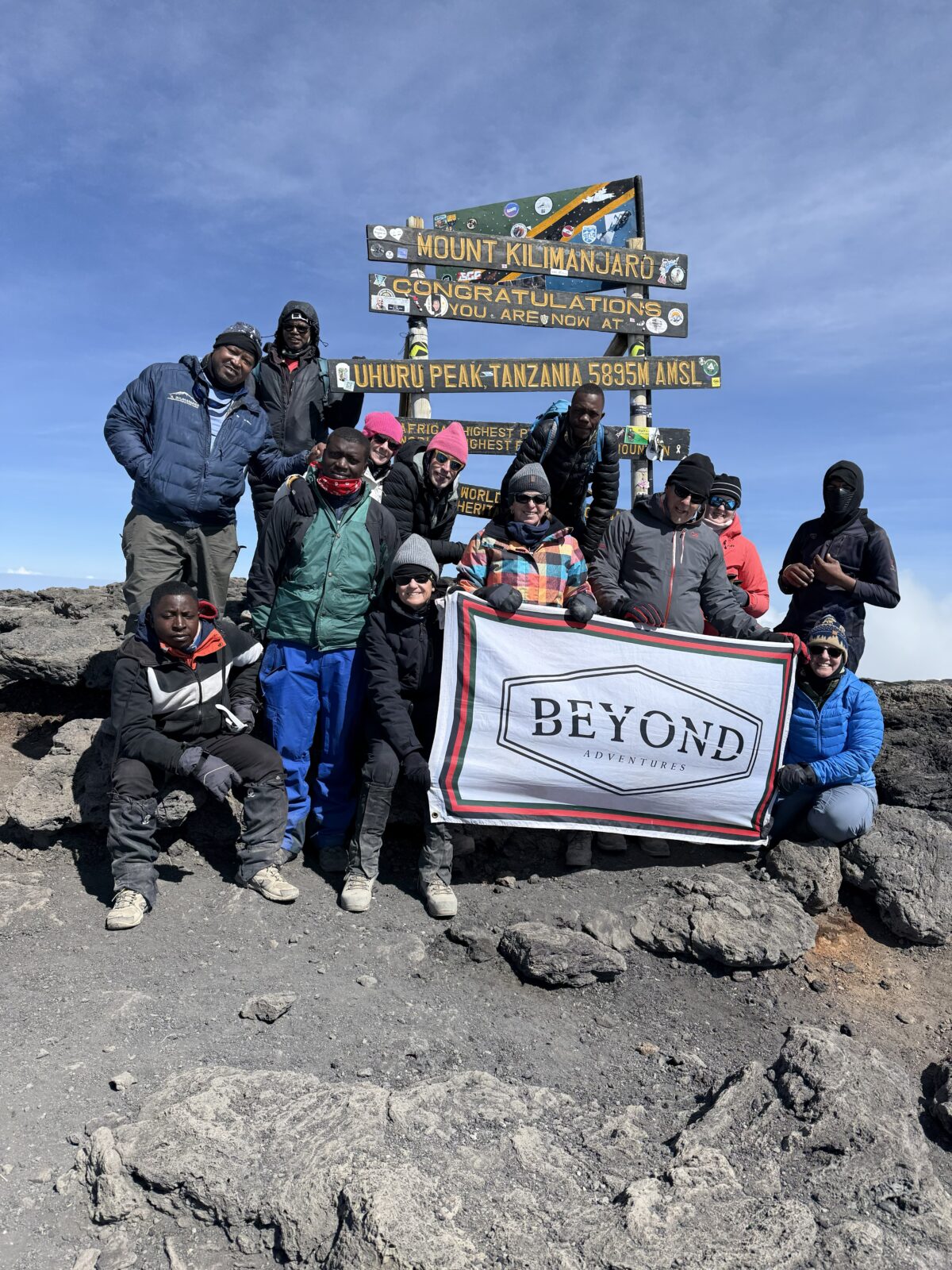
Holly Warlick, front row, third from left, gathers with the hikers and guides at the summit.
“The company took 40 people with them to support us, and that’s carrying tents and food,” she said. “You have a cook and people who prepare, people carrying toilets and people carrying every tent and supplies and water.
“You have to eat three times a day, and they’re really strict. You don’t gain any weight. You have to eat as much as you can, because you’re expending so many calories when you hike because of the altitude.”
Barafu was the last campsite before the final leg to reach the summit, which took 7.5 hours to go 2.8 miles.
“We went slow,” Warlick said. “We put one foot in front of us, step, one foot in front of us, step, one foot in front of us, step. It took us a long time to go not very far. It was probably the hardest thing I’ve done. It’s harder than Pat’s practice. I think my age had a lot to do with it. I’m sure that younger kids can go up there and say that wasn’t that bad.
“When we started (on the last leg), I looked up, and there were a lot of groups. You leave in the dark, so you have a headlamp on, and a lot of people are passing you, and then there’s a lot of people that didn’t make it because they went too fast.”
When Warlick and her crew reached the top, they took in the nearly indescribable views and got photos to remember the trip.
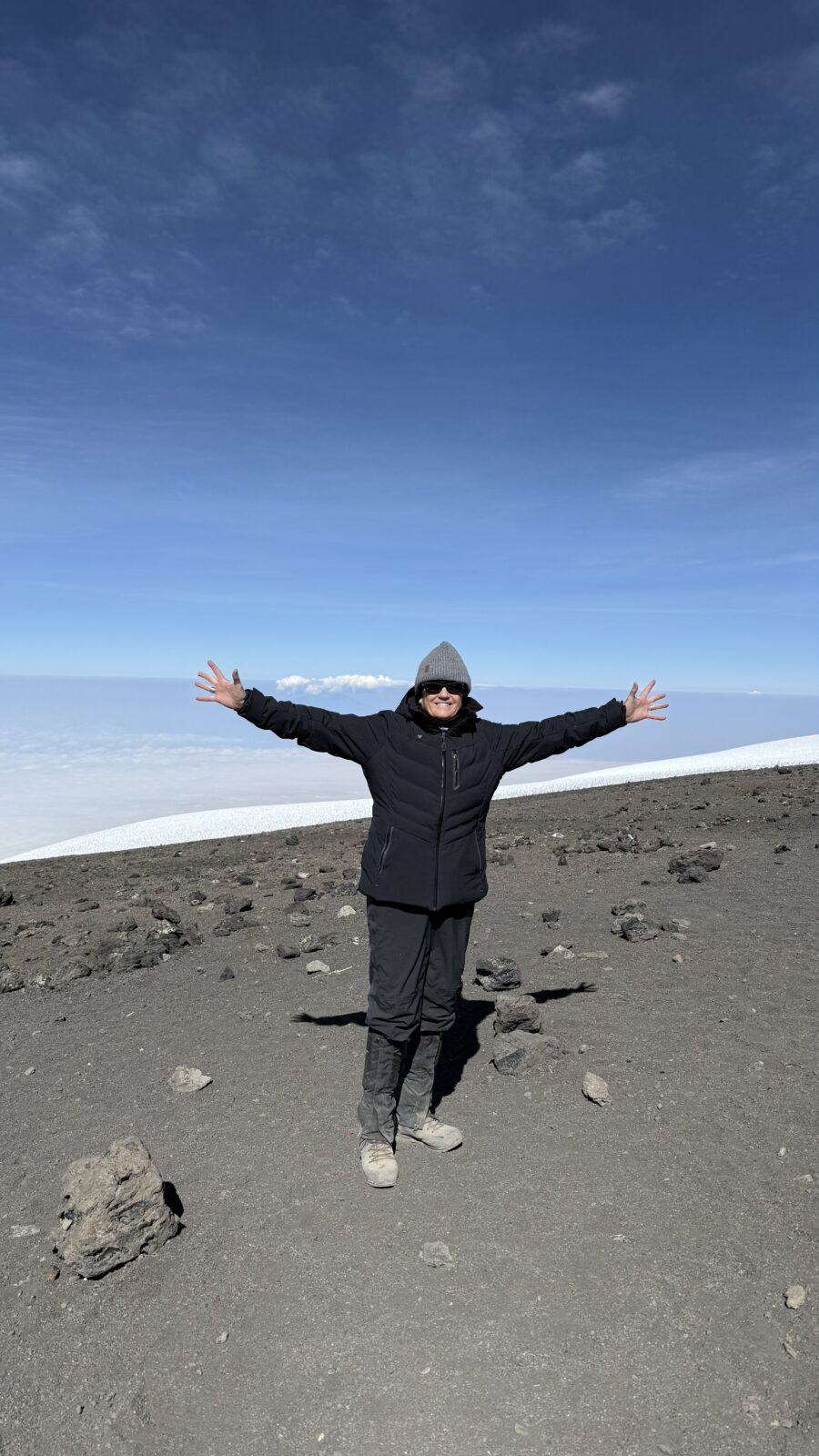
Full view of Holly Warlick atop Mount Kilimanjaro.
Mount Kilimanjaro is the tallest mountain in Africa at 19,341 feet. It is also the tallest free standing mountain in the world and is not part of a mountain range, such as the Smoky Mountains.
“You can’t stay up there long,” Warlick said. “I think we stayed for about 45 minutes waiting on everybody to get up.”
The descent follows the Mweka trail, which is 7.5 miles. From Barafu to the summit to the first day of the descent, the hikers had been up for 16 hours.
“It’s so mental,” Warlick said. “You have to get your mind going to another place because you don’t want to focus on your breathing. You just think of what you’re doing in the moment. I got a little stomach bug the first day and a half. I was hurting.
“We were in shorts the first two days, and then the third day, we’re in pants and a light jacket. You get into the fourth and fifth day and sixth day when we summitted, I’m in a full blown winter coat and winter pants. We’re going into five degree weather up to the top.
“We went through all climates, and the night was cold, and we slept in a little tent. Seven days without a shower was pretty tough.”
Warlick didn’t let the stomach bug keep her from the trek or any part of the adventure
“I wasn’t going to go back, I promise you that,” she said. “I did everything they told us to do. Everything. I was coachable.”
The adventure continued with trips to the Serengeti in Tanzania; Maasai Mara National Reserve, an area of preserved savannah wilderness in southwestern Kenya, along the Tanzanian border; and Laikipia County in Kenya.
“We went to three places,” Warlick said. “It was everything; it was life changing. Obviously, to see the animals, but the culture and the people.”
Warlick arrived back in Knoxville in time to see Lisa Soland’s one-woman play called PAT, which was covered by this website HERE and HERE.

Holly Warlick and Pat Summitt wave at a Vols football game on Sept. 8, 2012. (Tennessee Athletics)
“It was excellent,” Warlick said. “When she went and wrote on the board, she had Pat’s same mannerisms, her back and the way she held her pen. I’m like, ‘Wow! that was scary.’ She was pretty funny, and she did look like her in the cheerleading outfit. I had to laugh at that. She did a fabulous job.”
Warlick is embracing retirement after spending the last several years taking broadcasting assignments for women’s college basketball games across the country.
“I’m totally retired,” she said. “It started to be a job with the hours and the days. I loved doing it. It was fun. But I was working on weekends, and I didn’t want to commit myself to that and just enjoy life for change.”
Maria M. Cornelius, a senior writer/editor at MoxCar Marketing + Communications since 2013, started her journalism career at the Knoxville News Sentinel and began writing about the Lady Vols in 1998. In 2016, she published her first book, “The Final Season: The Perseverance of Pat Summitt,” through The University of Tennessee Press and a 10th anniversary edition will be released June 16, 2026.


Maria-
Great story and thanks for sharing with everyone.
The ol’ head coach is only slightly determined LOL
Just a little bit stubborn … and glad you’re back in Knoxville!
Oh thank you for sharing Holly. Dreams do come true. Do not stop adventuring out to reach more dreams. You never know the next adventure can master next.
Always pursue your passion. I agree.
What an amazing accomplishment! Well done, Holly!
I knew you would like this story, Susan!
Holly how amazing! Congratulations on doing the really hard trek. I’m certain Pat would be proud. Enjoy retirement…you earned it!!
Agree Lennie!
Great article and yes it painted the true picture of the hike. it was a challenge and we as worked together and did it! None of us can actually describe the feeling getting to the top and once off the mountain. We are blessed to have had the chance to do it and finish with success.
Thank you, Jackie. I am so glad y’all did it and so proud of y’all, too.
Holly looks like she’s standing on the moon. Great story, Maria.
Thank you, Sandra. It came about because Holly sent me a birthday text last month. I thanked her for remembering and asked how she was doing. She mentioned hiking Mount Kilimanjaro. I said that was a story, and I needed to interview her.
Wow! Thanks for the write-up. Congrats to Holly.
Very welcome. What an adventure they had.