
As we continue to move toward our nation’s semiquincentennial, my articles continue to focus on the Revolutionary War effort to attain independence and the related contributions and connections of families of the Fork, the Knox County lands between the French Broad and Holston Rivers.
Lots of Huffakers have lived in the Fork, and I grew up with a few of them. I’m wondering how many of those friends know about their ancestor, George Huffaker (“Hufacre”), who served in the militia during the years of the American Revolution?
George (“Hufacre”) Huffaker’s pension application states that he was born in York County, Pennsylvania, on August 7, 1757, and that he lived there for about 10 years until his family moved to Washington County, Virginia. That’s where he continued to live, even for a few years after the Revolutionary War was over.
He was drafted as a private into the local militia in 1776 to serve a tour of duty under Captain James Thompson against the Cherokee. His company marched along with two other companies led by Captains Edmonson and Cocke, who were commanded by Colonel Shelby, to engage the Cherokee near Long Island on the Holston River, where they defeated the warriors without losing any men. Only a few were wounded. Historian Dr. J.G.M. Ramsey’s book Annals of Tennessee (published in 1853) provides the official report of this battle on pages 154-155 and includes details as told by George Huffaker himself.
From there, George’s company went to Kincannon’s Fort and protected it until Col. Christie raised a force to go back to Long Island against the Cherokee again.
After that, Colonels Christie and Love led them across the French Broad into what are now Sevier and Blount counties. Once they crossed the Little Tennessee River, they encountered Cherokee leaders, who requested that both sides meet back at Long Island to establish a treaty. Because they had no provisions, the men were discharged and sent home from Long Island.
However, George was again drafted the next year to serve “in protection of the frontier” for two months at New Garden Station on the Clinch River. He served the same way again in 1778. And again in 1779. In 1780, he was called out once more, but this time it was to protect the citizens who were moving cattle below the fork of the Holston. After being discharged again, his company was commanded to go to Abingdon to guard some Tories being held in prison there.
Once the lands opened up in what is now Tennessee, he moved to the south side of the French Broad River at Seven Islands, which is where he lived in 1833 when he applied for his pension at age 75. In all, George served about 15 months during the years of the Revolution. Although he had no official papers to prove his service, fellow Knox County residents Samuel Bowman and Michael French vouched for his credibility. Even after the war, as conflict with the Cherokee continued in 1792, the “Indian fighter” was sent as a corporal at age 35 with six men to guard Henry’s Station in what is now Kodak.

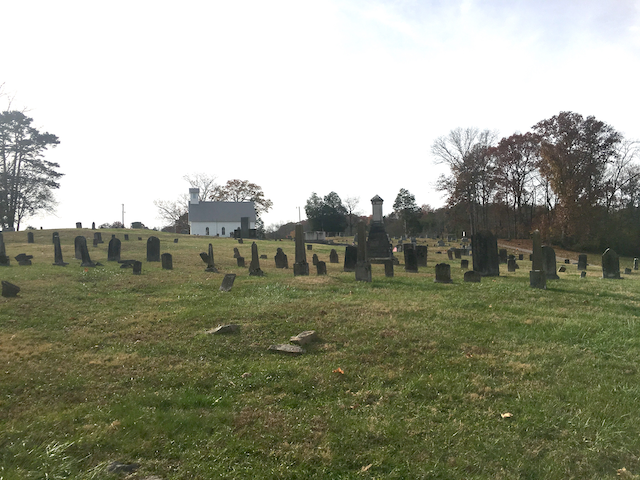
George Huffaker’s gravestone at Seven Islands
George was married twice (Agatha and “Polly”) and had 18 children. His family gave land for establishing the Methodist Church at Seven Islands, and his offspring soon established a ferry and moved across the river and into the Fork, where generations continue to thrive. The ferry site is now Cruze Landing on Kodak Road, and though the name has changed, George’s legacy can’t be forgotten in the Fork.
Jan Loveday Dickens is an educator, historian, and author of Forgotten in the Fork, a book about the Knox County lands between the French Broad and Holston Rivers, obtainable by emailing ForgottenInTheFork@gmail.com.
Follow KnoxTNToday on Facebook and Instagram. Get all KnoxTNToday articles in one place with our Free Newsletter.

