
In 1840, a riderless horse followed a funeral bier through the streets of Knoxville on its way to the graveyard of First Presbyterian Church. The horse, Rienzi, was the favorite of his recently departed owner, Hugh Lawson White, son of Knoxville founder James and recently retired and returned home from the United States Senate.
Though White had been raised in the church adjacent to his place of burial, he was not affiliated with any denomination at the time of his death, though he was a “man of strictest rectitude and uncompromising principles” (Knoxville – Betsey Creekmore). His funeral was held at his home. Though not an outwardly religious man, on May 13, 1816, White deeded half an acre of his property for the creation of Knoxville’s first Methodist Church in a town that was predominantly Presbyterian. The land was deeded to John Winton, Thomas Wilkerson, John Manifee, Jesse Turbeville, John Haynie, Jeremiah King and John Sutherland Jr. who named their new place of worship White’s Chapel after its benefactor. Haynie was its first minister.
White’s Chapel and surrounding cemetery were located just east of downtown between Hill Avenue and Jefferson Street, the latter no longer in existence. If you ever rode the glass elevators at the old Hyatt Regency and looked out toward the Tennessee River, the Hyatt’s backyard is where White’s Chapel was.
By 1836, the congregation had outgrown its facility and moved to a brick building on Church Street, though the original frame building remained in use as a Sunday school and later hosted Black Methodist congregants during the 1840s and 1850s. By 1844, the Methodist Church split over the issue of slavery, with the Church Street congregation siding with the Methodist Episcopal-South which, at the time, had no problem with the peculiar institution. This church became Church Street United Methodist.
The original site, which became known as Methodist Hill, served various purposes throughout the 19th century, including use as a Civil War hospital by Union and Confederate forces, a potter’s field and a burial place for enslaved people. It also hosted significant political speeches, such as those by John Netherland and Governor Isham Harris in 1859. Following the Civil War, a new congregation led by Governor William “Parson” Brownlow built First Methodist Episcopal nearby in 1869.
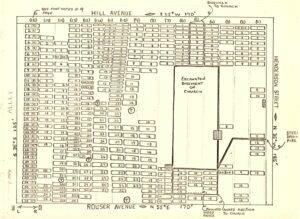
Excavation diagram of East Hill Avenue Methodist Church – 1967 (Knoxville Housing Authority/Knox County Archives)
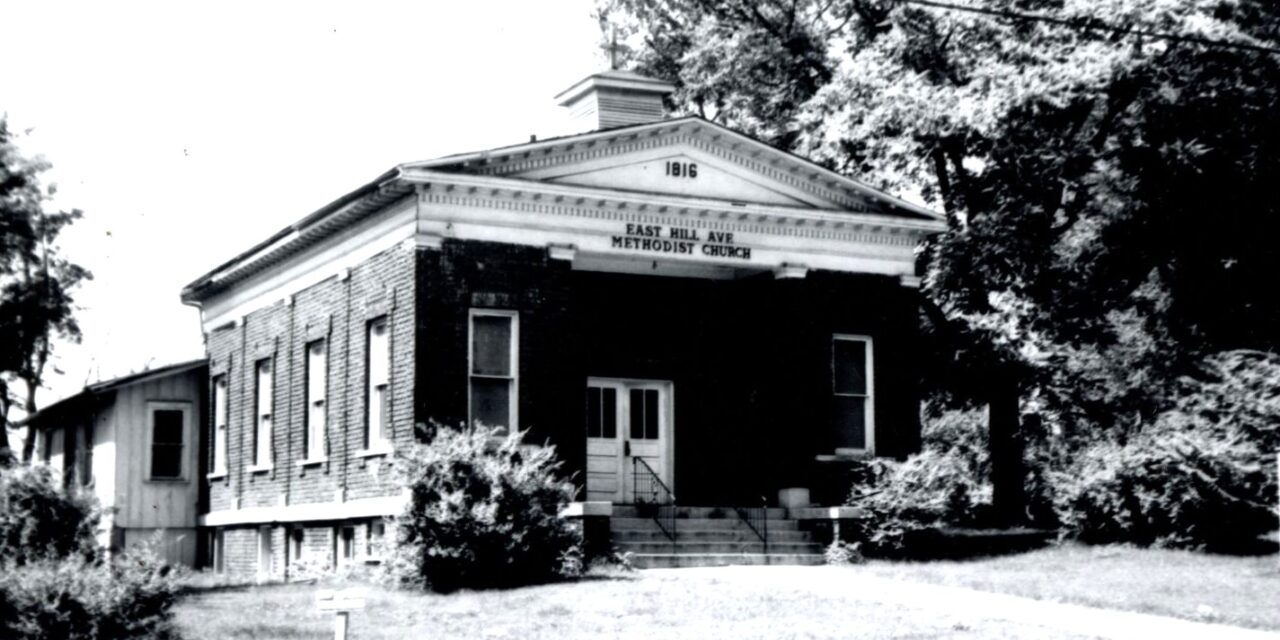
The late 19th century was marked by tragedy and neglect for the site. After years of disrepair, the chapel burned down in 1894. During the widening of Jefferson Street that same year, construction crews accidentally uncovered several graves. While a new brick chapel, East Hill Avenue Methodist Church, was eventually completed in 1910, the congregation dwindled over the following decades.
In 1963, the church was abandoned to make way for the Mountain View Urban Renewal Project and sold for $27,600. When the site was cleared in 1967, it was thought there would be about 25 graves to relocate from the cemetery. The contract for the removal went to Berry Morticians. Upon beginning the work, Ed Berry discovered at least 380 burials, including evidence of mass graves. The cost of the relocation ballooned from $5,000 to almost $75,000. The remains were ultimately moved to Woodlawn Cemetery in South Knoxville, where they are now marked by a single monument.
Beth Kinnane writes a history feature for KnoxTNToday.com. It’s published each Tuesday and is one of our best-read features.
Sources: The Knoxville Journal digital archives, Knoxville Housing Authority/Knox County Archives-Knox County Library, Knoxville by Betsey Beeler Creekmore.
Follow KnoxTNToday on Facebook and Instagram. Get all KnoxTNToday articles in one place with our Free Newsletter

