
As we continue to move toward our nation’s semiquincentennial, I’m still focusing on elements of the Revolutionary War effort of attaining independence and the related contributions and connections of families of the Fork, the Knox County lands between the French Broad and Holston Rivers.
I’ve mentioned his name several times as being a leader of the local militia during the 1790s, but who was Dr. James Cozby? He was born in Virginia in 1754 and married Isabella Woods in 1774.
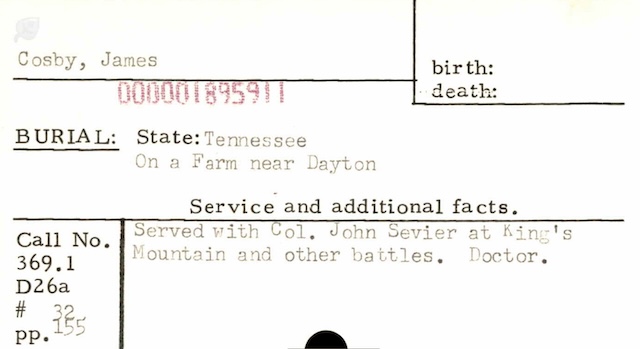
Government record of Dr. James Cosby burial
According to his great-grandson Dr. Spotswood Smith, Dr. James Cozby (also spelled Cosby) disrupted the courtroom in Morganton, North Carolina, in 1787, when John Sevier was being tried for treason during the State of Franklin conflict. The account, as reportedly described by Cozby himself to his son-in-law William Smith, told how the doctor and a fellow rescuer arrived on the scene and blended into the courtroom crowd during the trial, slyly alerting Sevier with a slight nod of acknowledgment to be patient but ready. They waited calmly with weapons hidden under their hunting shirts until Cozby boldly demanded of the judge, “Are you through with this man, sir?” The brazen address caused enough distraction that John Sevier, who had caught a glimpse of his prized horse stationed untethered outside the open courthouse door, bolted out of the building, sprang to his mount, and rode away with his band of rescuers protectively closing in behind him. Thanks to his friends, Sevier got away and lived to be voted in by his devoted followers as Tennessee’s first governor in 1796.
Dr. James Cozby’s mettle had been constituted during the Revolutionary War, when he served as a regimental surgeon for the Continental troops of Virginia. He also served in North Carolina and fought under John Sevier at the Battle of King’s Mountain and elsewhere.
Some Native Americans hated him because he had ridden against them with Sevier during border conflicts. But Cozby was aware of the threat and had cleverly constructed his cabin in such a way that it was practically impregnable.

Portion of Hoskins and Ketron map showing major Knox County sites and dates of events along the French Broad River
Sadly, the fortification of his home caused a band of warriors such frustration that after an attempted attack, they took their anger out on the nearby Casteel family, neighbors who also lived south of the French Broad in the vicinity of Gap Creek. As described by historian Dr. J.G.M. Ramsey, it was located “about nine miles above Knoxville and two miles from the then residence of Dr. Cozby.” When the slaughtered Casteel family was found by Anthony Reagan, arriving the next morning to go hunting with William Casteel, Dr. Cozby tended to the surviving two-year-old daughter at the Shook home, where she had been taken, hanging to life by a thread. Though she had been cut, scalped, and “thrown into the chimney corner,” she survived and grew into adulthood, thanks to the medical attention provided by Dr. Cozby.
When the local militia rode out on multiple missions, Dr. James Cosby led a company of horsemen that included riders from the Fork. He worshiped with them at Lebanon-in-the-Fork Presbyterian Church, where John Sevier joined him on his pew as they listened to the Rev. Samuel Carrick, considered the first president of what is now the University of Tennessee. At age 38, Cozby also became a ruling elder at First Presbyterian Church when it was established by Carrick in downtown Knoxville in 1792. Cozby was a trusted leader who was appointed as a justice of the peace for Knox County that same year.
Dr. James Cozby left Knoxville in 1809 and moved to a large farm near Chattanooga. He died in 1831 and was buried at Falling Waters Cemetery. Though he was once revered here between the French Broad and Holston rivers by his fellow countrymen who rode with him “for the protection of the frontiers,” his valor has been forgotten in the Fork.
Jan Loveday Dickens is an educator, historian, and author of Forgotten in the Fork, a book about the Knox County lands between the French Broad and Holston Rivers, obtainable by emailing ForgottenInTheFork@gmail.com.
Follow KnoxTNToday on Facebook and Instagram. Get all KnoxTNToday articles in one place with our Free Newsletter.



Thanks for providing this additional glimpse into the forks of the river happenings!