
As we move toward our nation’s semiquincentennial, I’m focusing on the related contributions and connections of folks of the Fork, the Knox County lands between the French Broad and Holston rivers. Last week, we learned about how the Rev. Samuel Doak prayed over the Patriots (also called “Whigs”) heading to confront British Major Patrick Ferguson and his Loyalist band of backwoodsmen, also called “Tories.” Today, we’ll follow them into battle at King’s Mountain.
Among the militiamen who kissed their wives and children goodbye and determined to help put an end to the war on their doorstep was George Gillespie. According to genealogical records of the Daughters of the American Revolution, George came to America with his parents and then left the farm he had bought in Maryland and moved in about 1772 to the Watauga settlement area of North Carolina, which is now upper East Tennessee. George and his son Thomas and their regiments set out under their leader John Sevier, along with other militiamen and their leaders Col. William Campbell and Col. Isaac Shelby, to engage Ferguson in 1780. Militiamen under Arthur Campbell, Benjamin Cleveland, and Charles and Joseph McDowell also joined them.
Many don’t think of the American Revolution as a civil war, but it very much was at times neighbor against neighbor, even kin fighting together or against one another. Some continued to pledge allegiance to British King George III, while others determined to fight for independence from the crown. At times, men were conscripted or forced to participate on one side or the other, no matter their personal opinions.
Parts of the seven Loyalist regiments that Major Ferguson had organized at Fort Ninety-Six (so named because it was about 96 miles from the Cherokee town of Keowee) supported his efforts at King’s Mountain. Only about 100 enlisted colonial soldiers in their red coats were present. Never suspecting a Patriot onslaught, Ferguson did not fortify his hilltop perch.
The Patriots learned along their 13-day journey that Ferguson was camped atop King’s Mountain. Hoping to surprise the enemy before British reinforcements could arrive, they quickly pushed on through the rain that had beset them for days.
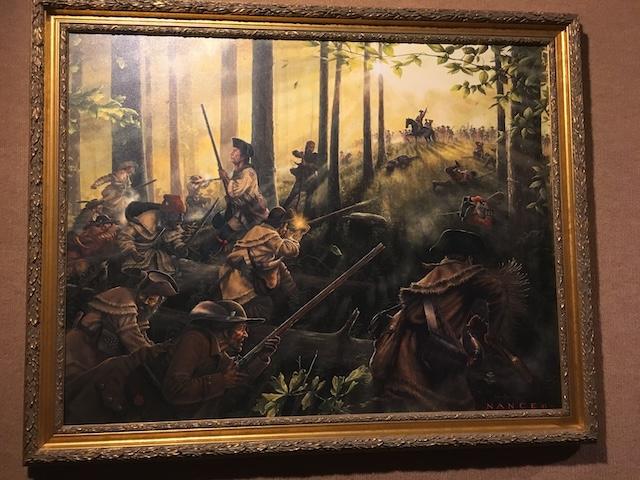
Dan Nance’s painting on display at King’s Mountain National Military Park
On the morning of October 7, 1780, they crept up the mountain and fired. Ferguson’s men had trouble shooting downhill, because the angle caused their bullets to fly over the Patriots’ heads. The Loyalists would charge down the hill with bayonets, and the Patriots would retreat, only to return again and fire from behind trees and rocks. Up and down the mountainside the opponents fought for an hour, while Ferguson rode his horse across the top, trying to rally his men. Shelby, Sevier and Campbell managed to reach the top and attack the Loyalists from behind, causing Ferguson’s men to begin to surrender. By the time it was over, Ferguson was shot and dragged by his horse into the Patriot line, where he was found dead with multiple bullets in him.
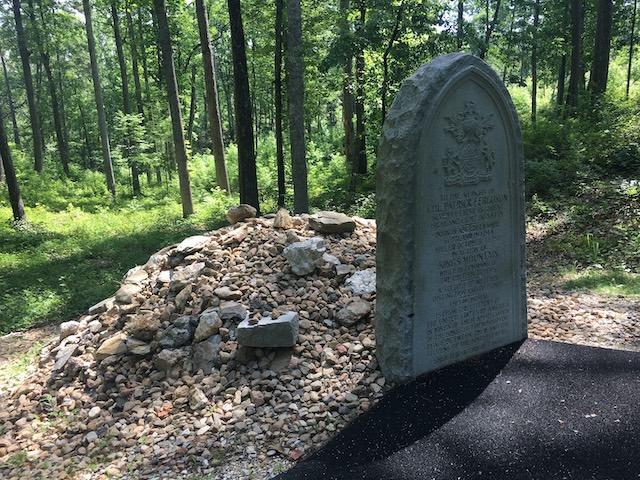
Rock cairn at Ferguson memorial, King’s Mountain
Of the 910 Patriots involved at King’s Mountain, 30 died as a result of the battle. Fifteen more died because of other battles or natural causes by the end of the war two years later, but the majority of the survivors of King’s Mountain lived long enough to make statements about their experiences years or decades later. Their pension applications or other records often tell their stories.
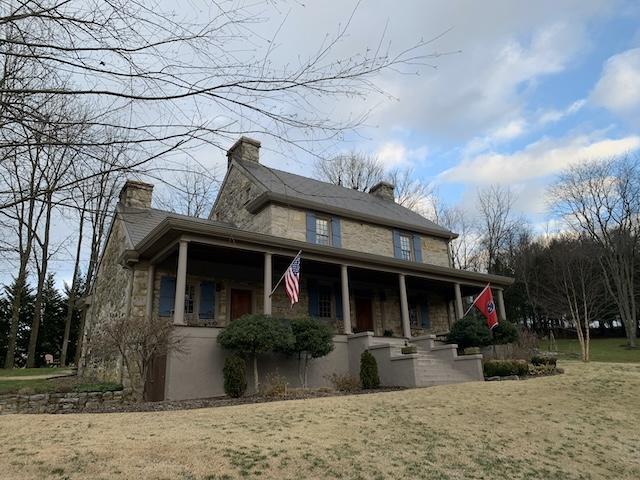
George Gillespie survived and lived in his stone home at Limestone near the Nolichucky River. It still stands and I’ve visited there. He and his wife, Martha, had at least nine children, three of whom moved to the Fork. Their daughter Martha married Jeremiah Jack. And you might recall my April 22 article about how Capt. Thomas Gillespie took his wife, Agnes, to shelter at Manifold Station when warriors threatened their home. The Gillespie valor is not to be forgotten in the Fork.
Jan Loveday Dickens is an educator, historian and author of Forgotten in the Fork, a book about the Knox County lands between the French Broad and Holston Rivers, obtainable by emailing ForgottenInTheFork@gmail.com.
Follow KnoxTNToday on Facebook and Instagram. Get all KnoxTNToday articles in one place with our Free Newsletter.


Hi Jan,
My name is Christy Martin and I am a retired educator from K-12 through higher ed as well. I am the lead writer for the Patriot Legacies of Blount County Tennessee. We are writing the bios of the approx. 200 Patriots that lived and died in Blount County. They are being published every other week in The Daily Times and I have a local history article on the opposite weeks. I have enjoyed reading your articles. The history of those times of the Revolution and settlement after in Blount County and surrounding areas is so interesting!
Hello, sister historian! Thank you for letting me know about your similar efforts. Keep in touch via my email below if something of note needs to be shared between us. I’ll check out your link!
Christy, I appreciate your reaching out,
Jan
Surprised you didn’t mention our local Colonel Joseph Hardin who Hardin Valley is name for in your article of Kings Mountain .he lost two sons in that battle and was second speaker of the House of the State of Franklin. He is buried in Hickory Creek Cemetery off Watt Road and Knox Co.
If he is connected to the Fork, we’ve still got 50 weeks of Revolutionary War related articles to go! Thanks for the tip!