
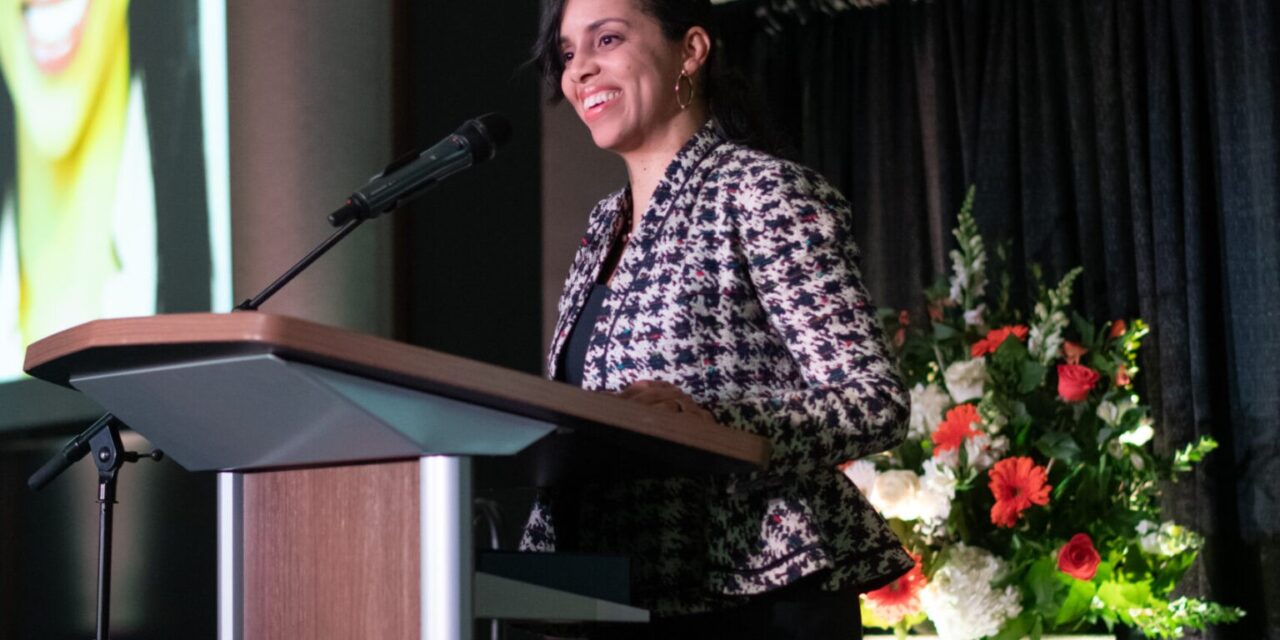
It makes a father proud. This year’s Julian Blackshear Jr. gala to support the scholarships in his name was headlined by his daughter, Lillian M. Blackshear, a partner of the Nashville Office of Bass, Berry & Sims PLC.
Lillian Blackshear is the daughter of Dr. M. Ann Upton Blackshear and Mr. Blackshear Jr. She graduated summa cum laude from both Spelman College in 2005 and the University of Tennessee College of Law in 2008.
Mr. Blackshear retired as a senior partner in the Nashville law firm of Smith, Hirsch, Blackshear Harris in 2006. Dr. Blackshear retired as a pharmacology professor in the biological sciences department at Tennessee State University in 2008. She passed away on June 10, 2025, in Nashville.

Julian Blackshear Jr. with his daughter, Lillian
Lillian Blackshear challenged those attending the gala to use their legal skills to uplift communities. She called on the young lawyers to practice with courage and to honor the legacy of those who came before.
One of those is her father.
Julian Blackshear Jr. knew Dr. Martin Luther King Jr. and on April 3, 2018, a day before the 50th anniversary of Dr. King’s assassination, Blackshear spoke at a luncheon. During Q&A he did not sugar-coat his experiences.
The scariest 48 hours: Dr. King was his professor at Morehouse College. During his sophomore year, he participated in several Atlanta sit-in demonstrations and landed for two days in the Fulton County Workhouse. “My friend and I were thrown into a cell with 14 other individuals – including criminals. I believe the police thought we would be scared, but instead these ‘hardened’ criminals recognized what we were fighting for … and instead of harming us, they championed our cause. During those 48 hours, we taught the criminals how to read, write and even wrote letters for them. The charges against the students were later dropped.
Leaving UT (the first time): He entered law school in 1963. “I was ignored and no one would study with me or speak to me. Several of the students signed a petition that would have required me to be segregated from the rest of the students and would have limited my presence in the library to a certain number of hours. Fortunately, the petition failed.
“Later, I received a letter, which I thought was sent directly from one of my professors. The letter informed me that an exam date had been moved. Thinking this was correct information, I did not show up on the exam date. As it turned out, the letter was a forgery and although I presented the letter to my professor as proof, he would not allow me to take the exam. After an appeal to the dean was denied, the professor failed me for that course, I lost my education deferment and got drafted for military service.
“Following my service in the Air Force, I returned to my law studies at the University of Tennessee. By this time, 1969, the dean had changed his stance, apologized to my mother and me and approved my enrollment. The whole climate had changed since I left in 1965, and it had only been four years! I also remember there were very few women in the class at the time.”
Blackshear graduated from UT Law in 1970, the third Black man to do so.
The job interview: After graduating in the top 15% of his class, Blackshear searched for a job. “Following graduation, several law firms in the state were interviewing groups of students based on certain criteria – grades, academic accomplishments – whatever. Unbeknownst to some of the firms and because of my academic achievements, I interviewed with one firm (however, they were unaware of my race). During this interview, the law firm partner told me point blank, ‘Mr. Blackshear, we do not hire black people.’
“Instead of responding with anger and hatred, I simply stated, ‘Sir, I hear you and understand you won’t hire me. That is your right. Instead of using this time for an interview, can you tell me how I can start my own firm? What will it take?’
“I followed Dr. King’s lead and responded with love – treating the man with humanity and in the manner of how I would hope to be treated. In my career I’ve tried to live by this example and to follow the words “Succeed in spite of your obstacles; not fail because of them.” The entire interview may be read here.

This year’s gala also featured a presentation of student awards by the Black Law Students Association. From left: Selena Hawker (’25) received the Frank Ennix Award for Excellence; Trinity Sandifer (’25) was recognized with the R.B.J. Campbelle Jr. Leadership Award; and Kameron Johnson (’25) received the Julian Blackshear Jr. Outstanding Student Award.

