
I continue to examine the more than 40 diaries of Dr. Swancey W. Kennedy (1844-1923), who was a physician in the Fork, the Knox County lands between the French Broad and Holston rivers. They are great springboards into some significant historical events!
On August 31, 1886, the good doctor casually mentions “a heavy earthquake shock” that happened that night at about 9 o’clock. How could I not follow that up by seeing what the local papers had to say about it? Well, it was no small incident. Although at least three shocks were each felt for about 30 seconds in Knoxville over only a 15-minute period, along with its aftershocks, it rumbled across multiple states for over an hour.
The Knoxville Journal and Tribune for the next day, September 1, was filled with detailed accounts of the quake that was reported across the nation. Reports from Alabama to Maryland recorded the effects, including experiences in Ohio, Iowa, Illinois, Indiana, Virginia, Georgia, South Carolina, and Washington, DC. The rumbling was felt to various degrees in different states as windows rattled, chandeliers swayed, furniture overturned, chimneys fell, and individuals were tumbled out of bed. Many people ran into the streets in a panic. In Richmond, Virginia, one hundred guards arrived at the state prison to secure the inmates. The shake was reported in Pennsylvania at 10:11, an hour after it shook up Dr. Swancey Kennedy.
-
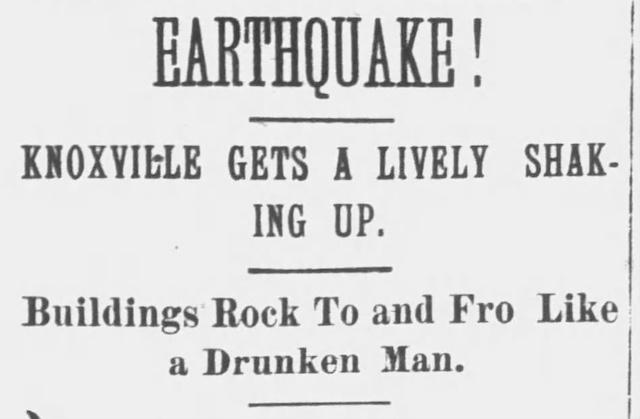
- From the Journal and Tribune on September 1, 1886
-

- In ancient China when an earthquake occurred, a pendulum inside this seismometer is believed to have knocked a ball from a dragon’s mouth into the corresponding toad’s mouth below, indicating from what direction the shock came and where aid should be sent. (Getty Images)
In downtown Knoxville, Alf and Bob Taylor, Carter County brothers who were running against one another for governor in 1886, were interrupted in discussing their political plan and ran out of the Hattie House motel. They were joined on the streets by the Odd Fellows from their lodge over Peter Kerns place on Market Square and the guests at the MaCullum Building, Schubert’s, the Atkin House, and the Lamar House (which is now the Bijou Theater). Walls in some structures were cracked from floor to ceiling. Mr. C.M. Harris, a traveling salesman at the W.W. Woodruff & Co. building said the hardware “made such a rattling” that he was ready to head home to be with his family in Rogersville. All the newspapers sold out, except just one to keep on file.
On September 3, the Knoxville Daily Chronicle reprinted an article by W.P. Reed of the Atlanta Constitution, which provided a little history of major earthquakes that had hit the United States up to that point. It reflected on those of 1785, 1853, 1858, 1871, 1872, 1875, and of course the most famous of them all, the one that hit the Mississippi Valley in 1811. Known as the “New Madrid Quake,” it was said that it “rose and sank, undulating like the waves of the sea,” drying up wells and streams and yet creating lakes where none had existed before and causing the Mississippi River to literally run backwards. Great fissures, running half a mile long, emitted steam, and hills and forests disappeared into the open earth. The town of New Madrid was destroyed in that 1811 quake, and Reel Foot Lake was created.
A few days after Dr. Swancey Kennedy wrote about the 1866 quake in his journal, a United Press correspondent reported that Charleston, South Carolina, had been hit hard and that its “most substantial buildings appear to hang together only by the hairs in the mortar.” The fields and woods were filled with families who camped out under makeshift shelters, such as umbrellas stuck in the ground and bedquilts draped over fences. The article concluded that it would “take fifty years to make the city what it was three days ago.” Another quake hit the Atlantic Coast on October 22, and shocks continued throughout the fall of 1886.
Did you know that what is considered by many to be the most sensitive seismic station on earth is located in Tuckaleechee Caverns in Townsend, Tennessee? Did you know that an ancient earthquake detector was invented in 132 A.D. by Chinese mathematician Chang Heng? I used to teach science at one point, and such facts fascinate me. However, Charles Richter didn’t invent his scale for measuring quakes until 1935, so we don’t know the severity of the 1886 shocks in any particular location, except by the damages left behind.
Dr. Swancey W. Kennedy made no other mention of the quake event in his diary. While parts of the rest of the nation still rocked and reeled for months, the August 31, 1886 quake was already forgotten in the Fork.
Jan Loveday Dickens is an educator, historian, and author of Forgotten in the Fork, a book about the Knox County lands between the French Broad and Holston Rivers, obtainable by emailing ForgottenInTheFork@gmail.com.
Enjoyed this article? Read more of Jan Loveday Dickens’s stories about the people, places, and history that make the Fork community unique.
Follow KnoxTNToday on Facebook, Instagram, X, and LinkedIn. Get all KnoxTNToday articles in one place with our Free Newsletter. Comments may be sent to news@knoxtntoday.com.