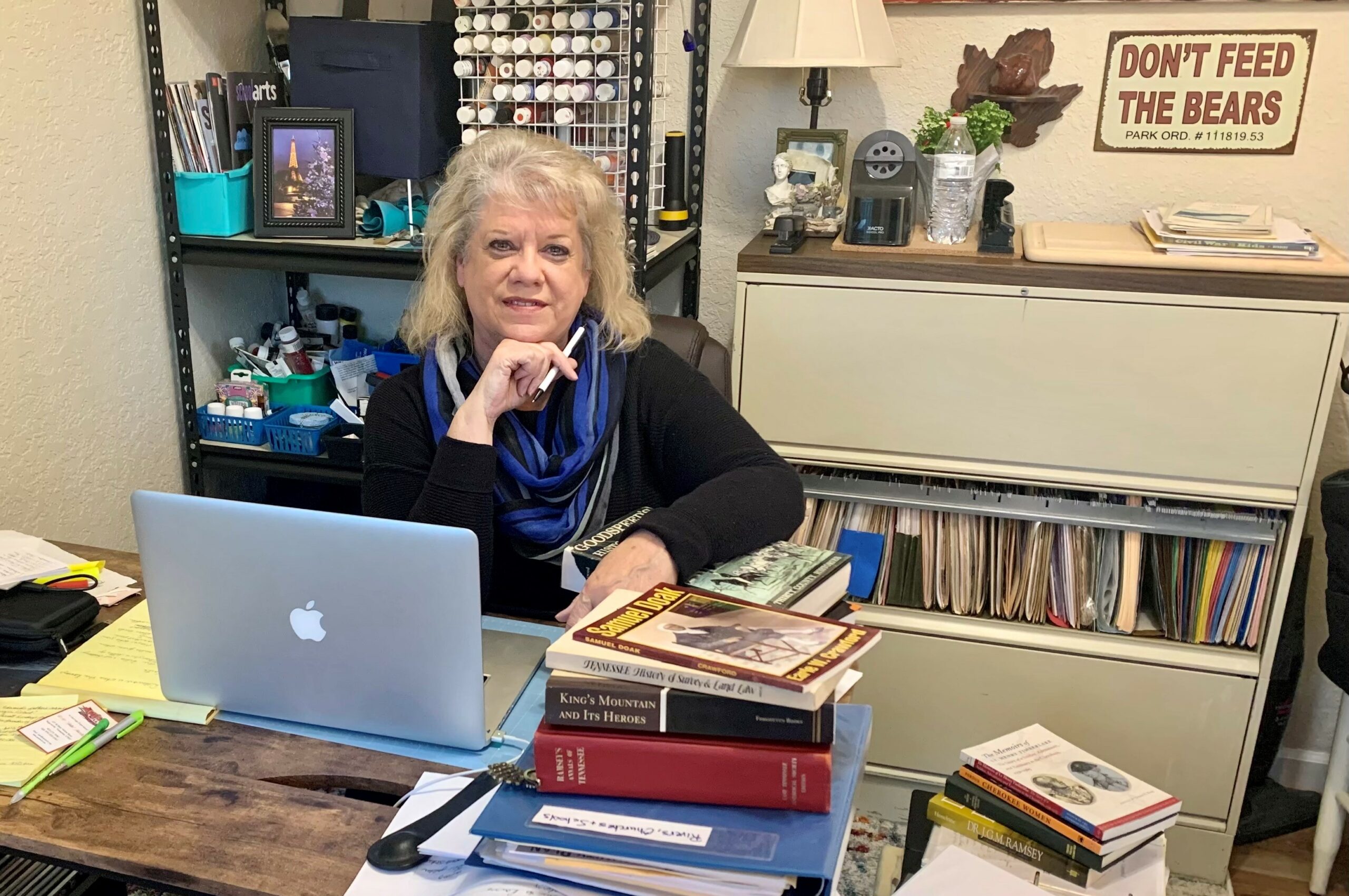
I continue to examine the more than 40 diaries of Dr. Swancey W. Kennedy (1844-1923), who was a physician in the Fork, the Knox County lands between the French Broad and Holston rivers. I said in a prior article that I thought the earliest diary I have is from 1888; however, it’s evidently 1886, and I’m not even halfway through the one for that year. I’ll try not to bore you with my personal fascination with the details, but no promises.
It’s not the parade of troubles with organs such as stomachs, livers, hearts, and lungs that catch my attention in his diaries; it’s the other tidbits of Fork community life that excite me. For instance, on May 17, 1886, on the way back from seeing Jack Wilson’s girl, who had some lung and liver trouble, Dr. Swancey Kennedy “came to where Jo Perry and Esq. Luttrell were painting Chestnut Hollow school house.” All three men were active in local Fork politics and held various civic positions throughout the years. Dr. Swancey Kennedy served as school commissioner for his district at one point.
 An 1883 article in Knoxville’s Daily Chronicle reveals that the Chestnut Hollow community had a lot of pawpaw trees, and an 1887 article tells that it was in what was then the 23rd District in the Fork. I doubt many folks know the significance of that location, but Chestnut Hollow School was the forerunner of Sunnyview Elementary. The name was changed when the school became two rooms instead of one, sometime between 1886 and 1896. You’re welcome. A newer, brick Sunnyview School was later built on the hill at what is now Ruggles Ferry Pike and Asheville Highway, where the American Legion eventually owned the building until 2016. Yes, the school’s name changed from two words to one at some point.
While trying to determine exactly when Chestnut Hollow ceased to exist, I came across another article from 1911, telling how an organ was stolen. Not the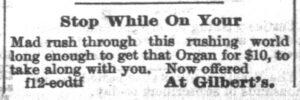 human body kind. The musical kind. Eight years earlier, the Sunny View Sunday School and Literary Society had held box and ice cream suppers to raise money to purchase the organ and song books for the school. (Most of our early schools were closely associated with churches.) The students were shocked to arrive one morning to find that someone had taken their prized organ. Wagon tracks were evident at the door, and the instrument was soon located. I’d like to think it was just a prank, but who knows?
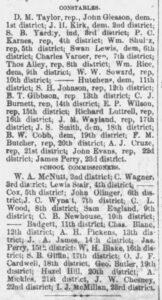 Besides community stores and post offices, as mentioned in my last article schools were (and still are in many cases) the places where voting and political speeches took place. These Kennedy, Perry, and Luttrell men were often mentioned in related political news. In fact, just a few days later after Perry and Luttrell were painting the Chestnut Hollow School, local elections were to be held. On the day before the election, Dr. Kennedy wrote in his diary that on his way home from visiting a patient, he “stopped at the creek and took a bath.” It was a different time, but doesn’t everyone appreciate a clean politician? The location of his handy bath tub, however, has been forgotten in the Fork.
Jan Loveday Dickens is an educator, historian, and author of Forgotten in the Fork, a book about the Knox County lands between the French Broad and Holston Rivers, obtainable by emailing ForgottenInTheFork@gmail.com.
Enjoyed this article? Read more of Jan Loveday Dickens’s stories about the people, places, and history that make the Fork community unique.
Follow KnoxTNToday on Facebook, Instagram, X, and LinkedIn. Get all KnoxTNToday articles in one place with our Free Newsletter. Comments may be sent to news@knoxtntoday.com.



I continue to marvel at these articles of our precious history. They remind me of a slower and perhaps even a more thoughtful life style that I wish we all could get back to. Thank you Jan. Keep them coming!
Yes. Jan does an amazing job of recreating the history for us to step back into.
Thank you, ladies!