
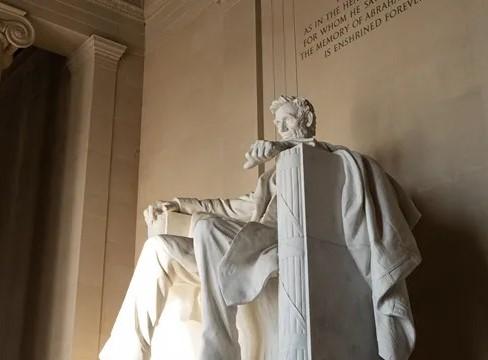
LMU Museum opens ‘Lincoln: Echoes of 1776’ exhibit
The Lincoln Memorial University-Abraham Lincoln Library & Museum has opened a new temporary exhibition, Lincoln: Echoes of 1776, in recognition of the 250th anniversary of the adoption of the Declaration of Independence.
Curated by Dr. Jonathan Smallwood, assistant director and curator of LMU-ALLM, the exhibit examines tensions between liberty and slavery at the nation’s founding while highlighting Lincoln’s efforts to uphold the principles of equality outlined in the Declaration.
The exhibition centers on three guiding questions: how the founders reconciled the concept of liberty with the existence of slavery; how global systems of slavery influenced the development of racialized chattel slavery in the United States; and how Lincoln defended the ideals of the Declaration in his fight against slavery.
The exhibit features campaign materials from Lincoln’s 1858 U.S. Senate race against Stephen A. Douglas and his 1860 presidential campaign. A rotating display will also showcase signed documents from the first 16 U.S. presidents, spanning from George Washington to Abraham Lincoln.
The museum will offer free admission from July 6 through July 31.
The Abraham Lincoln Library and Museum is located on the historic campus of Lincoln Memorial University in Harrogate, Tennessee. It is open year‑round Monday through Friday from 10 a.m. to 5 p.m. and Saturday from noon to 5 p.m. Sunday hours are offered March through October from 1-5 p.m. Info: 423‑869‑6235.
Bailey Patton of LMU provided information for this report.
KBA rates judicial candidates, clerks
The Knoxville Bar Association has released the results of its recent member survey for the judicial retention elections appearing on the August 6, 2026, ballot. In addition to the member survey, the KBA offers information on its website to help voters learn about candidates on the ballot related to the judicial system. Early voting started on July 17 and ends on August 1. Election day is August 6.
There are two local races:
Knox County Criminal Court, Division I, where recently appointed judge Emily F. Abbott is unopposed. And the race for General Sessions Court, Division IV, between Republican Judge Andrea A. Kline and Democratic nominee Ben H. Houston II.
Retention votes will be held on five recently appointed judges:
- TN Supreme Court: Justice Kyle A. Hixson was appointed in 2026 and took office July 1. Justice Mary L. Wagner was appointed in 2024.
- Court of Appeals – Eastern Division Judge William E. Phillips II, appointed in 2026.
- Court of Criminal Appeals – Eastern Division Judge Stacy L. Street, appointed in 2026, and Judge Steven W. Sword, appointed in 2025.
UT holds symposium on closing the rural justice gap

Briana Rosenbaum
Briana Rosenbaum, associate dean for access and community engagement and associate professor of law, has been appointed to the Law School Admission Council’s new Rural Access to Justice Workgroup.
Co-chaired by Dean Aviva Abramovsky of the University of Idaho College of Law and Dean Rebecca Zietlow of the University of Toledo College of Law, the workgroup will investigate innovative approaches to expanding the pipeline of future rural attorneys. Its work will include assessing the barriers that discourage rural residents from pursuing legal education and proposing ways to strengthen their pathways into the profession.
Across Tennessee, communities are facing a growing access-to-justice crisis. In many counties, considered “legal deserts” (i.e., fewer than one lawyer per 1,000 residents), attorney shortages and limited legal services make it virtually impossible for citizens to obtain assistance with essential legal needs, including housing, family law, consumer protection and other matters that can deeply affect their lives.
The University of Tennessee Winston College of Law’s 2026 Orr Symposium, “Closing the Rural Justice Gap: Innovation and Regulatory Reform,” sponsored by the Tennessee Supreme Court Access to Justice Commission, the Legal Clinic at Winston Law and the Tennessee Law Review, gathered national experts, scholars, judges and lawyers to examine the causes of legal deserts and discuss practical solutions.
The symposium was held as the Tennessee Supreme Court considers regulatory reforms aimed at expanding access to quality legal representation. Throughout the program, speakers explored how the legal profession can rethink legal service delivery to ensure that people in underserved communities are not left behind.
Opening the symposium, Tennessee Supreme Court Justice Mary Wagner emphasized that the Court’s recent call for public comment on regulatory reforms was designed to “have a conversation” about unmet legal need across Tennessee.
Wagner noted that Tennessee’s legal aid organizations are overwhelmed, citing studies showing that “92 percent of the problems of people who qualify for legal aid are still going unmet.”
During the panel on alternative pathways to licensing lawyers, Marsha Griggs, associate professor at the Saint Louis University School of Law, argued that states must modernize attorney licensing while maintaining public protection. “States are creating alternative licensure pathways because state supreme courts should recognize the need to modernize our admission.”
Another panel explored whether trained non-lawyer professionals could responsibly fill service gaps in communities where lawyers are scarce. Matthew Burnett of Frontline Justice and the American Bar Foundation astutely observed: “We’re not going to lawyer our way out of the access-to-justice crisis, and we’re certainly not going to lawyer our way out of the rural access-to-justice crisis.”
Speakers highlighted emerging models in states such as Arizona and Alaska, where community justice workers and allied legal professionals are helping people navigate legal systems under carefully designed oversight structures.
Laura Brown, executive director of the Tennessee Alliance for Legal Services, shared findings from their 2025 Civil Legal Needs Assessment, which revealed that 78 percent of respondents reported at least one civil legal problem, with healthcare, family law and housing issues among the most common.
Dean Lonnie T. Brown Jr. introduced a new Winston Law initiative, the Legal Desert Incubator Program, which would provide graduates who commit to spending five years in a legal desert with training, mentoring, business support and financial incentives to develop a sustainable law practice.
You can find the full article from the Winston Law news desk or watch the symposium free here.
***
Sandra Clark writes daily at KnoxTNToday – the Let’s Talk series, including Let’s Talk – Law, Let’s Talk – Neighbors, Let’s Talk – Schools, Let’s Talk – Leaders and Let’s Talk – Outdoors.
Enjoyed this article? Read more Let’s Talk – Law columns by Sandra Clark.
Follow KnoxTNToday on Facebook, Instagram, X and LinkedIn. Get all KnoxTNToday articles in one place with our free newsletter. Send comments to news@knoxtntoday.com/.