
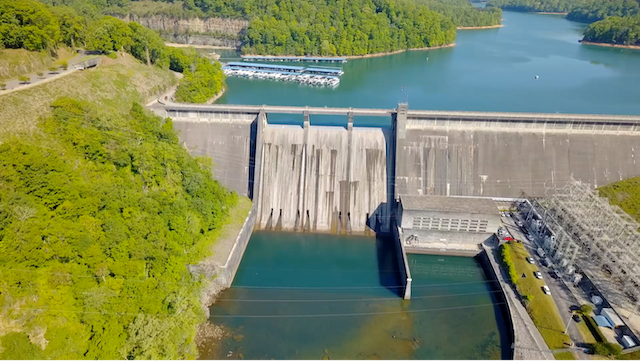
Water levels remain low at lakes across the Tennessee Valley, exposing hazards, as we are in the early stages of a drought, Scott Brooks, media relations for TVA’s River Forecast Center, said.
So far this year, the region has received about 69% of its normal rainfall. Even worse, the runoff water that fills the reservoirs is at just 45% of normal, according to Brooks.
Of the 49 dams, 9 mainstream dams must be maintained at a level to allow boats to move through the locks on the Tennessee River. Others feel the effect of low rainfall.
So, while the lakes never close and remain open and usable, they’re going to look different, Brooks said. People will need to be careful because low water is exposing hazards around the reservoirs, such as old fencing, downed trees, sandbars, and other dangers.
In the video, James Everett, the General Manager for River Management, said these drought levels haven’t been seen in decades, especially around Chattanooga, western North Carolina, and the western portion of the valley near the Kentucky Reservoir and Paducah areas.
“We may be getting some rainfall here and there, but it will take many weeks, if not months, of well-above-normal rainfall to help pull us out of these drought conditions,” Everett said.
If you want to know whether it’s a good day to go fishing or boating, you can check lake levels on the TVA’s website that is updated every Monday.
2026 Fill Status (updated 05/05/2026)
Valley Rainfall
- Calendar-year-to-date rainfall and runoff are 69% and 45% of normal, respectively.
- Observed rainfall and runoff for the last 30 days is 67% and 26% of normal, respectively.
- Conservative releases are being scheduled at all tributary storage and main stem reservoirs and only releasing the minimum amount needed to meet minimum flow commitments and downstream demands.
- The operating strategy is to provide the minimum flows by using tributary storage and maintain reservoir elevations by holding local inflows.
- Tributary levels remain below normal and will require above normal rainfall to meet summer pool levels. Specifics are below for each tributary reservoir.
Cherokee, Douglas, Fontana and Norris
- Cherokee reservoir is 7-8’ below normal elevation for this time of year. It would take at least 12 inches of rainfall to fill to summer pool.
- Douglas and Fontana are about 12-14 feet below normal at this time. It would take around 8 inches of rainfall to fill Douglas reservoir and about 12 inches to fill Fontana to summer pool elevation.
- Norris reservoir is about 9’ below normal elevation for this time of year. It would take at least 7-8 inches of rainfall to fill to summer pool.
- Releases will continue to support downstream minimum flow commitments.
- Reservoirs will require above normal rainfall to reach summer pool.
Main River Status
- Fort Loudoun, Watts Bar, Chickamauga are below normal operating range.
- Nickajack, Guntersville, Wheeler, Wilson, Pickwick, and Kentucky are in normal operating range for this time of year.
- The upper main stem river will require several inches of rainfall to reach normal summer operating levels.
- Flows along the main river are near minimal levels to meet minimum flow commitments.
Drought Status
- Drought conditions have been intensifying week over week during the last several weeks.
- The latest version of the drought monitor (April 28, 2026) shows the entire Tennessee River Watershed in some degree of drought. 85% of the watershed is experiencing at least Severe Drought.
- Calendar year to date rainfall is 69% of normal and runoff is 45% of normal in the Tennessee Valley.
- Drought conditions are expected to persist even with some recent rainfall and additional rainfall in the forecast. Even with rainfall, runoff percentages are falling off due to continued dry conditions.
- Lower than planned hydrogeneration; calendar year to date totals are 64% of normal. Hydro is about 10% of our annual generation, so no impacts to actual demand for electricity. We have a diverse generation portfolio that makes up for deficits in any particular generation source. We are generating as much hydro as possible during peak demand times to maximize that fuel.
Follow KnoxTNToday on Facebook and Instagram. Get all KnoxTNToday articles in one place with our Free Newsletter. Comments may be sent to news@knoxtntoday.com.




Drought is becoming all too familiar lately, I remember in 2023 traveling through Jackson County Al up North US 72 from Scottsboro and seeing the dry lake beds, something I’d never seen in that area before. And since this area is in the Tennessee Valley, 45 miles from Nickajack, drought has been an issue for longer than just this year. Farmers and ranchers are really up against it. And that translates to higher food prices for us all.
Antwan — Trying to reach you. Can you text or phone 865-661-8777. Sandra