For decades, travelers arriving in Knoxville via Southern Railroad could step off their train and be in a cozy room in no time. Built in the early 1910s, the Hotel Atkin took up a half a block across Depot Street from the Southern passenger station. The current address is 333 W. Depot and known as Regas Square.
The five-story hotel featured 200 rooms, more than half of which had their own bathroom, considered a luxury at the time. It had entrances on both Depot and Gay streets. It was the definition of what we now call a mixed used development, featuring a drug store, a barber shop and restaurant that often provided entertainment from a string quartet. Baseball legend Ty Cobb stayed at the Atkin. So did President William Howard Taft when he came to town for the Appalachian Exposition at Chilhowee Park in 1911.
The hotel was developed by Clay Brown “C.B.” Atkin. Born in Knoxville near the end of the Civil War, Atkin grew up in a furniture family. His father operated a brickyard, a sawmill, and furniture store. Atkin became a prominent industrialist, with his namesake company becoming the world’s largest supplier of wooden fireplace mantels in the late 19th and early 20th centuries, producing mahogany and oak mantels (many of which found their way into Knoxville homes) and eventually manufacturing maple furniture.
His factory on S. Gay Street was destroyed during the great fire downtown in 1893. But Atkin rebuilt and kept plugging along. He was also involved in developing the Bijou Theatre.
Passenger rail travel declined drastically after World War II. Well after his death in 1931, the hotel had lost its prominence and its bookings, fell into disrepair and was eventually demolished.
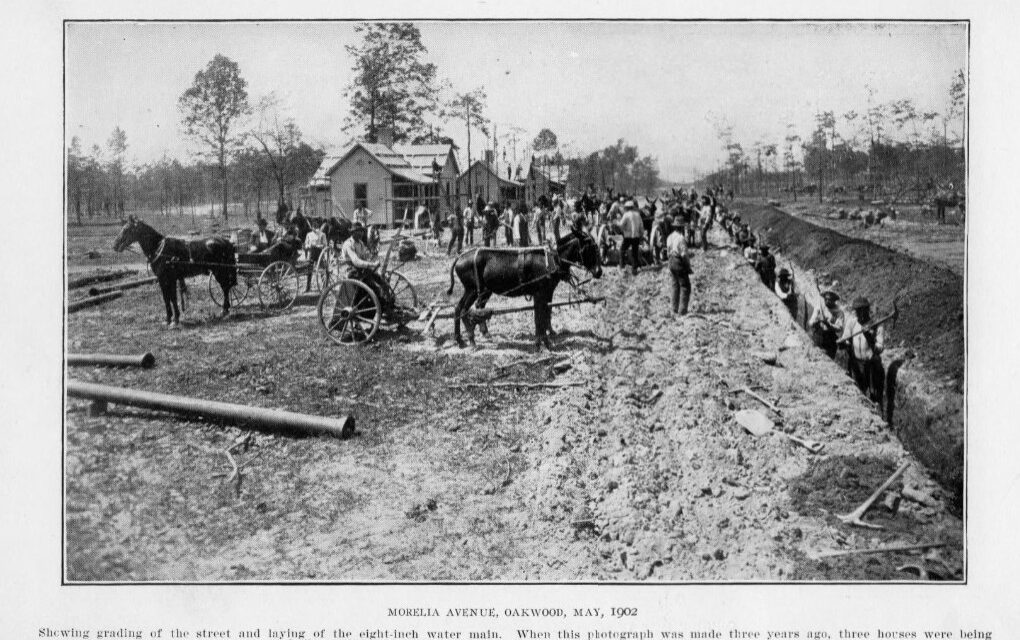
Atkin’s most lasting legacy, one could argue, is the neighborhood he began developing in the early 1900s, before he built the hotel: Oakwood. He bought up forest and farmland for both residential and industrial use. At the time, Southern Railway was Knoxville’s largest employer, and its yards were close by and his nascent neighborhood was just three miles from downtown. He located his new furniture venture on the property and by 1902 began subdividing for home construction. A pamphlet advertising the new neighborhood, noted that it was accessible by electric streetcar: 16 minutes to the Market House, 12 to the Southern Station and just a five-minute walk to the Southern Railroad shops. It boasted of water mains on all streets, electric lights, macadamized streets, and gas lines were on their way. Oakwood School (now an assisted living facility) would soon follow in 1914.
Burwell Avenue, which still exists today, was named for Atkin’s wife, Mary, as that was her maiden name. Mary died in 1949. The couple is buried in Greenwood Cemetery in Fountain City.
Beth Kinnane writes a history feature for KnoxTNToday.com. It’s published each Tuesday and is one of our best-read features.
Sources: The Knoxville Journal digital archives, East Tennessee History Center
Follow KnoxTNToday on Facebook and Instagram. Get all KnoxTNToday articles in one place with our Free Newsletter