As we continue to move toward our nation’s semiquincentennial, I’m still focusing on elements of the Revolutionary War effort of attaining independence and the related contributions and connections of families of the Fork, the Knox County lands between the French Broad and Holston Rivers.
This one goes out to all my Loveday kin in the Fork. And we are great in number.
You see, my dad was one of 11 siblings, 9 of whom survived into adulthood, and all but one of those had between 2 and 6 children of their own. In other words, I have a bunch of cousins. In fact, my mother came from the same situation. She, too, was one of 11 siblings, 9 of whom reached adulthood, and all but one had 2 to 5 children. I am one of 50 first cousins in my family tree. My four grandparents and their big broods were eventually neighbors in the Fork, which is how my parents met.
Of all my “boots on the ground” adventures into cemeteries with my history buddy Chase McSpadden, this one brought unexpected tears. It’s the oldest grave we’ve found to which I believe I have a personal connection.
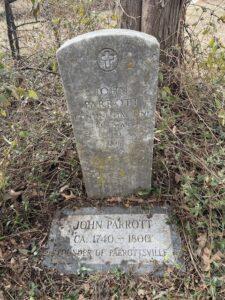
1850s marker created by Fagan Brothers Marble of Knoxville and 1983 stone placed by the Daughters of the American Revolution
This Revolutionary War veteran of interest is probably my ancestor, John Parrott, who founded Parrottsville, the third-oldest town in Tennessee. From the best I and others can conclude, John and Catherina (Myers) Parrott’s daughter, Barbara, married Edward Loveday, the progenitor of the Loveday family in Sevier County. This is evidenced by Barbara’s grandfather’s will, in which German settler Henry Myers (Miars, Moyers, Meyers) apparently left an inheritance to his grandchildren, including Barbara Loveday. John’s parents were Frederick and Barbara (Edwards) Parrott, to whom he was born about 1740 in Shenandoah Valley. Edward Loveday’s wife was evidently named for her maternal grandmother, and Sevier County Loveday daughters carried the name Barbara for generations.
Some time after his younger brothers had signed up to fight in the Revolution, John Parrott enlisted in 1777 at age 37 for three years as a private under Virginia Colonel William Grayson, who had served as an aide-de-camp to General George Washington. John was initially in Captain Thomas Triplett’s company, but after disease reduced the ranks, his unit was merged with Captain Joseph Smith’s. Some of the documents in his pension file show that John, too, was sick or in the hospital at times during his service. Before his term was up, he evidently went home to care for his several children and his wife Catherina, who was very ill. She died in 1781. Left with young children to care for on his own while taking care of the farm, John, at age 41, soon married Louisa (“Lucy”) Bean. Together, John and Louisa had more children.
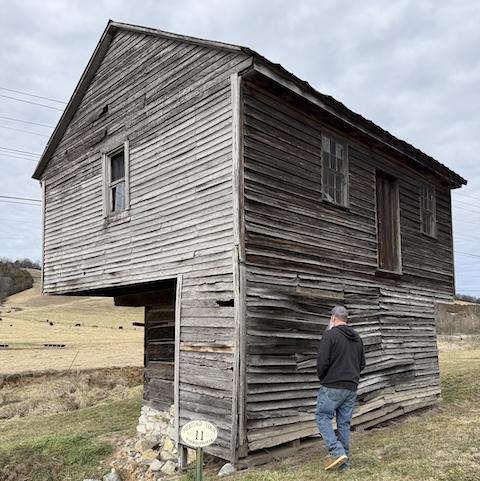
In 1787, John settled his family on a land grant of 640 acres along Clear Creek of Greene County. During Native American uprisings, they probably sheltered at Abraham Swaggerty’s blockhouse, which was on the farm next door to them. Tennessee became a state in 1796, and John died soon after. John, Louisa and a couple of sons are buried at Yett Cemetery on a hill off Highway 321, between Newport and Greeneville, near where the boys ran the Parrott Tavern along the old Stage Road.
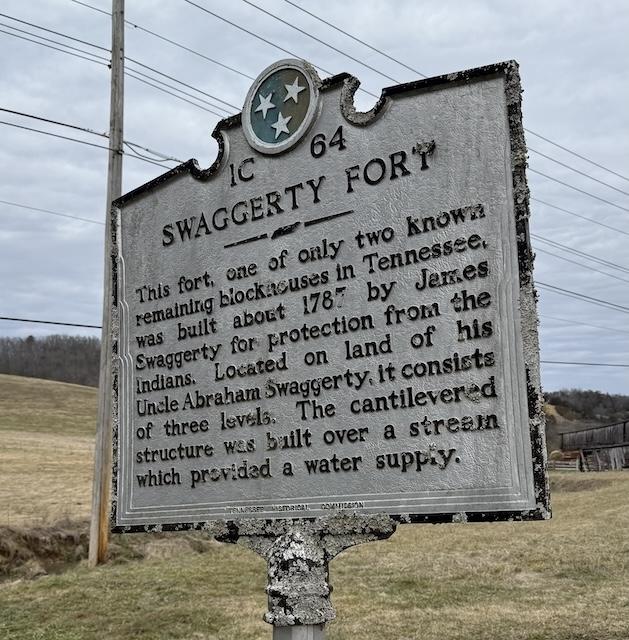
Though a blockhouse existed, recent studies suggest the history of this particular structure is in error.
We have evidence that Edward Loveday was several miles away at the East Fork of the Little Pigeon River in Sevier County by 1801, though he was probably there earlier. It took a while for homesteads to be registered. Our line descends from George Loveday, Edward’s presumed son, whose direct descendants through Noah, then Eli, lived in Sevier County until Eli’s son, Jesse James Loveday, brought his family during the Great Depression in the late 1930s to the Fork, where he worked as a dynamite man for the local quarry. Before that, he had helped to cut the roads through the Smokies, where our other ancestors gave up land for the National Park.
Although the Loveday name hasn’t been forgotten in the Fork, I’ll bet some of my cousins didn’t know that we also likely descend from the founder of Parrottsville.
Jan Loveday Dickens is an educator, historian, and author of Forgotten in the Fork, a book about the Knox County lands between the French Broad and Holston Rivers, obtainable by emailing ForgottenInTheFork@gmail.com.
Follow KnoxTNToday on Facebook and Instagram. Get all KnoxTNToday articles in one place with our Free Newsletter.


John Parrott’s great grandson, Jacob Parrott, was the first receipiant of the Congresdional Medal of Honor for his role in the “General” raid during the Civil War.
Jacob was in the family however I’d like to see info on him being from John – my info says he was from George
He was not John’s Great grandson but, still he came from the well. There was an exhibit in the Army Museum in Washington DC in the Congressional Medal of Honor recipients. Jacob had pride of place as the very first! I teared up. I am a direct descendant of John Parrott and when I told them that I wax his relative, they told me I should have called ahead so they could have done something special for me!
– Sean Parrott