
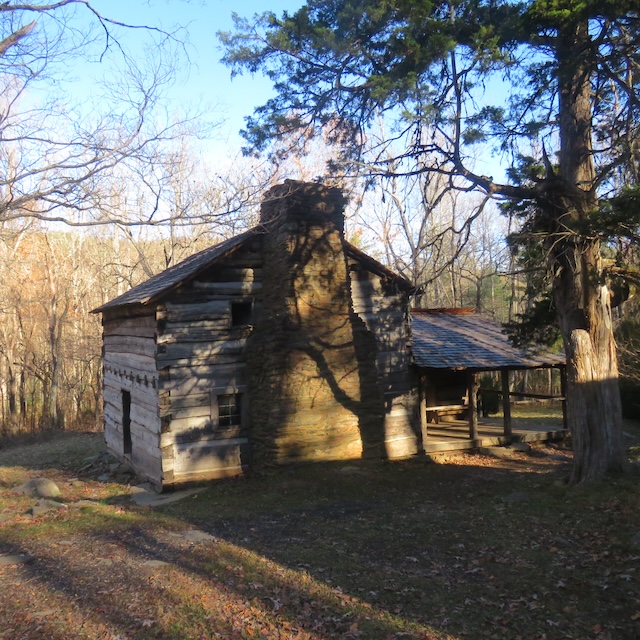
I hiked trails that started across Little River from the Metcalf Bottoms picnic grounds at 8 a.m. The route went up Metcalf Bottoms trail .6 miles to the Little Greenbrier School. This trail would be considered moderate, with a rather steep climb on the second tenth of a mile, and three-foot log bridges to be crossed.
The first classes in the Little Greenbrier School started on New Year’s Day 1882. School was usually only two to three months a year, and at a time when the children were not as needed on the farm. Reading, penmanship, spelling, and arithmetic were the subjects taught. Members of the community furnished the materials to construct the building and built it. Sevier County furnished the teacher. Some of the logs used to build the building were so large and heavy that it took two oxen to get them to the building site.
From the school, the next mile and a tenth was on the Walker Sisters trail to the Walker Sisters’ cabin, which was located on 122 acres. Six unmarried sisters lived there their entire lives. They had no running water, electricity, indoor plumbing, or bathroom. In the early years, the sisters bought only salt, sugar, coffee, and soda. They farmed and had chickens, ducks, turkeys, cows, sheep, and hogs; and they made their clothes.
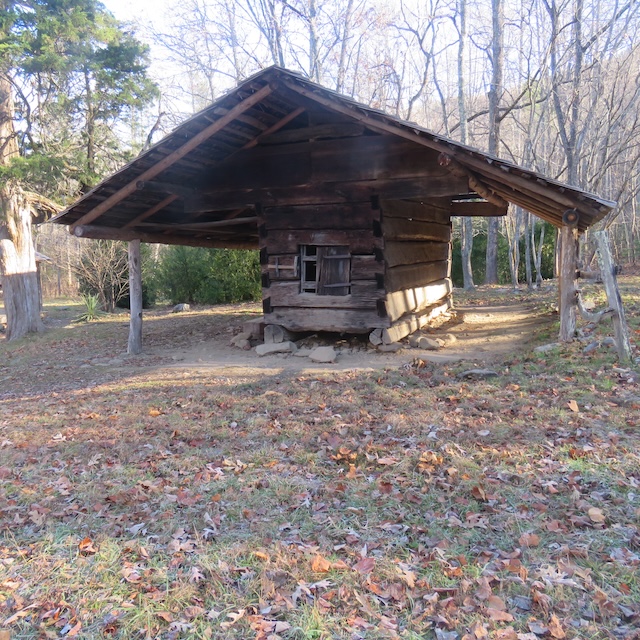
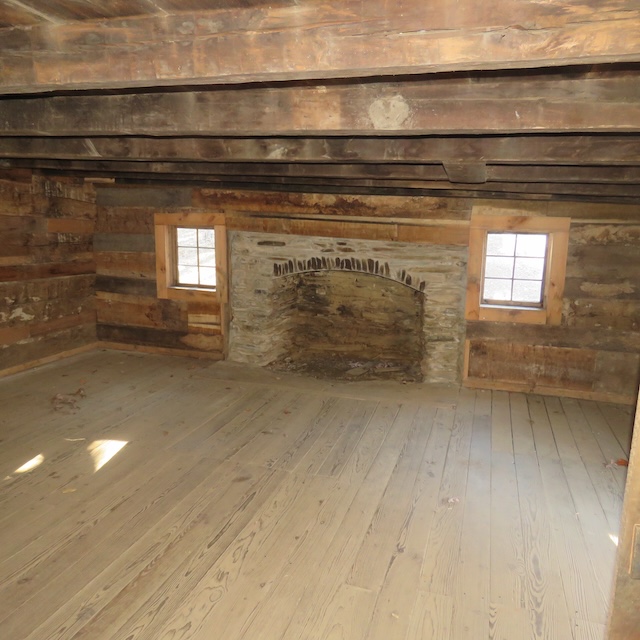

When the Great Smoky Mountains National Park was established on 15 June 1934, the sisters were asked to leave their property; however, public pressure persuaded the National Park Service to allow them to live out their lives in their home.
The sisters became very popular with park visitors. They sold baked goods, poems, and homemade toys to park visitors. It was said that while walking to the cabin some distance away, one could often smell the aroma of a stack cake being cooked in the home. It was reported that President Franklin Roosevelt visited the sisters while he was in the park to dedicate it on 2 September 1940.
The oldest sister, Margaret, was in charge of their home. She was said to have run off young men who came to call upon one of the younger sisters. Also, it was reported that a man approached Margaret and offered to build them an outhouse free of charge. She told him no. He asked why she had said no to his offer, and she replied that people would know where they were going. Ladies used the woods below the house for their bathroom, and men would use the woods above the house. The last sister living died in 1964.
From the Walker Sisters cabin, the Little Brier Gap trail (.06 tenths of a mile long) was taken to the Little Greenbrier Trail. Then that trail was followed 1.9 miles to the Wear Gap Road. The Little Greenbrier Trail would be classified as moderately difficult. From there, the road was walked back to the car at Metcalf Bottoms.
Hopefully, many readers can visit the Little Greenbrier School and the Walker Sisters Cabin the next time they are in the national park.
Tom Harrington is a regular hiker who reports on wildflowers in the Smokies.
Follow KnoxTNToday on Facebook and Instagram. Get all KnoxTNToday articles in one place with our Free Newsletter.


I can remember going to the Walker Sisters cabin when 3 of them were still alive. My daddy, Herbert Webster, knew them. I can remember in great detail how the cabin looked on both the inside and outside back then. There was a rifle over the fireplace which had a big fire. There was an iron pot on a swivel that had a stew cooking. I do not remember a wood stove or anything else to cook by. One sister was on the spinning wheel which was on the barn side of the cabin. The walls were covered with newspapers to keep the air out. The beds all had trundle beds underneath that pulled out. All had big heavy blankets on them. There were no closets. All clothes and coats were on hooks or pegs along the wall. They had long homespun dresses on. Outside, the spring house had lots of jars and containers sitting in the cold water as that was their refrigerator. The corn crib had an overhang on each side. One side had a wagon, the other had a sled. That way the big mule could pull them summer or winter. I saw the mule. The pig pen and sheep pen had big tall sharp sticks to keep the wild animals out. There were lots of fruit trees up the hillside. The big cedar tree by the back fence was already good sized back then. There was a big chopping block where they would cut up their fire wood that they used to heat and cook by. I remember all of the big boxwoods that are still there to this day. One of the sisters wrote a poem for my mother. Mother fussed because it cost a dollar. Wish I had it now.
Great memories, Clayton Webster