
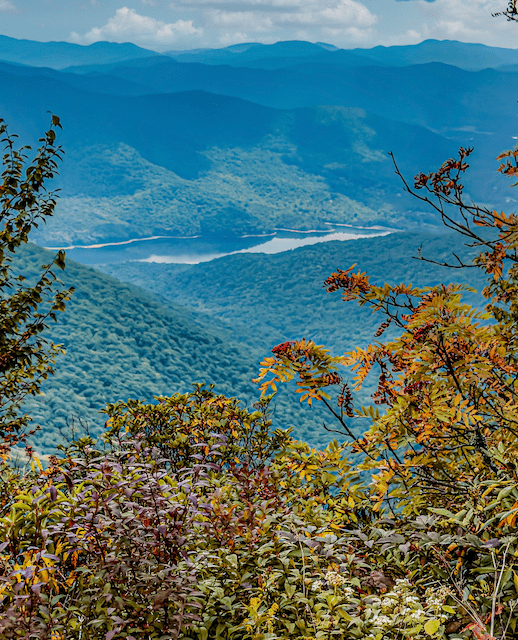
The section of the Blue Ridge Parkway from Asheville to Mount Mitchell reopened this past Monday, approximately 11 months after Hurricane Helene made her presence known in the Southern Appalachians.
Badger took the opportunity to take the drive, which had been dearly missed. Just south of the intersection of Mount Mitchell Road (NC Hwy. 128) and the Parkway, a visitor can stop and view a body of water down in the Asheville Watershed. As I took in a familiar view, my thoughts went to Ehrmann’s poem Desiderata: “Go placidly amid the noise and the haste, and remember what peace there may be in silence.”
Badger was then jolted back into reality, knowing the tumult this valley had recently endured.
Nestled high in the eastern flank of the Black Mountains — the towering sentinels that claim the title of the highest range east of the Mississippi — precipitation doesn’t just fall; it funnels with purpose.
Rain and snowmelt cascade down these ancient slopes, carving through dense rhododendron thickets and granite outcrops before pooling into the North Fork Reservoir, also known as Barrett Reservoir. This unassuming 350-acre body of water, impounded behind a sturdy dam near Black Mountain, isn’t just a scenic backdrop for motorists on the Blue Ridge Parkway. It’s the beating heart of Asheville’s water supply, providing a staggering 80 percent of the drinking water for the city’s roughly 63,000 customers and beyond.
But for Badger, there’s the Knoxville connection that hits close to home: from the reservoir, that crystal-clear flow spills into the North Fork of the Swannanoa River, merging downstream into the broader Swannanoa. That waterway, in turn, feeds the storied French Broad River, which snakes 210 miles northwest and then into Tennessee to join the Holston and form the mighty Tennessee River, right through the heart of the Scruffy City. What nourishes Asheville today could be flowing from your tap next week, a veritable hydrological handshake across state lines.
That fragile chain, though, was tested like never before by Hurricane Helene. What started as a tropical storm, then a hurricane, off Florida’s coast roared into western North Carolina as a deluge of biblical proportions, and together with a pre-existing system, dumped up to 31 inches of rain in 48 hours — unleashing flash floods that reshaped mountains and valleys and entire cities overnight.
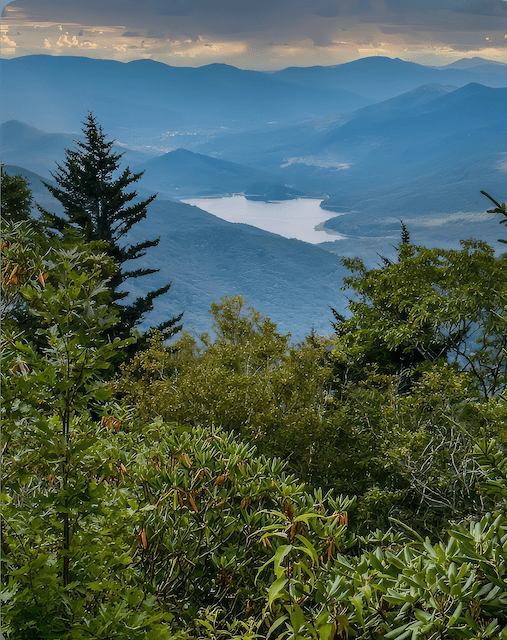
North Fork (Barnett) Reservoir from Black Mountain Gap on the Blue Ridge Parkway – 9.15.2025
The North Fork Reservoir, designed to tame such fury, was instead turned utterly upside down. Massive landslides from the saturated Black Mountains funneled untold tons of mud, boulders, and uprooted trees straight into the basin, transforming its pristine depths into a churning soup of sediment.
Officials described the reservoir as “catastrophically damaged,” with turbidity levels — essentially the murkiness from suspended particles — spiking so high that water couldn’t pass through treatment filters without risking clogs or contamination. Debris clogged intake lines and the dam’s auxiliary spillway, while the sheer volume of inflow forced designed emergency releases that scoured downstream channels.
For weeks, Asheville’s water system limped along at partial capacity, with crews pumping out 17 to 20 million gallons daily just to flush the “chocolate milk” reservoir and hunt for breaks in transmission lines buried under fresh debris fields. With no potable water for weeks, Badger and Rock Sprite suffered along with thousands of others similarly situated.
By early November, clarity had improved enough for limited operations. Still, the scars linger: roads to the site washed out, ecosystems upended, and a stark reminder that even expertly engineered havens have their limits.
This isn’t the first time the Swannanoa and French Broad have swollen with menace — far from it. Flash back to July 1916, when two back-to-back hurricanes hammered the region with 23 inches of rain, cresting the French Broad at 21 feet above flood stage and drowning Asheville in a torrent that killed dozens, demolished bridges, and left the city isolated for days.
A century later, in a June 2016 city of Asheville press release titled “100 Years After the Flood of 1916, the City of Asheville Is Ready for the Next One,” officials brimmed with confidence.
Citing multimillion-dollar upgrades to the North Fork Dam — including expanded spillway capacity, seismic reinforcements, and real-time river monitoring — they proclaimed the reservoir a bulwark against recurrence. “Detailed emergency preparedness plans” and “procedures for managing capacity” would ensure such a catastrophe was “unlikely, if not impossible,” to occur again.
The city’s press release didn’t age well. That optimism curdled in Helene’s wake. The storm’s ferocity overwhelmed those very safeguards, proving that while dams can hold back water, they can’t outrun nature’s raw math: warmer Gulf waters fueling fiercer storms, and a warmer climate amplifying every drop.
As Knoxville watches the Tennessee River glide past downtown, it’s worth pondering our shared vulnerability. Helene’s echo in Asheville underscores how interconnected our waterways truly are — not just in flow, but in fate.
What lessons might be learned? Badger isn’t a hydrologist, but on the trip back to Asheville this week, one phrase common to mountain folks experienced with freshets cycled in my brain: “The water always wins.” Indeed, it does
Thomas Mabry – Honey Badger Images Many of the HoneyBadgerImages are on display at instagram.com/honeybadgerimages.
Follow KnoxTNToday on Facebook and Instagram. Get all KnoxTNToday articles in one place with our Free Newsletter.


Oh dear Thomas, indeed it does. I could barely hold back the tears as I read your story because it’s true, it’s still so real, so fresh. People are still recovering.
You were our eyes and ears on the ground since day one. You and Kitty put your lives on the line to help others, to keep others aware of what was going on. At the same time, suffering in the same situation. You are still keeping us aware today.
This was so catastrophic, so horrific. As you said, it literally changed, not just lives, but our landscape!
Things nor People will never be the same. But through God and each other they will be made stronger.
Thank you for sharing this story with us as a reminder that we don’t have any control over what Mother nature can and will do.
And thank you Knox TN for publishing my dear friend Thomas Mabry’s story and beautiful photo.