
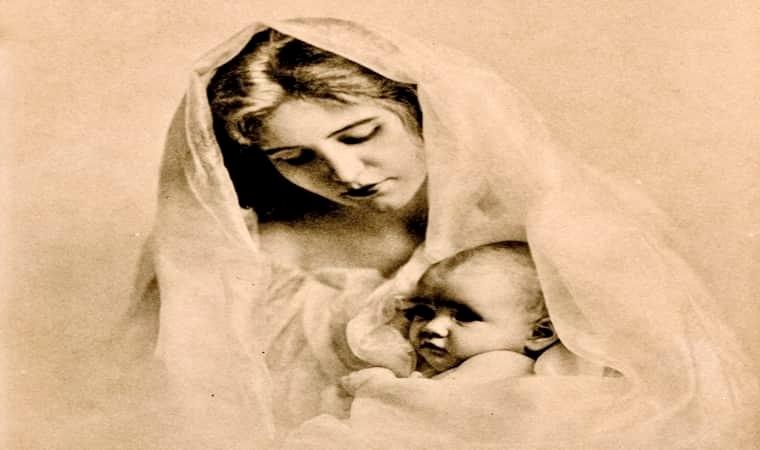
I ran smack into a common conundrum going through some old pictures the other night. And by old, I mean from a century or more ago. There are some people I know who they are, some that thankfully have notes on the back, and then there’s the pile of “who are these people?”
Dear everyone, spare your children, grandchildren and future historians. Label those piles of print photos you have lying about and caption the ones that are online. In one instance, I came across a photo of a photo I’d taken at a family reunion 11 years ago. I know I have it written down somewhere, but I am 90 percent sure it is of a great-great grandmother holding a chubby-cheeked great grandmother (or one of her siblings) in her lap.
But, this isn’t about which family member it was, but rather the style of the photograph: a demure and beaming young mother, draped in a long, white veil, looking adoringly upon her child, ensconced in a cloudy poof of tulle. It was the twitch of a memory that there is a far more famous iteration than the one in my family’s possession.
Ah, yes. The Knaffl Madonna. Officially, it’s called Madonna and Child, the creation of photographer Joseph Knaffl, with the help of an 18-year model, Emma Franz, as Mary, and his own baby daughter, Josephine, as Jesus. Produced in the original Knaffl studio on Gay Street in 1899, the photograph was a huge hit, and was printed in untold numbers into the early 1900s. It received numerous national and international awards. Hallmark has turned it into Christmas cards.

The Knaffl Building on Gay Street at Church Avenue (Photo: McClung Digital Collection)
Knaffl was born in Wartburg, Tennessee, in 1861, just in time for the Civil War. He was the son of an Austrian immigrant father, Rudolph, and a German immigrant mother, Rosalee Bodder. If you didn’t know, Wartburg was named for a castle in Germany, and was heavily populated by German, Swiss, and, later, Austrian immigrants. Rudolph was a doctor and court physician under emperor Ferdinand I in Vienna, but left in the wake of the revolutions of 1848 for the United States. He married Rosalee in Wilson County, before settling in Wartburg, where their five children were born. He served as a surgeon for the Union Army in the 10th Tennessee Infantry Regiment. The family moved to Knoxville sometime after the Civil War.
Joseph learned photography from his brother-in-law, Theodore M. Schleier, who was married to his older sister, Caroline. Eventually, he and his younger brother, Charles, went into business together, opening Knaffl and Brother in 1884. He maintained that studio after Charles’ death in 1909, but expanded into another building on Gay Street, going into partnership with one of his protegees, James Brakebill. Knaffl & Brakebill primarily served as a portrait studio at southwest corner of Gay Street and Church Avenue. They provided considerable work for the Appalachian Exposition of 1910 and the National Conservation Exposition of 1913, both at Chilhowee Park.
Knaffl died in 1938 and is buried (along with most of his family) in Old Gray Cemetery. The Knaffl building was still there when I was working at The Knoxville Journal from late 1989 until the end of 1991. It was demolished after suffering extensive damage from a fire in 1996. The space now holds a parking lot.
For more information on the Knaffl Madonna, go here.
Beth Kinnane writes a history feature for KnoxTNToday.com. It’s published each Tuesday and is one of our best-read features.
Sources: McClung Historical Collection-Knox County Library, Knoxville Journal Digital Archives, KnafflMadonna.net
Follow KnoxTNToday on Facebook and Instagram. Get all KnoxTNToday articles in one place with our Free Newsletter