

It is November now, and the winds are beginning to gather over the upper Great Lakes. I find myself returning in mind to the Lakes, where I spent every summer at our home in Door County, Wisconsin, “the Tip ‘O the Thumb.” The peninsula divides Green Bay and Lake Michigan. Over the years, my grandfather taught me to listen to the lake and observe the weather. We spent a great deal of time on boats, and with that time came respect for the waters. I remember the low rumble of iron ore freighters passing by our property several times a week across Death’s Door, a three-mile stretch that is the site of many shipwrecks over the years. They were headed for the steel mills in Gary, Indiana.
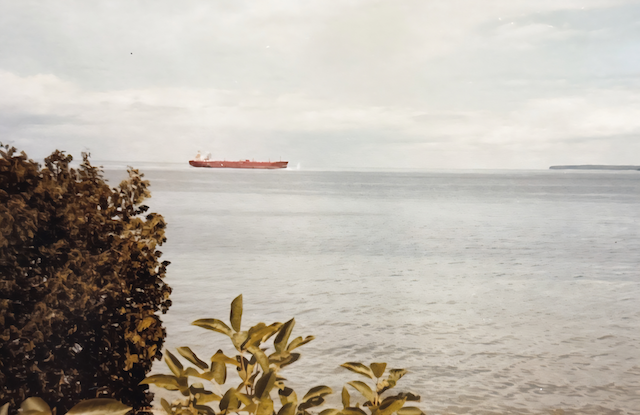
Iron ore ships like this one passing through Death’s Door in Door County, Wisconsin, 1974, are the same type of freighters as the Fitzgerald.
It is through that lens that I view the upcoming 50th anniversary of the sinking of the Edmund Fitzgerald, a disaster in neighboring Lake Superior. The somber memories echo through the entire Great Lakes region. I never lived on Superior’s rugged shore, but I knew the same wind-whipped waves of Lake Michigan. These inland seas can turn from serene to savage in minutes. These are not the kind of calm lakes we have here in East Tennessee. These can be violent, deadly waters. Summer storms could be as dangerous as fall storms.
The rest of the world has come to know about the fierce storms of the Great Lakes from Gordon Lightfoot’s iconic song “The Wreck of the Edmund Fitzgerald.” It was the tenth of November 1975, and the Fitzgerald was transporting a full load of taconite pellets – effectively iron ore – from Wisconsin to an island near Detroit when the winds started stirring. It was the Fitzgerald’s final run of the season, and its Captain Ernest McSorley had planned to make it his final run. He was retiring.
Then came the winds of November. At first it was minor damage to the Edmund Fitzgerald, some railing knocked down.
McSorley radioed the nearby Arthur M. Anderson, another freighter, and the two captains agreed to take the northern route, closer to shore, for more protection against the winds. That decision, intended as a cautious move, may have inadvertently increased the time the ship was exposed to the full force of the storm. Then the Fitzgerald’s radar went out. In frequent communication and about 15 miles behind, the Anderson tried to guide the Fitzgerald.
By 8 p.m., wave heights were 23 to 25 feet with occasional peaks reaching as high as 36 feet. Gusts were near hurricane strength. The Fitzgerald disappeared from the Anderson’s radar near Whitefish Bay, a particularly exposed stretch of lake. Moments before, the Anderson’s captain asked McSorley how they were doing. “We are holding our own,” replied McSorley. Those would be the last words from the Edmund Fitzgerald. There was no distress call.
Minutes later the mighty ore carrier sunk, taking all 29 crew members down with her. The story has been told and memorialized for 50 years, and known to many from Gordon Lightfoot’s song, “The Wreck of the Edmund Fitzgerald.”
This week, across the Great Lakes region, there will be ceremonies, memorial lights, and guided tours of museums, all dedicated to the Edmund Fitzgerald’s fateful voyage, cementing its place in Great Lakes maritime lore.
The wreck of the Edmund Fitzgerald began as a routine final run of the season and turned into a tragic convergence of extreme weather, design vulnerabilities, and perhaps, miscalculation. To this day, no one knows the exact cause of the sinking.
Were the massive waves and poor weather simply overwhelming her structural integrity? Maybe the narrowing of the ship’s freeboard (the portion of the vessel above the waterline) in the winter loading season made the ship more vulnerable to flooding or stress fractures. It could even have been an unexpected shoaling — running aground on submerged hazards such as the “Six Fathom Shoal” northwest of Caribou Island — potentially puncturing the hull. Most experts think it was no single factor that sank the Fitzgerald, rather a lethal combination of stressors that converged at the worst possible time.
Today the wreck sits in two sections roughly 400 feet apart in deep water beneath the lake’s dark surface. Canadian and Michigan laws forbid diving on the wreck. According to divers who recovered the ship’s bell in 1995, there are bodies intact. The water is too cold and is void of bacteria to cause decomposition. Families of the crew have lobbied to forbid diving.

Lighthouses will be lit and memorials on the Great Lakes will honor the Edmund Fitzgerald this week.
At memorial services held on November 10 every year, the bell is rung 29 times, once for each of the crew members. When Gordon Lightfoot died in 2023, a ring was added to honor him for telling the story of the Mighty Fitz.
In the end, the Edmund Fitzgerald taught the shipping industry valuable lessons: it needed improved weather forecasting, better communication protocols, and more conservative decision-making in late-season sailing. As mariners and meteorologists note, the freshwater waves on Lake Superior are pointy and close-spaced, more dangerous than ocean rollers in many ways.
On this anniversary, the memory of the 29 men lost aboard the Edmund Fitzgerald remains etched in maritime history and in Gordon Lightfoot’s famous song. And in my memories of the Great Lakes.
Melanie Staten is a public relations consultant with her husband, Vince.
Follow KnoxTNToday on Facebook and Instagram. Get all KnoxTNToday articles in one place with our Free Newsletter.
Send your news and community notes to send news@knoxtntoday.com.


“”…the narrowing of the ship’s freeboard. ” Now that certainly is a quaint euphemism for over loading.