
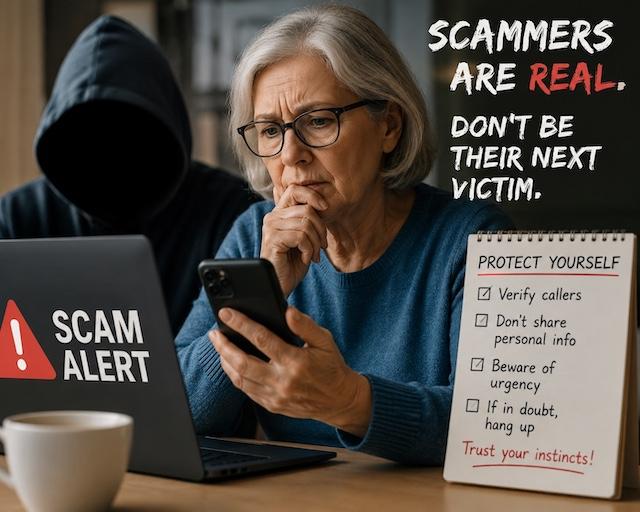
The phone call ends. The money is gone. The person you thought was helping you was never real. The investment opportunity was fake. The government employee was a criminal. The relationship was a lie.
And then comes the question almost every scam victim asks: “What do I do now?”
The first moments after discovering a scam matter. Not because every dollar can always be recovered. Often, it cannot. But because quick action can limit additional damage, preserve evidence and give investigators information they may need to connect one victim’s experience to a larger criminal operation.
The first response is not shame. It is action.
Stop before the damage grows
One of the first instincts after discovering a scam is to confront the person responsible. That is usually a mistake. Do not continue arguing with the scammer. Do not send another payment. Do not provide additional information. Do not believe someone who suddenly appears offering to recover the money.
Scammers often change identities when they realize a victim is becoming suspicious. A fake bank employee may become a government investigator. A fake investment adviser may become a “recovery specialist.” A romance scammer may create another emergency that requires one more payment. That is not a coincidence. It is the same criminal system continuing the attack.
Systems explained: Why recovery scams work
A person who has already lost money can become a more valuable target because criminals know the victim is often searching for answers, feeling embarrassed and hoping someone can fix what happened. The promise of recovery becomes the next opportunity for theft.
Preserve the evidence
Many victims want to immediately delete messages, block accounts and move on. Before doing that, preserve what happened. Save:
- Text messages.
- Social-media conversations.
- Phone numbers.
- Website addresses.
- Payment confirmations.
- Bank records.
- Cryptocurrency transaction information.
- Gift-card information.
Create a timeline.
- When did the contact begin?
- What did the person promise?
- When was money requested?
- How was payment sent?
- Who was contacted afterward?
Memory changes. Records do not.That evidence may be important not only for recovering money, but for identifying patterns. A $1,500 loss may look like one isolated event. A thousand similar reports may reveal an organized operation.
Contact your financial institution immediately
One of the most important steps is contacting the organization involved in the payment.
- Your bank.
- Your credit union.
- Your credit card company.
- A payment app.
- A cryptocurrency exchange.
- A gift-card company.
Use direct language:
“I believe I am the victim of fraud. I need to report this transaction immediately.”
The type of payment matters. Credit cards may provide stronger dispute protections because fraudulent charges can qualify for chargeback procedures.
Debit cards, bank transfers and payment apps can be more difficult because many transactions are technically authorized by the victim, even when the person was deceived.
Cryptocurrency transactions are recorded on public blockchains, which may allow investigators to trace movement, but recovery depends on where the money went and whether it can be connected to identifiable accounts.
The first question is not always: “Can police catch the person?” The first question is: “Can the transaction still be stopped?”
Protect yourself from the next crime
Many scams do not end with the first loss. If personal information was exposed, secure your accounts immediately. Change passwords. Enable multi-factor authentication. Review login activity. Protect your email account. Email deserves special attention because it can become the key to resetting banking, shopping and social-media accounts. A scam is not always just a money problem. It can become an identity problem.
The Federal Trade Commission provides identity-theft resources through IdentityTheft.gov, including steps for protecting personal information after fraud.
Report the crime
Many victims never report scams because they believe nothing will happen. They think:
“The money is already gone.”
“The police cannot do anything.”
“Nobody will care.”
Reporting still matters. Federal, state and local agencies use reports to identify trends, connect cases and understand criminal networks.
Important reporting options include:
FBI Internet Crime Complaint Center (IC3): IC3 collects reports involving online fraud, cryptocurrency scams, romance scams, business email compromise and other cyber-enabled crimes.
Federal Trade Commission: The FTC collects consumer fraud reports to identify patterns involving impersonation, deceptive businesses and emerging scams.
Tennessee consumer protection resources: Tennessee residents can report consumer concerns involving fraudulent businesses and deceptive practices.
Local law enforcement: A police report may not always lead to immediate recovery.
But it creates documentation. It creates evidence. It creates a record. Reporting is not only about getting money back. It is about creating the map.
The scams are changing, but the strategy is familiar.
Scammers continue using traditional methods while adding new technology. Government impersonation scams may claim: “You missed jury duty.” “There is a warrant.” “Your Social Security number has been compromised.” “You owe the IRS.”
A major warning sign:
Government agencies generally do not demand payment through cryptocurrency, gift cards or immediate wire transfers. Romance scams build emotional trust before introducing a financial emergency.
Investment scams often promise:
- Guaranteed returns.
- Secret opportunities.
- Exclusive access.
- AI-powered trading.
Business email compromise targets companies, churches, schools and nonprofits by impersonating executives, vendors or financial personnel.
Artificial intelligence has added another layer. Criminals can now create convincing voice clones, fake videos and automated conversations. Someone may hear the voice of a family member or see a convincing video of an executive and still be communicating with a criminal. The technology changed. The human vulnerabilities did not. Scammers still rely on trust, fear, urgency and hope.
Det. Brandon Burley (Ret.) M.P.A. is a freelance writer for KnoxTNToday.
Enjoyed this article? Read more of Det. Brandon Burley’s features about the public policy that shapes our community. Follow Detective Burley on Facebook.
Follow KnoxTNToday on Facebook, Instagram, X, and LinkedIn. Get all KnoxTNToday articles in one place with our free newsletter. Comments may be sent to news@knoxtntoday.com.