
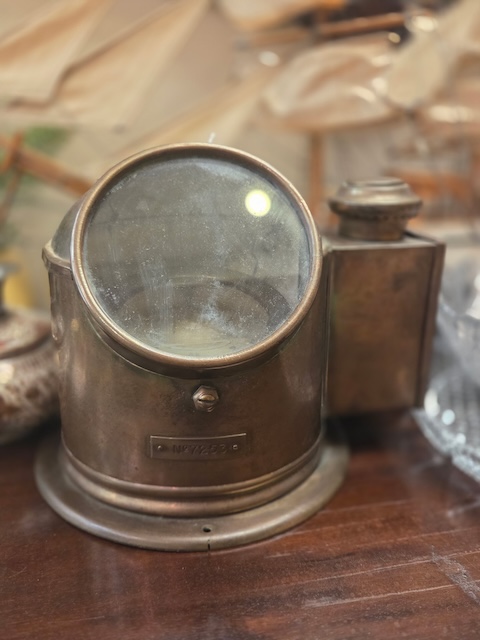
The Secondhand Sisters found a treasure in an antique maritime compass. Antique maritime compasses are fascinating artifacts that reflect the history and development of navigation at sea. These compasses often feature intricate designs and craftsmanship, showcasing the artistry of the period in which they were made.
Typically made from materials like brass, wood, and glass, some antique maritime compasses feature decorative engravings or inlays. The binnacle compass we have here is mounted on a pedestal, with a glass cover to protect it from the elements.
Just like a full-sized ship’s binnacle compass, its polarity can be adjusted for accuracy with self-contained corrector systems. The brass lid, when removed, is fastened to the binnacle base with a chain to prevent loss.
Who might have used this type of maritime compass? In the early 19th century, Captain James Cook, a renowned British explorer, set sail on his final voyage across the Pacific and would have used a similar compass, perhaps one handed down through his family. The compass, a symbol of adventure, guided him through treacherous storms and uncharted waters.
Cook would have relied on this type of compass in many instances, such as in dense fog that would have obscured both stars and the shoreline. Possibly trusting in its guidance, Cook navigated safely to the shores of what is now the Hawaiian Islands.
What ships did our compass navigate, and to what adventures did it lead sailors along the journey?
Please share your reflections with the other readers in the comments.
Treasures and Tales discovers that every object holds a story waiting to be told. Join us as we explore the possible stories behind the treasures we find.
Follow KnoxTNToday on Facebook and Instagram. Get all KnoxTNToday articles in one place with our Free Newsletter.

