
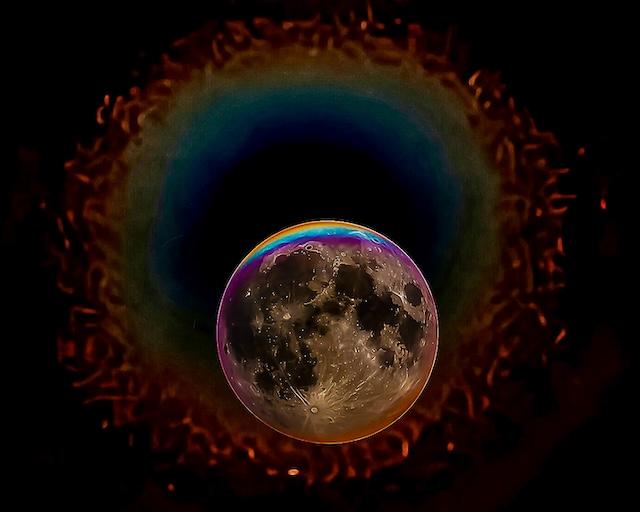
The passing of Dolly Parton on August 25, 2026, was the impetus for Badger’s initial iteration of The Dolly Moon, published in photo and prose last week in my regular column for KnoxTN Today. Little did Badger know that Dolly’s influence would extend to the partial lunar eclipse two days later. A sky portrait appeared in the heavens that night that rivaled any that I’ve seen in my years of photography.
From an elevation nearly a mile high at 5,197 feet, Badger set his camera on tripod and took numerous photos of the partial lunar eclipse from the Glassmine Falls Overlook on the Blue Ridge Parkway. The moon rose over the Asheville Watershed as the frame bearing the full moon was made at near maximum – when only a last bright sliver of the orb remained outside Earth’s umbra.
Please forgive the following technical interlude of how the atmosphere, sky, and shutter coalesced that evening in a fascinating way that left me staring at the frames long after they were made.
What the camera recorded was not the familiar 22° ice-crystal halo Badger originally believed. A tight ring of color wrapped the remaining sliver, and research confirmed, via the color and angle of the ring, that the phenomenon was indeed a lunar corona, the rarer of two similar but distinct night-sky optics.
Wispy clouds are commonplace above the watershed; on this night they ensconced the Moon at maximum. Thin water droplets in those clouds diffracted the moonlight. Blue bends less than red, so a small inner blue-green band formed with a slightly warmer ring just outside it. Fortunately, the uneclipsed sliver was still bright enough to light the droplets.
Fearing a lens or sensor artifact, Badger went back through the set of frames made near and at maximum. The same corona appears on numerous unedited files – same position, same colors, same ring appearing before any image processing ensued. After other trusted photographers concurred, that settled it for me.
The file was shot in RAW and eventually edited in Lightroom as is my usual custom. The main edit was denoising, as high-ISO grain sat on top of the midtones that already held the rings. The crop is tight on the Moon and the first two bands; except for minor tweaks to highlights and contrast, the rest of the frame was left virtually untouched.
My friend and disaster relief collaborator Sherrye Trice calls the image “Gaia’s Eye” – a coined metaphor that fits Dolly’s legacy. Gaia is the living Earth: soil, mountains, weather, the whole web of a place. For Dolly, that place was the Smokies – Locust Ridge, Sevier County, the cabin, the floods and fires, the people who stayed, and those in the Southern Appalachians whom she supported with her educational, philanthropic, and spiritual gifts.
Simplified, the mountains supplied the cloud. The eclipse supplied the light. The camera recorded both. Again, Badger was in the right place at the right time and another tribute to Dolly was composed in the ethereal Blue Ridge sky.
(Canon R6 Mark II · RF 24-105mm F4 at 105mm · ISO 800 · 0 EV · f/8 · 1/8 sec.)
Follow Honey Badger Hiking on Facebook for hiking adventures and trail discoveries.
See more of Thomas Mabry’s photography on Honey Badger Images.on Instagram.
Enjoyed this article and photography? Read more Thomas Mabry features on KnoxTNToday.
Follow KnoxTNToday on Facebook, Instagram, X, and LinkedIn. Get all KnoxTNToday articles in one place with our free newsletter. Comments may be sent to news@knoxtntoday.com.