As we continue to move toward our nation’s semiquincentennial, I’m still focusing on elements of the Revolutionary War effort of attaining independence and the related contributions and connections of families of the Fork, the Knox County lands between the French Broad and Holston Rivers.
Last week’s St. Patrick’s Day had me thinking about the Scots-Irish influence on our Appalachian culture. Did you know that British King George III, at times, actually called the Revolutionary War the “Scots-Irish Rebellion”? Yes, Scots-Irish men like Alexander McMillan, the subject of my last article, made up about half of those who fought for independence. Many of the forebears of the Fork were of Scots-Irish ancestry.
The Scots-Irish were descendants of the Lowland Scottish and Northern English families who had moved to Ulster in Northern Ireland in the 1600s. Their forefathers were known to have been “born fighting” in the border wars of Ireland, where they faced economic hardships, land scarcity, and religious discrimination. These Scots-Irish immigrants brought to America their distrust of elitist authority and their spirit of independence, which made them prime leaders of the Revolution.
Many immigrated to the American colonies on the coast, often first settling in Pennsylvania, Virginia, and the Carolinas. When the coastal towns wanted a buffer between them and the Native Americans who fought against encroachment, cheap land was offered on the frontier. The Scots-Irish were happy to go. Large numbers of them were drawn to the familiarity of the more mountainous western territories, which offered large landholdings and remote independence. They soon came through the Appalachian Mountains to what would become West Virginia, Kentucky, and Tennessee, among other areas.
In 1763, King George III issued a proclamation that prohibited settlement between the mountains and the Mississippi River, a region where the British government sent soldiers to fight the French and the Native Americans over land rights. Too late. The men who were already there as hunters, trappers, and general pioneers were called “Overmountain Men.” Before the Revolution, lots of them had actually fought alongside British soldiers in the French and Indian War, which was a costly financial endeavor.
When the British government decided to make the colonists help pay for their efforts at expansion, it imposed lots of tax laws. Many of the same men who had once helped to protect the frontier against the French and Native Americans turned their ire toward the British government and supported the Revolution.
After the war ended in 1783, states such as Virginia and North Carolina opened their western territories to grants, which were often made as payment for military service. Even more Scots-Irish were eager to settle on the frontier. Many continued to serve in the local militia to address conflicts with the Native Americans during the 1790s.
As Presbyterians, the Scots-Irish also believed strongly in education and were usually among the first to start schools wherever they settled. That’s how the first Lebanon-in-the-Fork Presbyterian Church minister Rev. Samuel Carrick’s seminary school led to the University of Tennessee. The Scots-Irish Armstrongs, Ramseys, Kennedys, and Campbells, too, all started schools in their individual Fork communities.
Scots-Irish women made great contributions to survival on the frontier by using local plants for home cures and being creative with their food resources, such as smoking and curing meats. They often carried the music ballads and were the storytellers who helped preserve the strong cultural elements of their society. Their essential crafts, such as hand-woven wool coverlets and linen, as well as other fiber arts, were crucial to daily life and are still celebrated in Appalachian culture today.
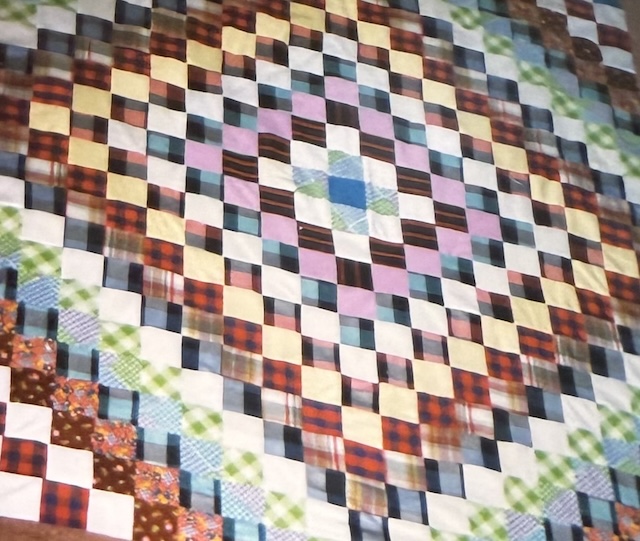
“Square World” quilt made with multiple Irish chain patterns
The Scots-Irish loved the “r” sound, which is why many Appalachians say “warsh” instead of “wash.” They also loved to end a word with the “e” sound, so “yesterday” sounds like “yesterdee.” If someone calls a bag a “poke,” we can thank the Scots-Irish, who also gave us the word “mess,” as in “I’ve got you a mess of greens in a poke.” And what good Appalachian doesn’t drop the “g” from words ending in “ing”? Thank the Scots-Irish. That’s also where we get the additional “a” before verbs that end in “ing.” If you say you’re “a goin’” somewhere or “a fixin’” to do something, or you “reckon” you “might could” or “used to could” do something, then you’re reflecting the Scots-Irish influence in our region, where much of their history has been forgotten in the Fork.
Jan Loveday Dickens is an educator, historian, and author of Forgotten in the Fork, a book about the Knox County lands between the French Broad and Holston Rivers, obtainable by emailing ForgottenInTheFork@gmail.com.
Follow KnoxTNToday on Facebook and Instagram. Get all KnoxTNToday articles in one place with our Free Newsletter.


I’m ‘fixing’ to read this delightful literary collectionagain!