It was during the Civil War, and residents of the Fork, the Knox County lands between the French Broad and Holston rivers, were floating goods by dark of night to Knoxville.
Knox County harness and saddle maker James A. Doughty had entered the war by trekking into Kentucky with about 300 other East Tennessee Union supporters to enlist in the Federal army a couple of years earlier. After rising through the ranks, he and his brother George W. were commissioned in the fall of 1863 to coordinate the gathering and transporting of forage and food supplies from the Fork and elsewhere along the French Broad. They were aiding in the relief of Union soldiers in Knoxville during the city’s Confederate siege that culminated in the Battle of Fort Sanders. Over two weeks, the Doughty brothers, their men, and the community members provided 10,000 bushels of corn, 6,000 bushels of wheat, along with bacon, lard, oats, and more, which were loaded at Bowman’s Ferry (later called Hodges Ferry), located just behind my house in Riverdale, and were covertly floated to Knoxville to feed General Burnside’s hungry troops.
Local Confederate sympathizers Dr. J.G.M. Ramsey, Capt. J.S. Boyd, Robert H. McNutt, and Gen. Joseph A. Brooks had met with General Longstreet and told him that his river blockades had not cut off the source of Union supplies because he was mistaken in his belief that the mouth of the French Broad was miles below Knoxville. However, he scoffed and refused to believe them, despite their lifetime familiarity with the area. Because Longstreet ignored their counsel, Brooks even concluded that Longstreet was traitorous in his concluding actions that resulted in Burnside’s men obtaining provisions. In addition to the nocturnal shipments obtained from the Fork via the French Broad, a pontoon bridge that stretched across the Tennessee River at Front Street also allowed additional precious supplies to be brought from South Knox County to sustain the Federal troops. A large chain stretched across the river to protect the bridge from being rammed. More about that in a minute.
On a recent research adventure, I made a new friend, Bill Alexander, who is also interested in local history, and I learned about his family’s legacy of dredging sand and lime sites along our rivers.
What’s Bill’s connection to my Civil War tale? I’ll get there.
When Bill joined me to look for the location of MacMillan’s Station near the north banks of the Holston River, we were stunned to find the remnants of an old stationary dredge, the type with a frame, boom, and clam bucket, probably something similar in construction to what his ancestor eventually had used on his boats all those years ago.
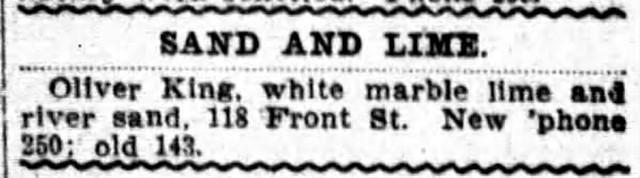
1899 ad for Oliver King Sand and Lime Company
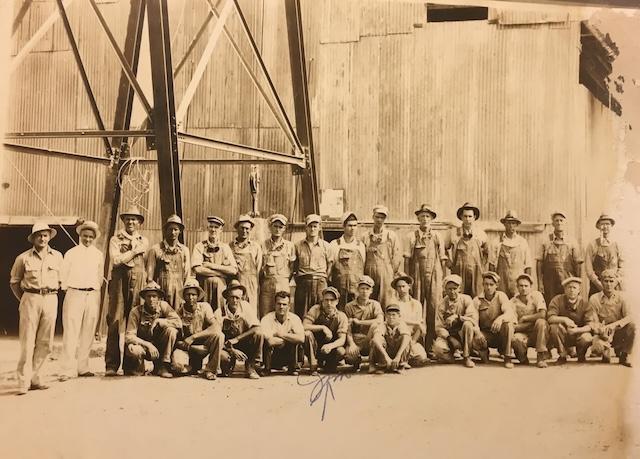
In the late 1800s and early 1900s, Bill’s great-grandfather, Oliver King, sold white marble sand and limestone from his Knoxville business at what is now Front Avenue. The company burned lime at its kiln just east of Knoxville near Cherry Street and sold sand and gravel, which were dredged from the French Broad and Holston rivers and transported on his barges and boats and in Packard trucks.
In 1884, King had started out gathering river silt with just one horse and a wagon, much like his father had done with a draying business. The next year, Oliver advanced to two horses, but in 1886, he added a barge, which he navigated by hand with poles, while using long-handled shovels to collect the sand. In 1888, with money won from racing his horse, Robert E. Lee, he built a steamboat. He then expanded into the excursion business and continued to add steamboats, while also hauling marble from the quarries in the Fork.
Here’s the connection. In 1962, almost 100 years after the Civil War’s end, King’s Sand and Lime company snagged the chain that had been stretched across the Tennessee to protect the Union’s pontoon bridge. After the chain and its anchor were dragged to shore, it was donated to the Confederate Memorial Hall on Kingston Pike.
-
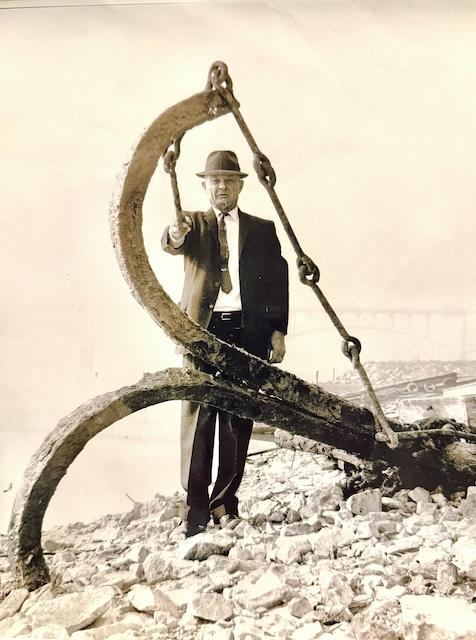
- Cyrus Alexander, with the anchor and chain found in the Tennessee River
-
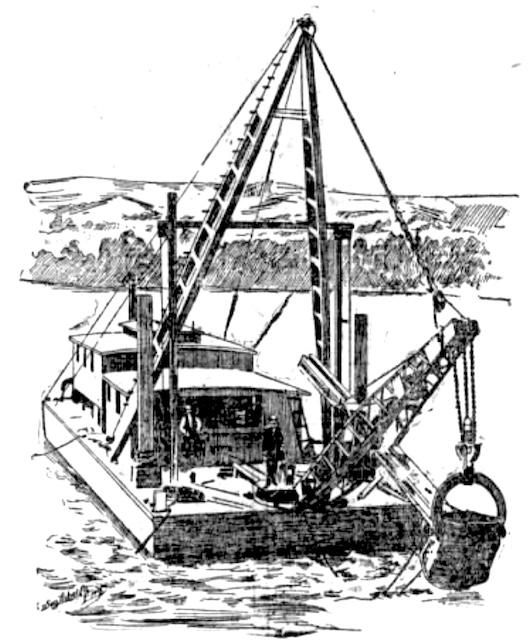
- \Early 1900s U.S. Army Corps of Engineers dredge boat named Kwasind, which was a Native American word for “strong man” used in Longfellow’s epic poem, “The Song of Hiawatha”
Bill Alexander said his grandfather Cyrus Alexander had worked for Oliver King and had married King’s daughter, Gladys. Fellow history adventurer and blacksmith Chase McSpadden, who has seen the artifact in person, explained that the anchor had been made from railroad rails and that the chains were hand-forged.
While many details of the Battle of Fort Sanders are preserved in multiple historic sites, the contributions made at Bowman’s Ferry have been forgotten in the Fork.
Jan Loveday Dickens is an educator, historian and author of Forgotten in the Fork, a book exploring the Knox County lands between the French Broad and Holston rivers. To obtain a copy, email ForgottenInTheFork@gmail.com.
Read more stories by Jan Loveday Dickens about the people, places and history of the Fork community, and learn more about her in her author bio on the same page.
Follow KnoxTNToday on Facebook, Instagram, X, LinkedIn and TikTok.
Get all KnoxTNToday articles in one place with our free newsletter. Comments may be sent to news@knoxtntoday.com.