
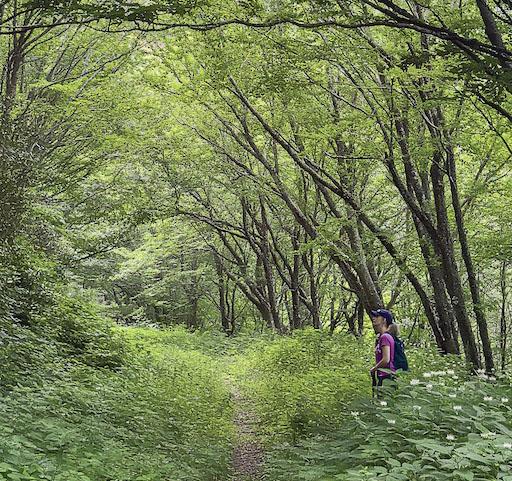
Rock Sprite Kitty Myers and the Badger recently went looking for evidence of Helene’s fury in the Pisgah National Forest. We found it in two massive landslide scars that look raw and gaping more than a year and a half after a rare but quintessential Southern Appalachian hurricane.
We named the first landslide Craggy 1 and the second Craggy 2. Craggy 1 is roughly 500 feet vertical and about 100 feet across. From the bottom it rises like a cliff of shattered rock and exposed earth as can be seen in the “Rock Sprite at the Rockface” photo. We looked at it, measured it with our eyes, and left it alone. Without ropes and climbing gear, we chose not to ascend as we also knew from Kitty’s research that another scar was further down the mountain.
Craggy 2 is in another league entirely – approximately 1050 feet of vertical relief and as much as 250 feet wide in places. The creek that the slide followed is normally only three to five feet wide. Now the channel is a broad, boulder-choked wound running straight down the mountain and then curving like a dogleg left following the original creek bed. That is the one we climbed.
We started up the debris field and kept going until the angle steepened to a 45 percent gradient. The scramble was Class 3 and sometimes Class 4 according to the Yosemite Decimal Scale (YDS) and was reminiscent of the loose, shifting rock and verticality of our famous Echo Canyon hike in the Black Canyon of the Gunnison. Due primarily to time constraints, we only climbed roughly 300 up Craggy 2 instead of the 1800 vertical feet of Echo Canyon. Nearly a continent apart, the verticality and the debris underfoot spoke the same language.
The ground underfoot was a shifting mix of angular rock and shattered stone that was seldom completely settled. Stepping up required testing, loading, and rebalancing as the surface tried to migrate downhill with us. Standing on that face, looking up at the remaining height and down at the chaos we had already crossed was enough. The degree of difficulty for Badger on the descent was nearly as high as the ascent!
-
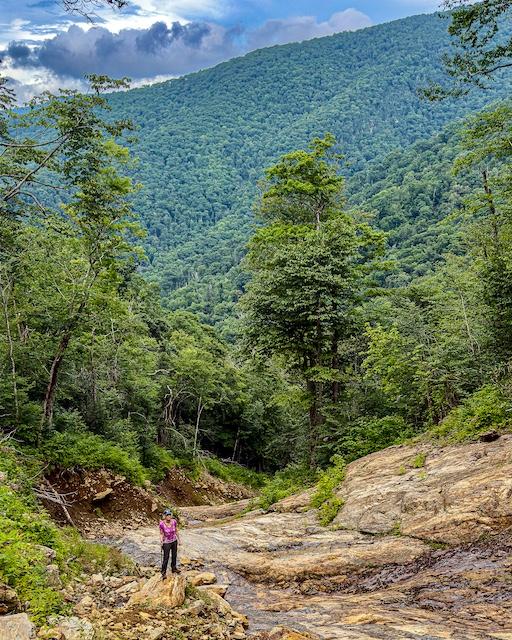
- Rock Sprite Kitty Myers descends the Craggy 2 Scar (photo by Thomas Mabry)
-
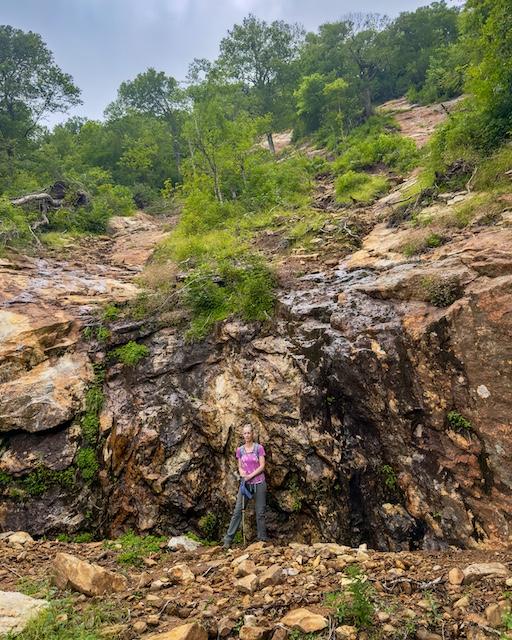
- Rock Sprite and Badger on the Craggy 2 Scar (photo by Thomas Mabry)
-
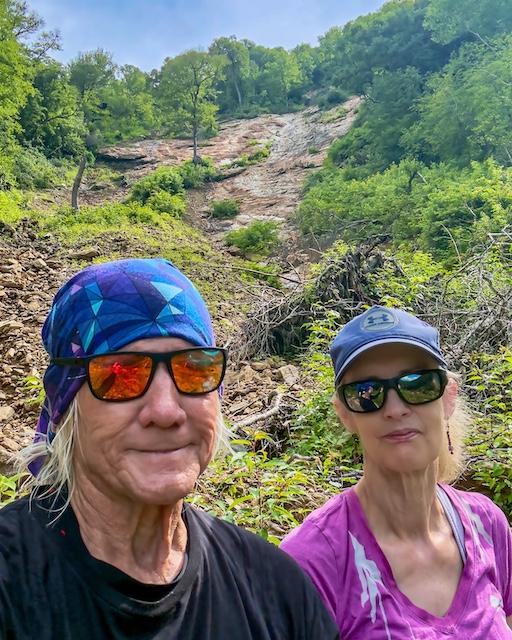
- Rock Sprite and Badger contemplate the Craggy 2 Climb (photo by Thomas Mabry)
Where we were standing is the residue of a Helene debris flow. In simple terms, Badger’s geologist experts say that a debris flow occurs when prolonged, intense rain saturates the soil and weathered rock on a steep slope until the water pressure between the particles overcomes the friction holding them together. The mass liquefies, picks up speed, and begins to move like wet concrete – a dense slurry of mud, rock, boulders, and trees. As it races down a drainage it scours the bed and banks, incorporating more material and growing larger. The original narrow creek becomes a wide, deeply scoured scar. When the slope finally lessens or the flow loses enough water, the whole mass stalls, leaving behind the unstable, angular debris field that we climbed.
The approach trails to the scars still felt like normal paths until they didn’t. One moment we were hiking under a green summer canopy; the next we stepped out onto open ground of broken stone and splintered timber. The scale is hard to photograph and harder to describe. Craggy 1 and 2 are not neat textbook landslides. They are chaotic, still settling, and remain very much alive.
Helene did not simply drop rain on these mountains. In places like this it rearranged them. The scars are reminders that the forest we walk through is not permanent scenery. It is a surface that can fail when the water and the weight align.
Kitty and I did not summit the big scar. We didn’t need to. Three hundred vertical feet of steep, unstable ground was sufficient education for one day. The mountain above still holds the high ground. We just wanted a closer look at the places where it let go on September 27, 2024.
Follow Honey Badger Hiking on Facebook for hiking adventures and trail discoveries.
See more of Thomas Mabry’s photography on Honey Badger Images.on Instagram.
Enjoyed this article and photography? Read more Thomas Mabry features on KnoxTNToday.
Follow KnoxTNToday on Facebook and Instagram and subscribe to our free newsletter to receive every new article in one convenient email.