
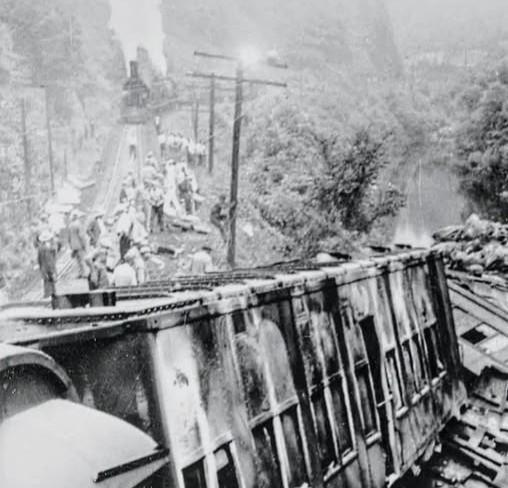
If you head north on I-75, about 45 minutes, take the Jellico exit just before crossing into Kentucky, then go east on 25-W a few miles, you’ll find a historical marker on the north side of the road overlooking the Clear Fork River. On the opposite bank lie the railroad tracks, presumably now owned by Norfolk Southern or CSX.
This area of Clear Fork, 82 years ago, was known as Highcliff and was the site of one of the worst stateside military disasters of World War II. There was no battle, there were no bombs nor acts of terrorism. Just a train clocking through a curve in a mountain pass faster than it should be and jumping the tracks to the ravine below.
The Louisville & Nashville Troop Train #47 was traveling from Indianapolis to North Carolina, carrying 1,000 new recruits to Army basic training. The locomotive was pulling 12 coaches and four kitchen/baggage cars when it left the tracks around 9 p.m. on Thursday, July 6, 1944. The engine and four of the Pullmans separated from the rest of the party and tumbled 50 feet or more down the ravine to the river below.
The first responders in this case were the people around Highcliff and Jellico. Despite the presence of the interstate, this is still a somewhat remote area now, and was more so back in 1944. Even still, old fashioned oil torches and smudge pots began to dot the landscape. Eventually emergency flood lights came in.
Doctors, nurses and volunteers arrived from the surrounding area, including Knoxville. Soldiers stationed in Oak Ridge were dispatched. Ropes were sent down both sides of the gorge as most of it is too steep to climb unaided. Those who somehow survived the crash without serious wounds hauled themselves up. Then came the painstaking task of hauling up the wounded and deceased, which could take 10 men to pull one on a rope sling stretcher up the cliff.
Doctors and nurses descended into the crumpled Pullmans to administer plasma and other aid to wounded survivors trapped in the wreckage. By daybreak on July 7, most of the survivors had been extricated. By 11 a.m. there were only a handful still needing to be freed. A joint taskforce of Army intelligence, the Knoxville office of the FBI and officials from L&N was quickly convened to investigate the cause of the accident. While eventually ruled an accident, the country was in wartime, and in the immediate aftermath sabotage had to be ruled out.
Engineer John C. Rollins, of Etowah, had taken over the helm in Corbin, Kentucky. He was found dead, wedged in his cab, his watch still ticking. Fireman J.W. Tummins, also of Etowah, initially, somehow, survived the crash. Whether he jumped or was just thrown from the engine is unclear, but he was found near the water’s edge, grievously scalded. He was taken to Jellico Hospital, but ultimately succumbed to his injuries. But before he died, he uttered the words immortalized on that plaque: She jumped the tracks. The wreck claimed the lives of 33 and injured 99.
Source: Knoxville Journal digital archives, Tennessee State Library and Archives
Beth Kinnane writes a history feature for KnoxTNToday.com. It’s published each Tuesday and is one of our best-read features.
Enjoyed this article? Read more of Beth Kinnane’s stories about the people, places, and history that make our community unique.
Follow KnoxTNToday on Facebook, Instagram, X, and LinkedIn. Get all KnoxTNToday articles in one place with our free newsletter. Comments may be sent to news@knoxtntoday.com.




Thanks for the article Ms. Kinnane. I hadn’t heard about the Clear Fork wreck.
There is a similar historical marker, just off White Bridge Road in west Nashville, about a train wreck there at Dutchman’s Curve, 26 years before Clear Fork almost to the day, on July 9, 1918. A westbound train that had just left Nashville’s Union Station and traveling at an estimated 50 mph collided head on with an eastbound train from Memphis, moving a an estimated at 60 mph. The official death toll was 101, and it is considered the worst train wreck in U.S. history. It occurred during the First World War but rather than soldiers, the eastbound train carried workers headed to work at the gunpowder plant in Nashville.
https://en.wikipedia.org/wiki/Great_Train_Wreck_of_1918
And then there was the Waverly, TN disaster 1978, when a propane tanker on a derailed train exploded, killing 16 and injuring 43 others. https://en.wikipedia.org/wiki/Waverly,_Tennessee,_tank_car_explosion
We’ve had more than our share of train disasters in Tennessee.
Thank you for the addition to the story.
As a child, my family had relatives that lived in Jellico. Enjoyed visiting with them but did not enjoy the trip there and back. Daddy always made sure we left in time to get down the mountain before dark.
Yes, and it still a good idea to get back down the mountain before dark and not when there is a chance of rain or snow.
Here’s another story of a train wreck — a personal story centered on a Knoxville engineer and his wife who had a unique way of communicating as he left and returned each day.
On August 12, 1909 Southern Railway Engineer Samuel R. Bush blew the whistle as his engine left the city at the Park Avenue bridge near his home on Park Avenue. A series of low, soft blasts signaled to his family that he was leaving the city on his daily run north toward Bristol. Loud blasts would announce his return later in the day.
But on that fateful Thursday, there would be no return blasts for his family to hear. His engine left the tracks between Mohawk and Midway in Greene County and the well-liked and popular engineer lost his life from the results of the crash.
My good friend, Bo, and I just happened onto his unique grave marker today. It was nestled on the hillside near the back of Greenwood Cemetery off Tazewell Pike…our random journey on a cold January nearly 113 years after his death led us to the remarkable story.
In spite of his suffering from a broken thigh, bruises over the head and body and scalds caused by hot water and steam from his engine, not a murmur of complaint was heard from the wounded engineer from the time he was removed from the wreckage until his death the following day.
Engineer Bush remained with is engine as it left the tracks and rode the cross ties. He then applied the emergency brakes to all the cars and thus slowed the train and saved dozens of passengers’ lives.
Born in Virginia, Bush was very popular with railway men and the officials of the road and for many years had been considered one of the most careful and safe engineers in the Southern system.
Today, a large tree wraps its roots around the engineer’s grave marker as if to hold him safe. He refused a flask of whiskey to ease his pain. On the Bush family marker which has an engraving of an engine on it are his last words to four men whom he had asked smell his breath to verify that he was not drinking.
“Let me have one more look at my Engine”
“All an engineer has is his record.”
“Against his record he cannot afford to let anything stand..”
It was a remarkable find on a sunny day in January..
As always, have a wonderful day.
https://davescreations.weebly.com/he-never-returned.html for the story
https://davescreations.weebly.com
Fascinating story! I lived in nearby Williamsburg for five years but never heard of this incident, though I sometimes travelled through that area of 25-W when the interstate was shut down. I can certainly see how it happened. Such a tragedy!