As we continue to move toward our nation’s semiquincentennial, I’m still focusing on elements of the Revolutionary War effort of attaining independence and the related contributions and connections of families of the Fork, the Knox County lands between the French Broad and Holston Rivers.
I’ve written before about the residents of Revolutionary War veteran Alexander Campbell’s house, but this connection takes us in a different direction.
I can’t always verify information beyond indicated conclusions, and I don’t always have access to the records that others reference. That’s frustrating. I can only hope my articles serve as a springboard for those who can dig a little deeper. However, none of the family lines seems to doubt the following information.
Wilhelm (“William”) Ulrich (“Ullery” or “Woolery”) Keener is said to have come to Pennsylvania with other family members in 1727. Ulrich’s 1784 will appears to indicate that he and his wife Anna Elizabeth had a son named Peter, among other children. Ulrich bought land in Shenandoah Valley, Virginia, in 1750, the year Peter Keener is believed to have been born, making Peter in his mid-twenties when the Revolution began. Records from the Daughters of the American Revolution state that Peter Keener was a drummer during the Revolution.
Concerning an inquiry about Peter Keener’s “patent for land in Mercer County, PA,” that was divided in 1836, a 1940 letter from the government states, “There is no record for pension or bounty land on file based upon service in the Revolution for Peter Keener.” It further suggests that the inquiry be sent to the Adjutant General of the War Department. Maybe that’s where the supportive details were located. I don’t know. While I found several other Keeners (Bostian, Christian, John, Joseph, etc.) with military records for Pennsylvania and Virginia, Richard Keener’s service as a drummer in Virginia’s 1st, 10th, and 14th Regiments throughout the war is well documented. Is Richard Keener the same person as Peter Keener?
What was the role of a drummer during the American Revolution? Despite the fact that members of the Fife and Drum Corps were usually only in their teens or early twenties, they were vital elements of communication. Their instruments could be heard much more easily than voice commands over the din of battle, so they used specific rhythms to relay the maneuvers called by officers to soldiers. When not drumming the call to load weapons, volley, retreat, or march, etc., they might also help to transport the wounded off the field or carry messages between military units. Away from battle, they sounded the alarm to wake up, have a meal, perform duties, or go to bed.
I did find Peter Keener’s 1792 military records as a private in the mounted infantry of the Knox Regiment under Captain James Cosby, “called into service for the protection of the frontiers of Washington District in the Territory South of the River Ohio.” That’s what this area was called before it became the state of Tennessee in 1796. Those guys were usually in pursuit of the Native Americans with whom the settlers fought over land rights. Even though the War for Independence ended in 1783, that kind of conflict was a continuation of the violence that began during the early years of the Revolution, when the British encouraged Native American attacks upon the frontiersmen. Additional records for Peter Keener include similar service under Captains Thomas Gillespie and Joseph Tedford and Commander James White in the Hamilton District Militia in our territory in 1794, often for a month at a time.
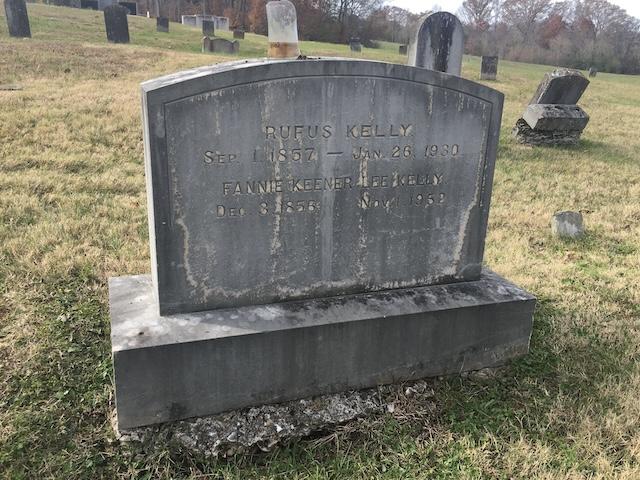
Marker for Peter’s descendant Rufus Kelly and wife Fannie, whose grandson “J.B.” Kelly’s descendants still own the Alexander Campbell house in the Fork.
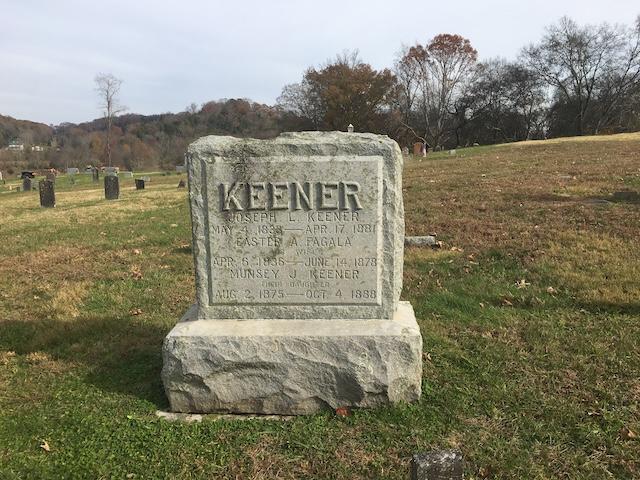
An early settler here along the French Broad in the late 1700s, Peter Keener established his two-story log home on 243 acres on the south bank at Seven Islands, where he built a mill that also served the Fork side of the river. He died at age 87 on September 17, 1837. His and his wife Susannah’s offspring married into the Huffaker, Randles, Johnson, Davis, and other families, and their great-granddaughter, Fannie Lee Keener, married Rufus Kelly of Kelly Bend (now the 7 Islands State Birding Park) in the Fork. Fannie and Rufus’s grandson, “J.B.” Kelly, bought the Alexander Campbell house in 1950. Although the Kelly descendants still own the home, for many local residents, Peter Keener’s connection to that family has been forgotten in the Fork.
Jan Loveday Dickens is an educator, historian, and author of Forgotten in the Fork, a book about the Knox County lands between the French Broad and Holston Rivers, obtainable by emailing ForgottenInTheFork@gmail.com.
Follow KnoxTNToday on Facebook and Instagram. Get all KnoxTNToday articles in one place with our Free Newsletter.


Thank you for your interesting research! Knowing this helps us understand and appreciate our area so much more!
Your words mean so much to me! Thank you.