
Now that the Olympics are over, it’s time to look back on some Olympic history, specifically, 78 years ago. Imagine a time when a perfectly placed municipal park or a visionary city layout could earn you a standing ovation on the Olympic podium. Between 1928 and 1948, the “Pentathlon of the Muses” was a real thing, and the fiercest competitors weren’t just sprinters—they were town planners.
During the Olympic Games, we’re used to seeing the medal podium occupied by skaters, skiers, hockey players, and gymnasts who can do physics in midair while smiling at the judges. For a quirky stretch of modern Olympic history, there was another kind of champion. This event was not won with a stopwatch, but with blueprints.
Baron Pierre de Coubertin, the father of the modern games, was a bit of a romantic. He believed a true Olympian should be as handy with a blueprint as they were with skis. He wanted a marriage of “muscle and mind. ” Alongside the athleticism of the stadium, the Olympics awarded medals in five artistic categories: architecture, literature, music, painting, and sculpture.
In 1928, the IOC decided “Architecture” was too broad, so they and split it into two: one for specific buildings and a second for “Town Planning.” In Amsterdam that year, the Dutch architect Jan Wils won the gold for the very stadium in which the athletes were competing. It was the ultimate home-field advantage: he didn’t just play in the venue; he was the venue.
However, the 1936 Berlin Games—the “Nazi Olympics”—proved that town planning could be as politically charged as any event. While Jesse Owens was shattering records, an American landscape architect named Charles Downing Lay was securing the United States’ first medal of the Games. His event was the design for Marine Park in Brooklyn.
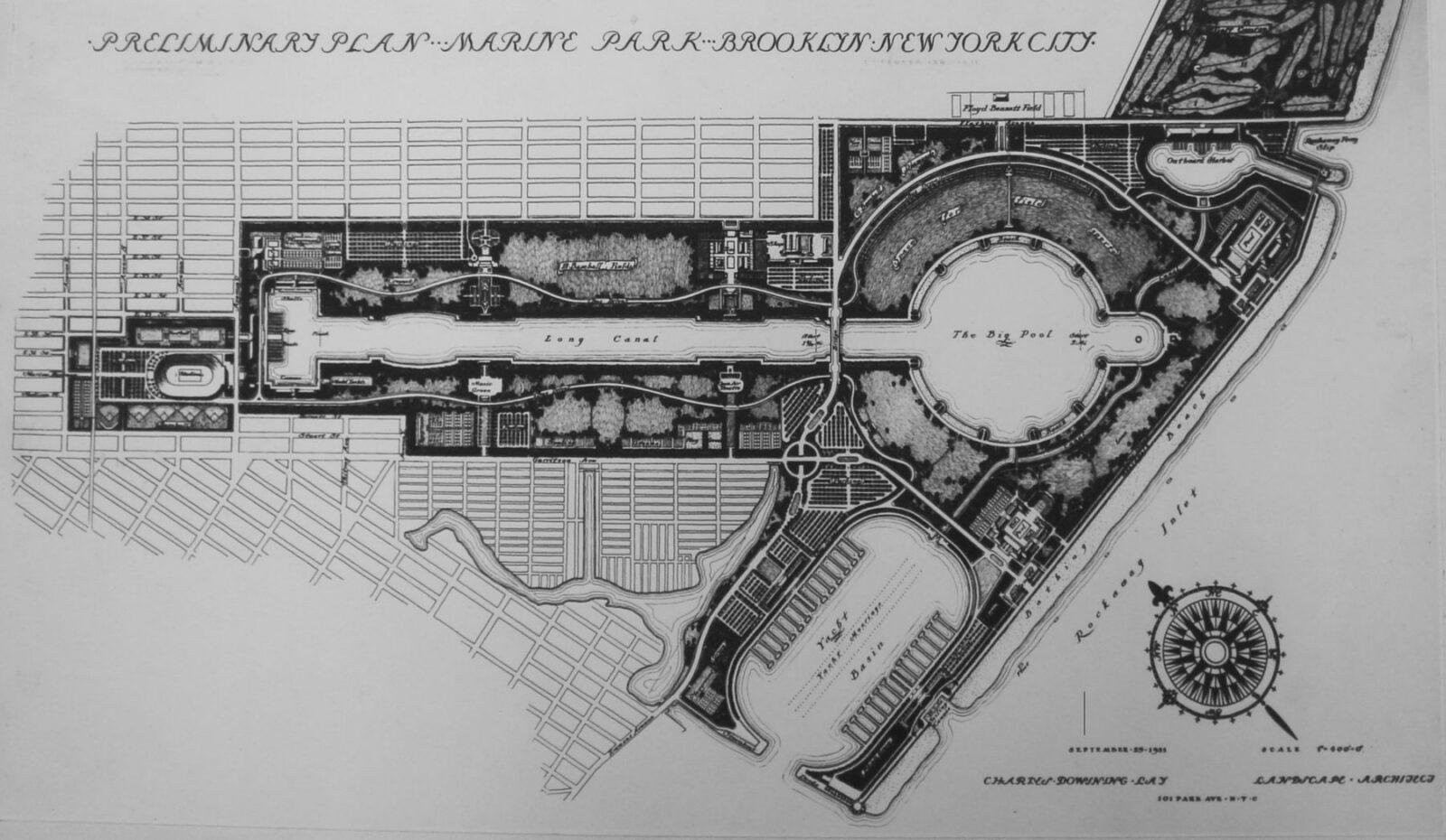
Charles Downing Lay’s designs for Marine Park in Brooklyn
Lay’s vision was a 1,500-acre “People’s Park,” larger than Central and Prospect Parks combined, featuring a yacht basin and a 125,000-seat stadium. He took home the silver, finishing behind the German brothers Werner and Walter March, who won gold for the Reich Sport Field. Some historians whisper that Lay’s silver was no accident; his design mirrored the symmetrical, formal “Volksparks” popular in Germany at the time, winning over the heavily biased local judges.
In Brooklyn, the “Silver Medal Park” faced a formidable opponent: Robert Moses. The legendary “Power Broker” of New York dismissed Lay’s $50 million dream as a “grandiose” waste of money. Moses shelved the Olympic blueprints, hired his own firm, and opted for a more modest layout. Today, Marine Park stands as a beautiful green space, but the Olympic-sized yacht basin remains a ghost in a filing cabinet.
By the 1948 London Games, the Muses were losing their puff. The biggest hurdle was the IOC’s obsession with “amateurism.” While a runner could be disqualified for accepting a free pair of shoes, it was nearly impossible to find a world-class town planner who wasn’t a professional. The IOC eventually decided these artists were “pros” who might use their medals to drum up business—a scandalous thought for a committee that now manages billions in broadcast rights. How ironic.
The final gold for Town Planning went to Finland’s Yrjö Lindegren in 1948. After that, the artists were not allowed to compete.
Today, we might not need medals for urban zoning, but in an age of concrete jungles, perhaps we could use a little more of that old Olympic spirit in our city halls. After all, who wouldn’t want to live in a town that’s officially “Gold Medal” standard?
If this had continued, imagine the medal ceremony: no national anthem swelling over a championship hockey team, but instead a city planner standing proudly while someone unfurls a rendering of a municipal park.
Melanie Staten is a public relations consultant.
Follow KnoxTNToday on Facebook and Instagram. Get all KnoxTNToday articles in one place with our Free Newsletter.
Send your news and notes of community interest to send news@knoxtntoday.com.

