Let’s get back to the forty-plus diaries of Dr. Swancey Kennedy (1844-1923), who served as a late 1800s physician in the Fork, the lands between the French Broad and Holston rivers in Knox County.
A couple of the Psalms include the admonition to “make a joyful noise unto the Lord,” which is about all I can do. I certainly could have benefited from the “singing schools,” which evidently became popular in the early 1800s and once were heavily advertised by Knoxville papers. The schools often consisted of 10 to 20 lessons or lasted from a few days to two weeks, usually culminating in a concert or demonstration event for the general public at the various churches where the lessons were held.
Some singing schools were offered specifically for children at the cost of $1.50 for 24 lessons and used the book, The Young Melodist. Other classes were free to young women on Saturday mornings. A few in Knoxville before the Civil War were led by Miss F.M. Clark and Henry M. Butler.
One particular demonstration concert in Knoxville was held at Butler’s Seminary, which promised comfortable seating for 300 to 400 attendees at 23 cents per adult and 15 cents per child. Folks could ride in Mr. Coleman’s omnibus, a large, horse-drawn public carriage available on Gay Street, to and from the event.
In January of 1888, Dr. Kennedy wrote in his diary that he took his children to nearby Salem Seceder Presbyterian on Wayland Road to attend singing school. Perhaps it was led by Professor James E. Bassett of Strawberry Plains, a minister who is known to have taught singing later at Salem in 1899 and also taught at Asbury and other nearby locations in the Fork. Dr. Kennedy made additional references to attending various singing schools at Salem and elsewhere.
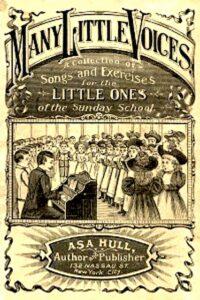
Singing school songbook used for children in the late 1800s
Another instructor who led classes at Salem was Professor John C. Wilson of Hampden-Sydney, one of the nation’s oldest all-male colleges, having been established in 1775. Wilson, who was from Blount County, provided instruction at several area churches and sometimes had at least 300 in attendance. Others who taught local singing schools were A.E. Sherrod, N. Fagan, Wade Gentry, and George W. Henry.
Materials used in these sessions included song books such The Song Monarch, The Leader, and The Standard by Horatio Richard Palmer and Luther Orlando Emerson or Sparkling Rubies by Asa Hull and Harry Sanders, as well as Singing School and Encore by William Oscar Perkins, all of which were sold by W.F. Cummins Music Emporium at 47 Gay Street. The manuals included “exercises, rounds, and glees” for the singers, along with instrumental music and interludes for their accompaniment.
Years earlier, in 1847, a singing school in Grainger County had celebrated Independence Day by positioning male members of three Singing Societies at various stations a quarter mile from the church at Buffalo Creek. As an initial part of the service, the men marched forward to the church as they sang a hymn of praise, and at least 1,500 citizens were in attendance that day. Can you imagine?
One of the funniest articles I read related to singing schools was an 1847 account of a curious person who passed by a church during a lesson and decided to observe for a minute. Upon hearing the scale exercises that he heard as, “Dough me! See me! Seelah! Ray me!”, he concluded they were learning to sing in Cherokee!
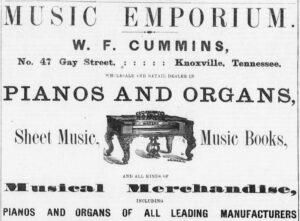
1875 ad for a Knoxville music dealer
By the 1890s, singing schools were being referred to as “old-timey,” and they seemed to slowly disappear by the early 1920s, when music classes were beginning to be integrated into public school curriculum. As elsewhere, singing schools eventually were forgotten in the Fork.
Jan Loveday Dickens is an educator, historian and author of Forgotten in the Fork, a book exploring the Knox County lands between the French Broad and Holston rivers. To obtain a copy, email ForgottenInTheFork@gmail.com.
Read more stories by Jan Loveday Dickens about the people, places and history of the Fork community, and learn more about her in her author bio on the same page.
Follow KnoxTNToday on Facebook, Instagram, X, LinkedIn and TikTok.
Get all KnoxTNToday articles in one place with our free newsletter. Comments may be sent to news@knoxtntoday.com.