
Imagine being 6 years old and having school close for two weeks so you could help your family make sorghum syrup. For Mark Guenther, that wasn’t a childhood fantasy. It was part of growing up in an Appalachian community where making sorghum was as much about family and tradition as it was about putting something sweet on the table.
“When I was 6 years old and it was Sorghum making time, I had to go to school. I wanted to stay there and help make Sorghum,” Guenther recalled. “Thankfully, they closed school for 2 weeks for us to help make Sorghum and spend time with family at the Sorghum Mill.”
It was a private community school, and the experience helped shape a lifelong commitment to preserving an Appalachian tradition.
Today, Mark and his wife, Sherry, of Muddy Pond Sorghum, continue sharing that heritage through demonstrations that show visitors how sorghum cane becomes the rich, distinctive syrup once found on nearly every mountain family’s table.
The couple will demonstrate traditional sorghum making Oct. 23–25 at the Great Smokies Welcome Center in Townsend, giving visitors a chance to see the process firsthand.
A lifetime in the cane fields
Mark has been involved in sorghum making for 57 years, beginning before he was old enough to understand the work going on around him.
“I remember well being a toddler, and being in the cane field while stripping and cutting cane was going on,” he said. “So, I grew up around it.”
For generations, sorghum was an essential part of Appalachian life. Mountain families needed a dependable sweetener, and sorghum cane could be grown in about four months, compared with the year required to grow sugar cane.
Growing their own cane allowed families to produce syrup without depending on commercially produced sugar.
From field to syrup
Mark describes the traditional process as one requiring hard work, patience and a dependable mule.
A field of sorghum cane looks much like a cornfield. Harvesting begins with stripping leaves from the stalks, often using a narrow stick or piece of metal. The stalks are then cut with a machete or tobacco drawknife, and the seed heads are removed.
Nothing needed to go to waste. The seed heads could be fed to mules, milk cows or chickens.
Mark remembers taking mules and a wagon into the field to gather the cane and haul it to the mill.
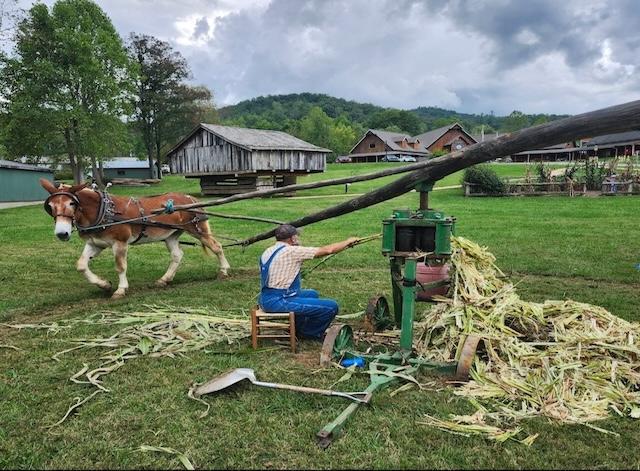
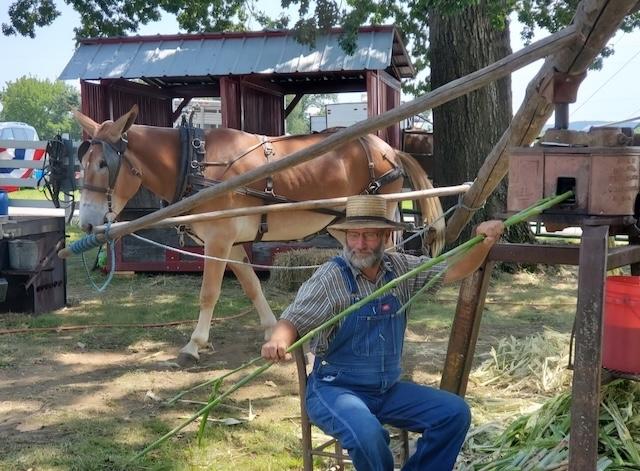
“I would then unhitch my mules from the wagon and hitch them to the cane press,” he explained. “As the mule walks around in circles turning the cane press, the rollers in the press turn and squeeze the juice out of the cane.”
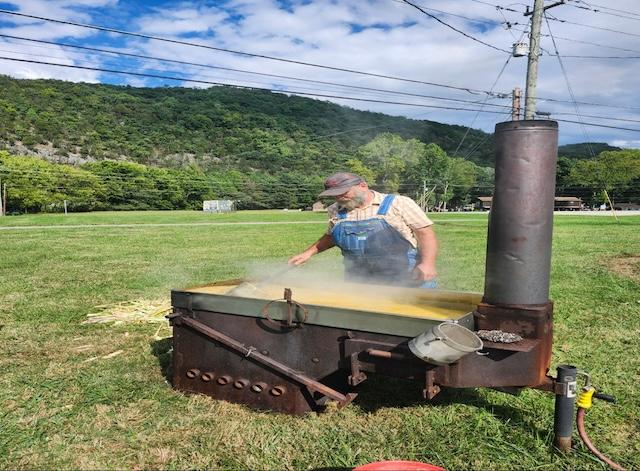
The extracted juice is boiled in a long pan until it becomes sorghum syrup.
Visitors are often surprised by two things: the amount of juice produced by the cane and the remarkable obedience of Mark’s mules.
Tradition meets modern equipment
Although the Guenthers demonstrate the old-fashioned method, their family operation has also adapted to modern production.
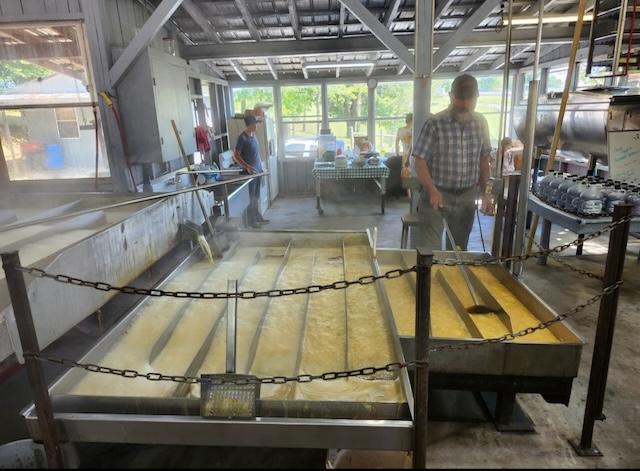
They now use a machine they built themselves, pulled behind a tractor, to harvest the cane and extract the juice. The juice is pumped into a tank and taken to the sorghum mill, where it is preheated overnight.
Their production equipment includes a cooking pan measuring 23 feet long and 8 feet wide, with internal baffles. A wood-fired steam locomotive boiler provides the steam heat used to turn the juice into syrup.
But modern equipment hasn’t diminished Mark’s appreciation for the traditions he learned as a child.
“It is important to pass the skills of making Sorghum Syrup to the younger generation because they need to know how their ancestors survived and made their own food,” he said.
“The making of Sorghum Syrup is a tradition that should be carried on.”
Sorghum isn’t molasses
Mark wants people to understand one important distinction: Sorghum syrup and molasses are not the same thing.
Molasses is a byproduct of making sugar from sugar cane. Sorghum syrup, on the other hand, is made by cooking the juice extracted from sorghum cane.
“Sorghum Syrup has a very earthy, distinctive taste of its own,” Mark explained.
And while many Southerners enjoy sorghum on biscuits, Mark has a favorite combination that might surprise even the most adventurous eaters.
His signature dish is a sorghum tomato sandwich.
He starts with toasted bread, pours sorghum syrup over it and lets the syrup soak in. Then he adds peanut butter, sliced tomato, Miracle Whip, salt and pepper.
He also enjoys using sorghum syrup to sweeten tomato juice.
It might sound unusual, but after 57 years around sorghum, Mark has certainly earned the right to experiment.
Keeping Appalachian history alive
During their demonstrations, Mark and Sherry explain how mountain families grew patches of sorghum cane, pressed the stalks and cooked the juice into syrup.
Visitors can watch the mule turn the cane mill and see Mark boil the extracted juice into syrup while learning about the importance of sorghum in mountain life.
For the Guenthers, the demonstrations are more than a chance to show off an old skill. They are an opportunity to preserve the ingenuity, resourcefulness and family connections that helped earlier generations survive.
And somewhere along the way, visitors may discover that a little sweetness can carry a great deal of history.
See the tradition firsthand: Mark and Sherry Guenther will demonstrate sorghum making Oct. 23–25, 2026, at the Great Smokies Welcome Center, 7929 E. Lamar Alexander Parkway in Townsend. Admission is free. Visit Muddy Pond Sorghum to learn more about the family operation.
Follow KnoxTNToday on Facebook, Instagram, X, LinkedIn and TikTok. Get all KnoxTNToday articles in one place with our free newsletter. Comments may be sent to news@knoxtntoday.com.