
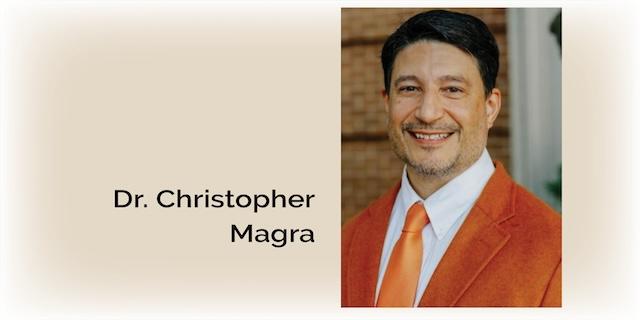
If you missed Dr. Chris Magra’s lecture at Blount Mansion, plan to attend his next one on Monday, March 23, 7 p.m. at the Clayton Center for the Arts on the Maryville College Campus.
The Watauga Association, as it came to be known, will be the subject of the third and final talk in the ongoing Witherspoon Lecture Series, delivered by Dr. Christopher Magra, a professor of early American history at the University of Tennessee-Knoxville and director of the Center for the Study of Tennesseans and War.
“The 1772 Watauga Association represents the first constitutional government formed by American-born settlers independent of British authority,” said Magra, who will deliver his lecture — titled “Wataugan Self-Governance: The Trans-Appalachian South and the Declaration of Independence, 1763-1776” — on Monday, March 23, in “As we approach the 250th anniversary of the American Revolution, Watauga matters because it demonstrates that the spirit of independence did not flow outward from the Continental Congress in Philadelphia,” Magra added. “The Spirit of 1776 was everywhere, even in the foothills of the Appalachian Mountains.”
“I was drawn to this subject by the sheer audacity of the Wataugans,” Magra said. “These were individuals who crossed the Proclamation Line of 1763 — illegally, in the eyes of the Crown — and had to establish a political system from scratch to avoid total anarchy.
“Watauga reflected the broader colonial frustration with distant, unresponsive government. However, they shaped the Revolution by forcing Founding Fathers to deal with westward expansion and government protection for settlers.”
“The Wataugans leased land from the Cherokee (specifically Attakullakulla), a move that (Cherokee) traditionalists like Dragging Canoe saw as a betrayal of their heritage. Today, we must understand this as a foundational moment of displacement that shaped the next century of American-Indigenous relations.”
Not that the Wataugans were in a constant state of warfare with the Cherokee; while skirmishes with Native Americans made for exciting frontier stories, everyday life was much more complicated, Magra said.
“At a time when many feel disconnected from governance, Watauga reminds East Tennesseans that our ancestors were among the first to demand a seat at the table,” he said. “It provides a sense of place in the larger American story that is often overlooked in national textbooks. Scholarship shouldn’t live in a silo. By bringing the Watauga story to a public forum, we bridge the gap between archival research and local pride.
“I want people to leave (the lecture) understanding that the frontier is not just a place on a map, but a state of mind. You don’t need a Ph.D. to appreciate that the roots of American democracy are buried in the soil of the Watauga River valley.”
Maryville College is a nationally ranked institution of higher learning and one of America’s oldest colleges, located in Maryville, Tennessee, between the Great Smoky Mountains National Park and the city of Knoxville. Maryville College offers more than 60 majors, seven pre-professional programs and career preparation from their first day on campus to their last, in the words of our Presbyterian founder, to “do good on the largest possible scale.”
Karen Eldridge, Executive Director of Communications: karen.eldridge@maryvillecollege.edu.
Follow KnoxTNToday on Facebook and Instagram. Get all KnoxTNToday articles in one place with our Free Newsletter.

