

Today, we continue the saga of William Henderlight, whose dramatic story I introduced in last Tuesday’s article. As established, William Henderlight was a wanted man who fished during the day but at night was said to have terrorized the people of the Fork, the Knox County lands between the French Broad and Holston rivers.

The scene of the shootout: the Fork bluff where Henderlight moored his boat on the Holston (with appreciation expressed to Martha and John Nicely for their assistance in locating it)
When I left off from the tale, William Henderlight and his live-in young cook, Hilda Parker, had been seized in a gunfight on the Holston and taken to the Knoxville jail in May of 1875. Henderlight reportedly had vowed to kill his captors, which included Sheriff M.D. Swan and Deputies James W. Bailey and William C. McCammon, along with posse members B.F. Badget, James Rhea, H.H. Holden, Cole Nelson, F. Gibbs, and two others.
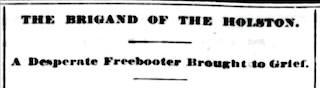
1875 “Brigand” newspaper header about Henderlight
However, J.M. Luttrell provided another side to the account. He wrote to the newspaper and told how Henderlight was simply a peaceful river man who fished and trapped on the Holston waters and kept his boat anchored near the bluff where he had access to firewood and shelter. According to Luttrell’s statement, Henderlight had even been providing free ferry transportation to the public and could have been arrested by any one man at any point in time during the five months he had been fishing there. Luttrell, who lived in the Fork and nearby the Holston, had never heard anyone accuse Henderlight of anything troublesome. He ended his defense of the fisherman by saying, “History teaches us that thousands of men have been judicially murdered because they were condemned before they were tried.”
Just a few days after his arrest, William Henderlight himself visited the office of Knoxville’s Daily Press and Herald and wanted to talk about what had been printed about the incident. He stood with his gunshot hand in a sling and was described as having a “quiet, frank, and open countenance.” He went on to tell how he was an honest fisherman and produce dealer, who actually came to Knoxville often. He told that though he had appeared in court and paid a $75 fine for having a concealed pistol and a woman on his boat, the only other gun he had was an old musket, a far cry from the reported arsenal. He was cordial, but he informed the writer that the posse that had shot and arrested him had been totally unnecessary and that he was going to bring a suit against them all. His bond had been paid by upstanding citizens.
Amazingly, another account of his escapades was printed just a few months later in December of 1875. It told how he had been arrested in Hawkins County for abducting a young girl, presumably Hilda Parker, during his wife’s lifetime. After his wife died, he married Hilda. But while he was in jail, he and a couple of other inmates were said to have attempted to escape by taking the iron hooks from a water bucket, heating them in the stove that was in their cell, and then burning off the rivets that secured some planks surrounding their cage. It was the jingling, heavy watch chain Henderlight wore that alerted his keepers of their movements.
He was eventually released, because the next coverage I can find of him is from January of 1879, when his small skiff was caught among ice and driftwood on the Holston and he was observed trying to free it. The next thing witnesses saw was the skiff floating freely and unoccupied below Armstrong’s Island. His brother initiated a search, and others joined in. They didn’t find the fisherman and concluded that he had perished.
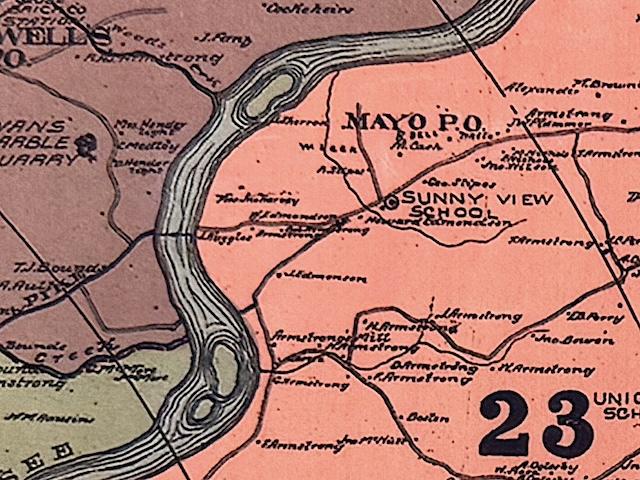
But he survived. He told how he had managed to secure himself in a tree sticking up above the waters and had spent Sunday night and Monday morning calling for help and waiting and hoping for rescue. When none came, he finally made it to the island on his own.
A few months later, a young fisherman named John Nursery, who had been seen fishing from a canoe on the Holston, went missing. When his empty canoe was later found in the waist-deep water, he was assumed to have gone to sleep and to have fallen overboard after fishing all night. His body was recovered by William Henderlight.
In 1885 and 1886, William Henderlight was charged with being in “violation of the internal revenue law,” which often applied to moonshiners who “illegally distilled spirits to avoid excise taxes.” He was found “not guilty.” Was he really a desperado, or just a misunderstood fisherman? Many of the facts about this citizen who was accused of terrorizing the Knox County lands between the rivers might never be known, for the truth has been forgotten in the Fork.
Jan Loveday Dickens is an educator, historian, and author of Forgotten in the Fork, a book about the Knox County lands between the French Broad and Holston Rivers, obtainable by emailing ForgottenInTheFork@gmail.com.
Enjoyed this article? Read more of Jan Loveday Dickens’s stories about the people, places, and history that make the Fork community unique.
Follow KnoxTNToday on Facebook, Instagram, X, LinkedIn and TikTok
Get all KnoxTNToday articles in one place with our free newsletter. Comments may be sent to news@knoxtntoday.com.