
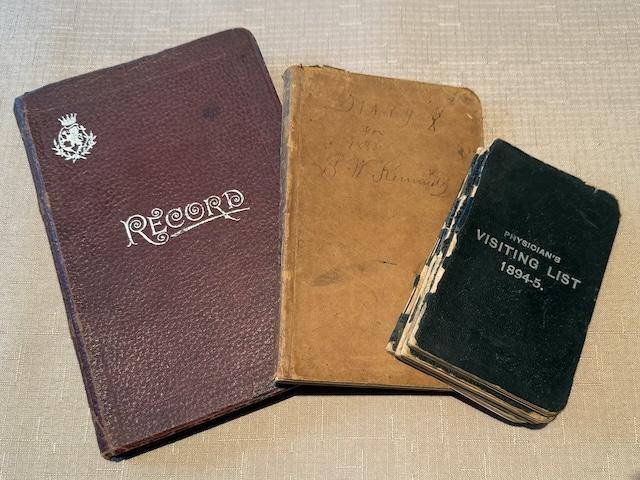
Reading the 40+ diaries of Dr. Swancey Kennedy (1844-1923), a physician who served the Fork, the lands between the French Broad and Holston rivers in Knox County, is like viewing life in the Fork from a crow’s perspective. We can see where he goes throughout the community, but we never know what he’s thinking or feeling. Seems as though his last note in 1886 was written just for me: “I might have gone into more of the minutia, but enough to show my business each day and my whereabouts and several occurrences.”
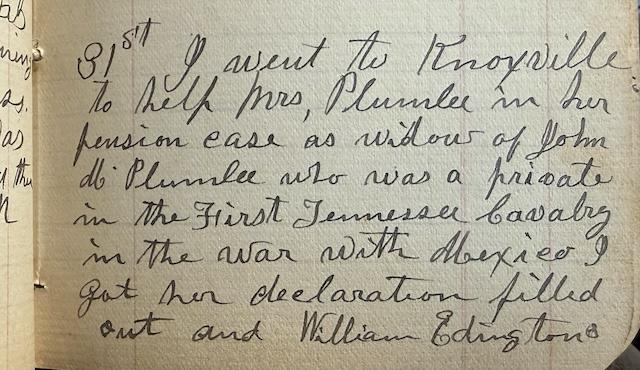
March 31 diary entry about Mrs. Plumlee’s pension application
However, by following his daily movements, we get a glimpse into the rhythm and flow of life in the late 1800s. Day by day, we know whom he visits and usually why, as he documents ailments and treatments. Neighbors also come to his home for medicine. When these pages are microfilmed, some university student should use them to study rural medical practices of the time—more about those in a minute.
I eventually came to understand that individuals mentioned by first name alone are close kin to the good doctor. He often stops by to see Bill, Samuel, Ebb, or Riley, or they come by to visit and stay for dinner. Sometimes they travel with him to Knoxville. They hunt together, kill hogs, survey land, pick up and deliver one another’s mail, etc. Looked it up. They were his brothers who lived close by.
He also often tells who is at home, whether it is Mary, Chalmers, Hatton, or “the little fellows,” which obviously refer to his wife and children, the youngest of whom were Swance Jr, Hannah, and Frank. As shown in last week’s article, I finally realized that Mrs. Plumlee was his mother-in-law, who also lived nearby.
Dr. Kennedy regularly notes visits to so-and-so’s wife (never a woman’s first name, unless she is a widow), or he visits so-and-so’s child or babe (again, no first name, unless the child is almost grown). And he uses “Mr.” or “Mrs.” only when showing respect to the older individuals of the community. I had to look up names and life dates before I understood the pattern. Professionals, however, such as doctors, lawyers, judges, and clergymen, are noted by their respective titles or suffixes.
His activities are stamped by time: “Called on before daylight.” “I was at home in the morning.” “Went in the forenoon.” “Came home by close dark.” “At home all day.” And his notes about the weather make me smile. “Very windy and cold.” “There was a light scift [sic] of snow and there was ice one half inch thick.” “Cloudy and cold.” “Hard thundered and lightninged.” “Still snowing at bedtime.” One of my favorites is, “Very cold. Some snow. Killed a hog in the evening.” It’s just what you do in cold weather.
Call me crazy, but I love to see whether he includes that he “took the buggy” or “forded the river” when he goes to town. And I get excited when he visits places such as “Andy Kain’s to get my boots fixed,” or “Moshina for a trial.” Such entries provide a more intimate glimpse into Fork community life beyond the doctor’s practice.
I’m drawn to the phrases he uses in his daily routes and routines. He visits so-and-so’s wife “in her confinement,” when a woman is in labor, and then she is “delivered of a” male or female. And lots of folks “have a diarrhea.” That’s how he writes it every time. And seems like everyone had a diarrhea.
We can track the elderly’s decline as he begins to repeatedly tend to them day after day, then writes something like, “I went to Samuel’s to get his wagon. Nancy Merriman died.” Or as another example, the same day he took his children to see the circus, he “paid Jim Cash eighty cents for Mrs. Browning’s burial cloth.”
And then there are the details of when he went with Dr. Bowman “to help perform an operation on William Lones’ wife for an abdominal tumor. We made an incision in the abdomen some four inches and found that the tumor was so greatly attached that it could not be removed.” (She lived to be 80 in 1937, when she fell and broke a leg.) On another day, Dr. Kennedy “Went to Wes Huffaker’s to help Dr. Bowman perform an operation on his son for talipes equinovarus [a congenital deformity where the heel is turned upward and the sole faces inward] of the right foot. I gave the chloroform and held the foot. We also cut two shots out of Charles Campbell’s neck. We went to Charles Campbell’s and took dinner…. I charged Huffaker $6 for administering the chloroform.” Yes, the good ol’ days when anesthesia cost ya only a few dollars have been forgotten in the Fork.
Jan Loveday Dickens is an educator, historian, and author of Forgotten in the Fork, a book about the Knox County lands between the French Broad and Holston Rivers, obtainable by emailing ForgottenInTheFork@gmail.com.
Enjoyed this article? Read more of Jan Loveday Dickens’s stories about the people, places, and history that make the Fork community unique.
Follow KnoxTNToday on Facebook, Instagram, X, and LinkedIn. Get all KnoxTNToday articles in one place with our Free Newsletter. Comments may be sent to news@knoxtntoday.com.



Many thanks for giving insight on the doings and the late 1800s?