
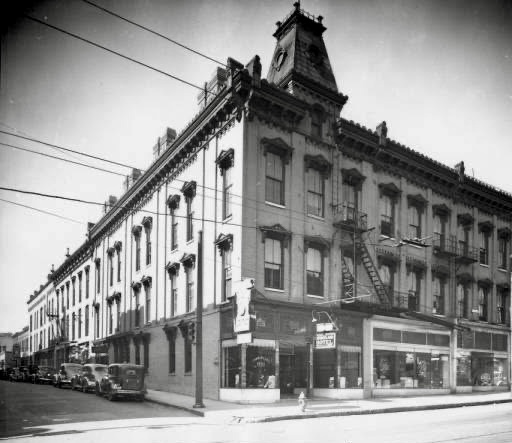
Cal Johnson swore he would raise no hand against her, no matter what she did. Well, as long as she was only swinging at property and not persons. “She” was Carrie Nation, the radical hatchet slinging temperance crusader, and she was on her way to Knoxville for Thanksgiving in 1906.
Johnson, the wealthy Black saloon and racetrack entrepreneur formerly enslaved by the McClung family, had gathered with other local tavern owners to decide what to do should Nation show up in their bars and commence to wreaking havoc. The majority said they would give her as good as they got, they had no intention of having their bars, bottles and brews busted to smithereens by the grandmotherly holy roller.
“No sirs,” he reportedly said. “If she enters my place and breaks every bottle and mirror, I shall not raise my hands to harm her. I conduct my business according to the law, and I expect the law to protect me.”
A teetotaler himself, Johnson never had a violation of any liquor ordinances, never served women or minors or on Sunday. As it turned out, no confrontations happened with Nation, who had just turned to 60 at the time of her visit to Knoxville. She had ensconced herself at the Cumberland Hotel at the corner of Gay Street and Cumberland Avenue (presently a parking lot). Instead of barroom blitzing, she kept herself to lecturing at the Market House Hall, including two lectures on Thanksgiving Day, and some local churches like the People’s Tabernacle. She travelled out from Knoxville to speak at other towns in East Tennessee.
By the time she arrived in Knoxville under the auspices of the Salvation Army, Nation had been arrested 29 times. Perhaps she was tired of charges stacking up, or maybe the Salvation Army wasn’t up for posting bai, but while here, she gave destruction a rest. She also sold her signature hatchets as well as copies of her autobiography, The Use and Need of the Life of Carry A. Nation, proceeds from which helped fund her shelter for the wives and children of alcoholics in Kansas City, Missouri. She would later start another one in Arkansas. She also campaigned hard against corsets; I couldn’t agree with her more on that count.
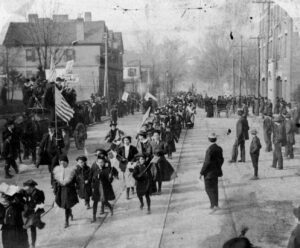
A temperance parade in downtown Knoxville, 1907 (Photo C.A. Wayland-McClung Digital Collection)
Nation had departed our fair city for good by December 8, but returned again in early February 1907 for a long weekend. She must have left a mighty impression. Just over a month later, there was a huge pro temperance parade downtown, with over 5,000 people lining the streets. On a Monday morning!! The parade extended for more than 15 blocks.
The prohibition battle was underway, and Tennessee was early on that party pooper bandwagon, with the first laws to prevent the sale and manufacture of liquor in the state going into effect in 1909. Carrie Nation died in 1911, so didn’t live to see the Prohibition Era do absolutely nothing to slow the roar of the 1920s. Along with banning alcohol, Tennessee also banished gambling, which essentially outlawed horse racing. Cal Johnson was run out of two businesses at which he excelled – selling drinks and racing horses. But the law was the law, and that was that.
Beth Kinnane writes a history feature for KnoxTNToday.com. It’s published each Tuesday and is one of our best-read features.
Sources: The Knoxville Journal digital archives, Beck Cultural Center
Follow KnoxTNToday on Facebook and Instagram. Get all KnoxTNToday articles in one place with our Free Newsletter