They say patience is a virtue. They also say to “make hay while the sun shines.” Sometimes both colloquialisms are relevant to what I do, as in the example of waiting for a field to be bushhogged in order to visit a cemetery in the Fork, the Knox County lands between the French Broad and Holston rivers.
I love it when I can have a conversation with someone who enjoys local history as much as I do, and such is the case with local luthier Gary Watson, who first called my attention to the Randles Cemetery off of Thorn Grove Pike. He invited me to come by once the field was mowed, so we waited while the necessary farm equipment was being repaired.
The cemetery is surrounded by a concrete wall that has no opening and must be scaled, and Gary was gentlemanly in helping me do just that. Only after I was inside the overgrown grounds did I notice that a couple of cinder blocks that could be used as a stile were located on the opposite wall. Such is my life.
The earliest person interred there was John Randles (1817-1875), whose parents are buried at Old Boyd’s Creek Cemetery in Sevier County. John’s wife Margaret (1830-1889) is buried beside him and was the daughter of John Underwood who, according to Underwood’s will, gave her 300 acres “for the love and affection he had for his daughter.” Some of John and Margaret Randles’ children and their spouses, as well as some grandchildren, are buried there, too. Their son John (1865-1949), however, is buried at Thorn Grove Cemetery.
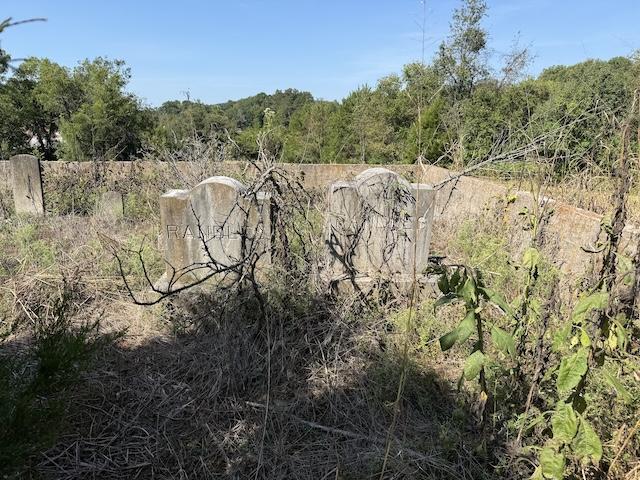
Randles family cemetery
I was curious about the possible connection to my Uncle Doyle Loveday’s wife Dorothy, whose maiden name was Randles. I found that, indeed, she and John Randles were related. John Randles’ father was my Aunt Dorothy’s great-great-grandfather, John Sydney Randles, Sr. While Aunt Dorothy’s great-grandfather Henry (1814-1881) married into the Huffaker family of Seven Islands, some of the junior John Randles’ female descendants married into the Kelly, McCarty, Jones and Brakebill families of the Fork.
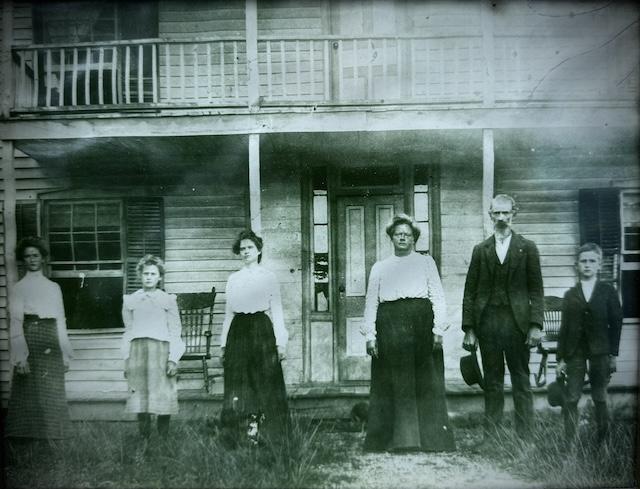
Gary Watson was a gracious host in showing me the barns related to the old Randles farm, where the Dandridge wagon road ran through the property. His two-story home, once belonging to Richard Randles (1851-1925), was likely built in the mid-1800s. The barn on the adjoining property, which was also part of the original 300 acres that John Underwood gave his daughter Margaret, is an old cantilever with beams about 40 feet long. And Richard’s son Robert Randles (1879-1948) expressed his creativity by carving images into some of the logs in the newer barn on Gary’s land.
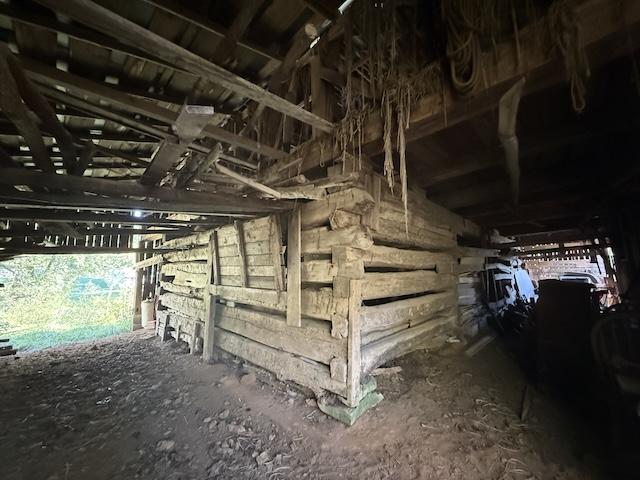
One pen of the Randles cantilever barn, which includes 40-foot beams
I never cease to be amazed at the log structures, often concealed by siding or some other shell, still standing in the Fork. Hand-hewn log construction was once a necessary skill but is now a forgotten craft.
Oh, and what’s a “luthier”? Well, Gary Watson’s French Broad Lutherie on the old Randles farm is where you’ll find him making beautiful stringed instruments, another form of craftsmanship forgotten in the Fork.
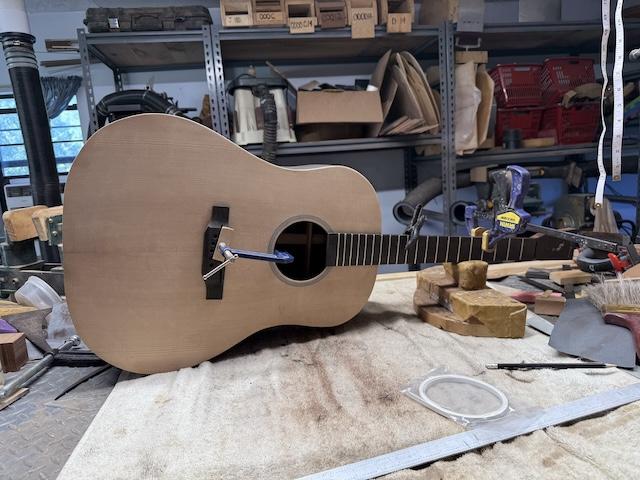
One of Gary Watson’s guitars in process
Jan Loveday Dickens is an educator, historian and author of Forgotten in the Fork, a book exploring the Knox County lands between the French Broad and Holston rivers. To obtain a copy, email ForgottenInTheFork@gmail.com.
Read more stories by Jan Loveday Dickens about the people, places and history of the Fork community, and learn more about her in her author bio on the same page.
Follow KnoxTNToday on Facebook, Instagram, X, LinkedIn and TikTok.
Get all KnoxTNToday articles in one place with our free newsletter. Comments may be sent to news@knoxtntoday.com.