
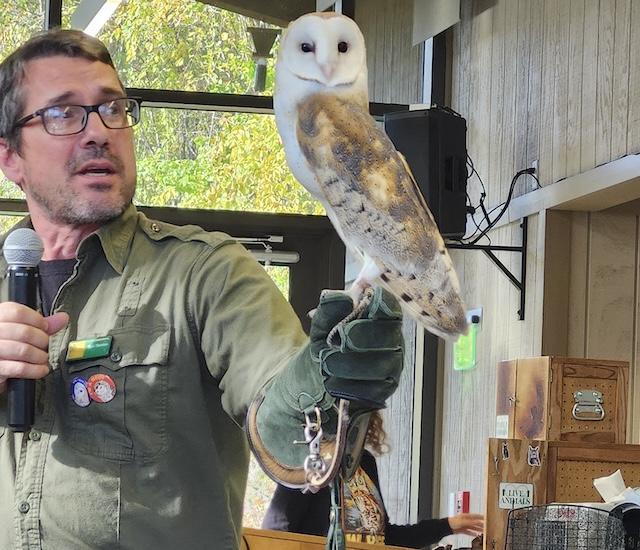
Perched on a quiet ridge an hour northeast of Knoxville, the steady gaze of a great horned owl greets visitors to the Owl Ridge Raptor Center. It’s not a zoo, nor a pet sanctuary. It’s a hospital, a halfway house, and sometimes a launch pad back into the wild.
Owl Ridge Raptor Center is a nonprofit dedicated to rescuing, rehabilitating, and sometimes releasing injured and orphaned birds of prey: owls, hawks, falcons, vultures, osprey, and even the occasional Bald Eagle. These are nature’s elite flyers, hunters, and scavengers. They are creatures built for precision, power, and patience. When something happens to one of them, Owl Ridge steps in. With partners, the UT Veterinary Hospital and the Tennessee Wildlife Resources Agency (TWRA), Owl Ridge rehabs their birds 24/7.
Speaking of Bald Eagles, Owl Ridge is the only eagle rehab facility between East Tennessee and Memphis.
Meet director and founder of the Owl Ridge Raptor Center, Lisa Thomison and her husband, co-founder Chris. While Thomison was working in the laboratory field, she discovered and volunteered for the Clinch River Raptor Center where she learned about birds of prey. When the leaders of the organization retired, she applied for her state permit. Owl Ridge Raptor Center now holds both state and federal permits for education and rehab. When working with birds of prey, it is required that the organization hold a federal permit as these birds are protected at the federal and state levels.
While permits are required there is no federal money for the rehab organization or any similar rehab organization, Owl Ridge is 100 per cent dependent on donations.
Because of their love of these birds of prey, the Thomisons converted a barn into an aviary hospital. Sitting on 68 acres in Grainger County, the birds are housed in specially designed enclosures—spacious flight pens that allow them to regain strength and coordination before release.
Beyond rescue and release, Owl Ridge also serves an educational mission. The staff visit schools and community events to teach about raptor ecology, the dangers of pesticides, and the importance of preserving habitat.
When Lisa, her husband and sometimes other volunteers like naturalist Stephen Lyn Bales talk to community groups, they bring several live raptors. They introduce the work of the federal and state licensed raptor rehabilitation center, her “feathered ambassadors,” as she calls them.
They recently visited a standing room only crowd at the UT Arboretum in Oak Ridge where they explained the center’s mission.
“Our ambassador birds are non-releasable raptors who help us raise awareness and educate the public about these fascinating and important creatures,” explained Thomison. To meet Owl Ridge’s Ambassador Birds, click here https://owlridge.org/ambassador-birds.
-
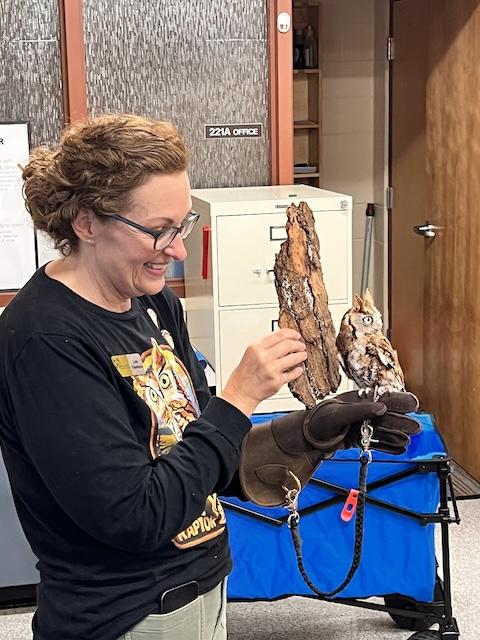
- Raptors like this red phase screech owl are camouflaged by tree bark. This is excellent “cryptic coloration.
-
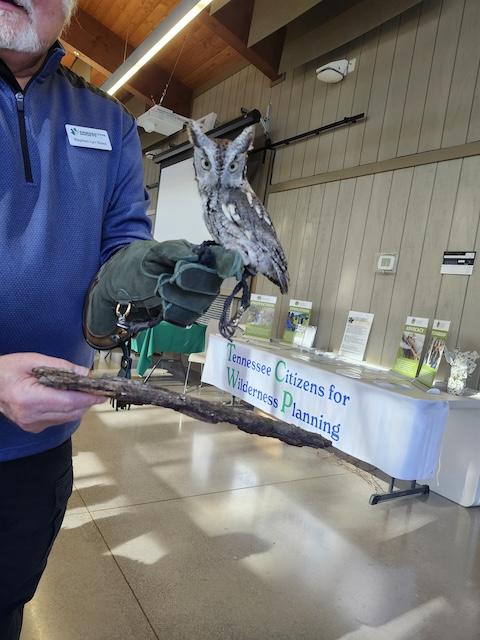
- Naturalist Stephen Lyn Bales holds Fizzgig, an Eastern Screech Owl
-
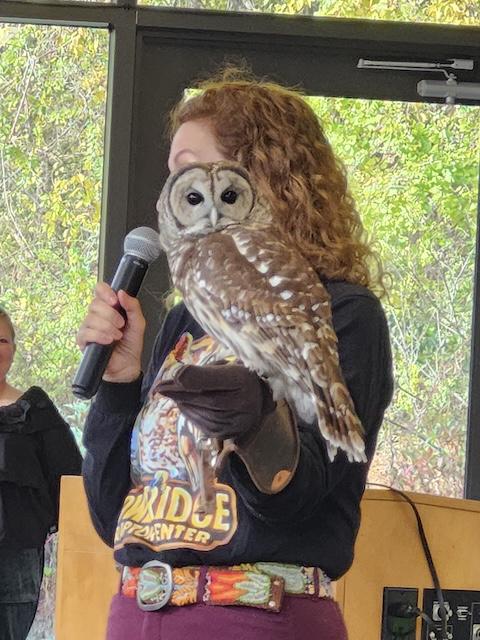
- Meet 19-year old Littledude, a Barred Owl, the oldest resident at Owl Ridge Raptor Center
The work is required seven days per week. When an injured raptor is brought in, the expert at Owl Ridge triages the bird by doing an oral swab for avian flu. If the bird tests negative, it is taken to the University of Tennessee Veterinary School by Owl Ridge or a network of volunteers. The bird may then get x-rays or surgery if needed.
The veterinarians and rehabbers all share one goal: giving every bird the best possible chance of recovery and return to the wild. Some cases are as simple as a wing strain or a concussion from a window strike. Others involve fractured bones, lead poisoning, or starvation. Rehabilitation is delicate work.
“You can’t just tape a wing and hope for the best,” said Lisa. “These are apex predators. Every feather matters.”
When recovery succeeds, release day feels like a small miracle. Volunteers gather quietly as a rehabilitated hawk or owl is carried to an open field. The box lid opens, and in a heartbeat, the bird is airborne—strong, silent, and free again.
“That’s the moment we all work for,” says the director. “It never gets old.”
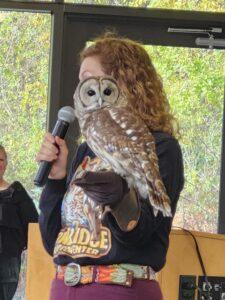
Meet 19-year old Littledude, a Barred Owl, the oldest resident at Owl Ridge Raptor Center
Every donation to Owl Ridge goes directly toward food, housing, and medical treatment. Feeding an eagle for a week can cost more than a family’s grocery bill. Surgery for a hawk hit by a car can reach hundreds of dollars. The center’s motto could be summed up as compassion powered by community.
“The more people understand these birds,” said Chris, “the more they care.”
In a world that too often measures success in speed and profit, Owl Ridge Raptor Center stands for something quieter: the patience to heal, the will to protect, and the faith that even a wounded wing can fly again.
Owl Ridge’s mission statement summarizes their work: Owl Ridge Raptor Center is a nonprofit dedicated to rescuing, rehabilitating, and releasing injured and orphaned birds of prey, including owls, hawks, falcons, vultures, and eagles. We partner with local veterinarians, the UT Veterinary Hospital, and a network of rehabbers to give every bird the best chance of recovery and return to the wild. Every donation directly supports the housing, feeding, and medical care of these remarkable animals.
To visit these incredible creatures, you can schedule an appointment-only tour. Click here.
Their donation button says it all: “HELP US, HELP THEM.”
Melanie Staten is a public relations consultant.
Follow KnoxTNToday on Facebook and Instagram. Get all KnoxTNToday articles in one place with our Free Newsletter.

