
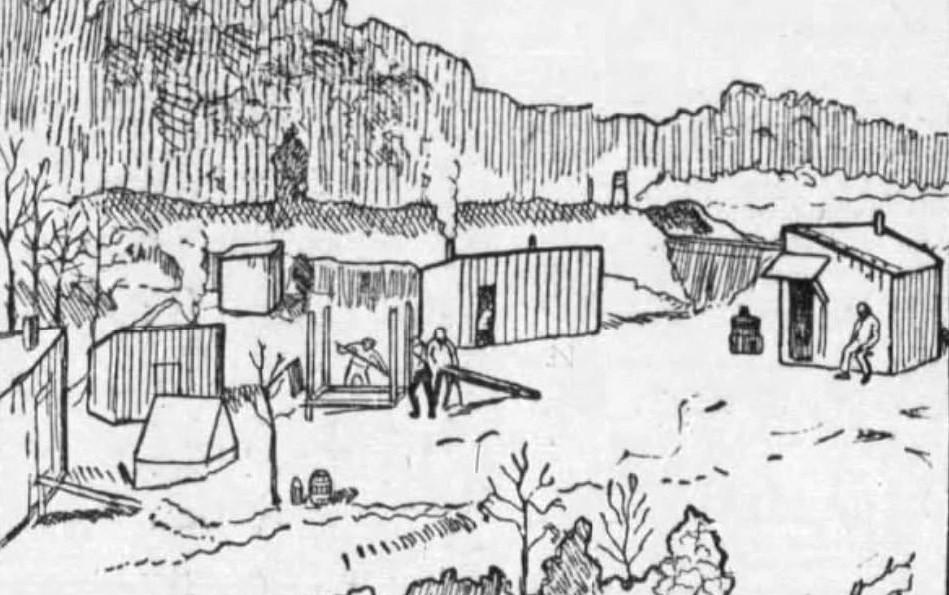
Last weekend, I tried to go for a walk in the woods. I wanted to get my own pictures of a place with a sad history. There are locations like this dotted across Knox County: unoccupied, forested land, filled with downed trees and underbrush, random rocks, and, often, trash. Under the leaf cover, there are large depressions in the earth. There are no markers, simply places where someone once was or still is buried.
The best time to wander such places is in the deep of winter. Trees are bare, foliage doesn’t obscure possible paths, and an unusually warm and sunny early spring day isn’t coaxing the vipers out. I had unwisely worn shorts and tennis shoes when I need to be in jeans and hiking boots. The only approach that didn’t involve traipsing through someone’s backyard did not offer a semblance of trail. A steep drop into a rock-strewn draw was less than encouraging. Discretion being the better part of valor, I decided to abandon my pursuit.
My quarry was a monument placed on a hill off Prosser Road in East Knoxville. It reads “Memorial For Those Who Died Of Smallpox 1903-1928.” At the bottom it says “Donated By The Residents of Plantation Hills 1983.” The marker sits on a little over seven acres of land still owned by the city. Those seven acres were once part of a 60-acre quarantine facility known as the Smallpox Pest House. Though rudimentary inoculation against smallpox dated back to the 18th century, it hadn’t been universally adopted everywhere. And Knoxville was continuously plagued by it for a solid 50 years from the 1870s into the 1920s.
Those who had the means could quarantine at home. And by “means” I mean the money to pay for a guard, stationed outside the home in a mobile yellow guard house, to watch for unauthorized entries and/or exits to the home. A yellow flag was planted at the house as well. Those without the income to pay for the guard were sent to the Pest House. Quarantine generally lasted 21 to 40 days. Those who’d been exposed but didn’t show symptoms after 10 days could go home.
The first pest houses were somewhere on the west end of town. But downtown businesses and what not wanted it moved further out from the city center. So the acreage on not-yet Prosser Road was selected, a mile from Chilhowee Park, and at least a half mile from any other road. There was a keeper’s house and separate dwellings for men and women, black and white. There was a well and a mess hall and kitchen, though patients all dined in their dwellings.
Back in 1978, Knoxville News Sentinel columnist Carson Brewer interviewed 78-year-old William Frost, whose entire family went to the Pest House in 1909. He was the oldest of four and he and all his siblings and their father had the pox. His mother was spared the scourge because she had been vaccinated, but she came along with the family to care for her children. She even brought the family cow along to keep her milked (which she gave to the staff). Young William remembered the gray mule that drew the black draped Pest House wagon to carry them off. There were two meals a day: prunes and fried Irish potatoes for breakfast, prunes and beans at 4 PM. No one died while William and his family were there. They all got to go home.
But those who didn’t still rest on a quiet hilltop in East Knoxville.
Beth Kinnane writes a history feature for KnoxTNToday.com. It’s published each Tuesday and is one of our best-read features.
Sources: The Knoxville Journal digital archives, Knoxville News Sentinel digital archives, The Tennessee Encyclopedia
Follow KnoxTNToday on Facebook and Instagram. Get all KnoxTNToday articles in one place with our Free Newsletter


Very interesting article. There are probably graves unknown in a lot of the woods in Knox County.