
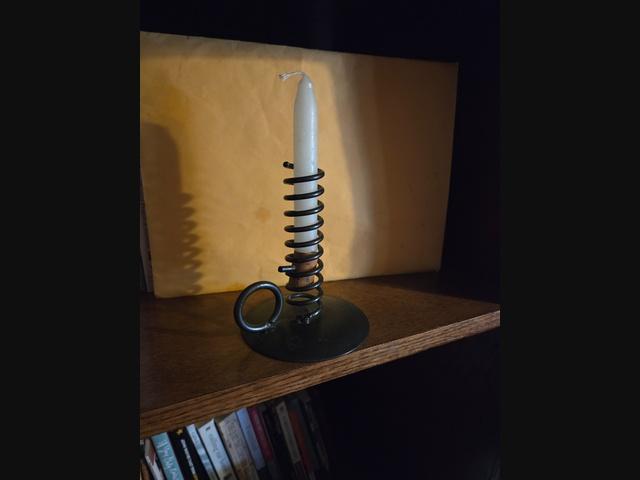
Long before parents worried about how late a teenager might stay out on a date, there was supposedly a much simpler solution.
A candle.
This unusual piece is commonly called a courting candle, found by the Secondhand Sisters on a recent trip. The wrought-iron holder coils around the candle, while a small wooden piece can be turned to raise or lower it. As the candle burns, the flame eventually reaches the top of the metal holder.
And, according to a favorite bit of American folklore, that meant one thing for a young man visiting a daughter of the house: Your time is up. Go home.
The story gets even better.
If the father approved of his daughter’s suitor, he could raise the candle and give the couple more visiting time. If Dad wasn’t particularly impressed with the young man sitting in his parlor, he could lower it.
That could make for a very short evening.
Imagine the scene
The following scene is imaginary, but it is based on the traditional story told about courting candles.
A young man arrives at the front door one evening, hat in hand and trying his best to make a good impression.
The young woman’s father invites him inside. The young couple settles into the parlor — probably under considerably more parental supervision than either would prefer.
Then Dad reaches for the candle.
The young man watches closely.
Perhaps this is his third visit, and he has learned something important: Always check the candle.
Dad turns the little wooden adjuster.
Up goes the candle.
The young man smiles. Apparently, he is making progress.
The candle is lit, conversation begins and everyone knows the rules. There is no checking a watch. No father standing in the doorway asking, “Do you know what time it is?”
The flame is doing the counting.
Eventually, the candle burns down to the iron.
The young man looks at the candle. The father looks at the young man.
No words are necessary.
Hat on. Good night.
And perhaps, if things went well, he would return another evening hoping Dad might give that little wooden adjuster one more turn.
History or a very good story?
Here is where our treasure becomes even more interesting.
Adjustable spiral candleholders really are historic objects. The design is associated with Germany and was brought to America by Pennsylvania-German settlers. The spiral helped support softer candles, while the adjustable mechanism allowed the candle to be raised as it burned so more of the expensive candle could be used. Wrought Works
But historians have questioned whether these holders were actually created for courtship. Historical interpretation from the John Jay Homestead describes the romantic courting explanation as a myth: the spiral holder was fundamentally a practical design for securing and adjusting candles. John Jay Homestead
Could a father somewhere have looked at that adjustable candle and realized he had just found an ingenious way to send his daughter’s beau home?
Certainly possible.
Can we say that was the established purpose of these candleholders?
The historical evidence doesn’t support going that far.
And somehow, that doesn’t spoil the treasure.
Objects passed from one generation to another often carry two histories — the documented story of what they were and the family or cultural stories people told about them.
This little candleholder has both.
And whether or not it ever sent a reluctant suitor out the door, you have to admit: “When the candle burns down, your date is over” beats waiting up until midnight.
Treasures and Tales explores the stories behind the things we save, inherit and discover — because sometimes the story is as interesting as the treasure itself.
Follow KnoxTNToday on Facebook and Instagram. Get all KnoxTNToday articles in one place with our Free Newsletter.