
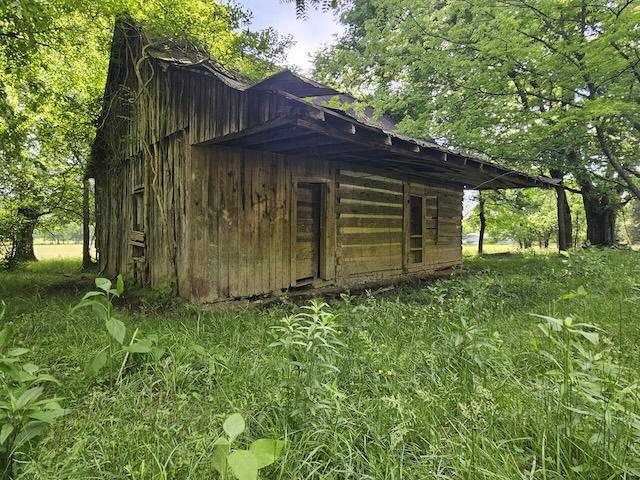
As we move closer toward our nation’s semiquincentennial, I’m still focusing on elements of the Revolutionary War effort of attaining independence and the related contributions and connections of families of the Fork, the Knox County lands between the French Broad and Holston Rivers.
His pension, first applied for by his widow in 1838 and again for further provisions in 1843 at age 80, contains 101 pages. His name was William Underwood, and a lot of his relatives are near and dear to my heart. The family’s genealogical record, The Underwoods from Roaring Gap, (NC) to Dumplin Valley (TN) compiled by Burl Underwood, is 356 pages and is a great resource for many families of the Fork.
William was born in February 1756 to John and Margaret (Jackman) Underwood in Surry County, North Carolina, where he then enlisted on January 27, 1780, just shy of his 24th birthday. He served as Captain of Company B of the light horse militia, corroborated by the pension application of Matthew Armstrong, who is mentioned in William’s file and also rode with Col. “Light Horse” Lee. They likely served under Col. Martin Armstrong, who led the Surry County regiment throughout the war from 1775 to 1783 and later oversaw the veterans’ land claims in Tennessee. Under the Armstrongs’ leadership, William probably was part of the Battle of Camden and saw a lot of action in the intense fighting against the Loyalists in the Piedmont area of North Carolina. Payment records indicate that even after his term in war, William continued to serve in the militia to protect the frontier against Native Americans until at least 1782.
On February 28, 1782, William married Susannah (“Susan”) Kerby/Kirby, and they continued to live in Surry County until 1797, when they moved to the part of Knox County, Tennessee, that became Anderson County in 1801. He was paid for his service while a soldier, but he died on December 20, 1814, a few years before pensions were offered to veterans in 1818.
When William’s younger brother John (who had settled in Dumplin Valley) submitted paperwork to support Susan’s request for a widow’s pension, his credibility was vouched for by Radford Gatlin, the controversial merchant, judge, and preacher whose store and post office caused White Oak Flats to be renamed Gatlinburg in 1854. Susan’s pension was initially $150 but ultimately was increased to $300 a year until her death in March of 1851.
Like William, his brother John Thomas Underwood also married a Kirby, likely Susan’s sister. She is believed to have died before John moved to what was known as Underwood Bend, or the “Bent,” on the northern banks of the French Broad in Kodak. John later married Elizabeth Manifold, then Mary (Evans) Huffaker. John lived in Tuckahoe until the late 1820s. According to John’s wills, his children were George, Nancy, Susannah, John, Elizabeth, Sarah, Mary, Thomas, and Joel. George was a blacksmith like his father. George’s and his siblings’ descendants married into familiar families of the Fork: Armstrong, Baker, Bales, Burkhart, Burnett, Campbell, Cate, Cruze, Drinnen, Evans, Frazier, Green, Hickman, Hodges, Huffaker, Johnson, Loveday, Maples, McCarty, Newman, Pickle, Randles, and Robertson, among others I’ve previously written about. Most of the land between Kodak and Thorn Grove was once owned by John Thomas Underwood’s descendants.
-
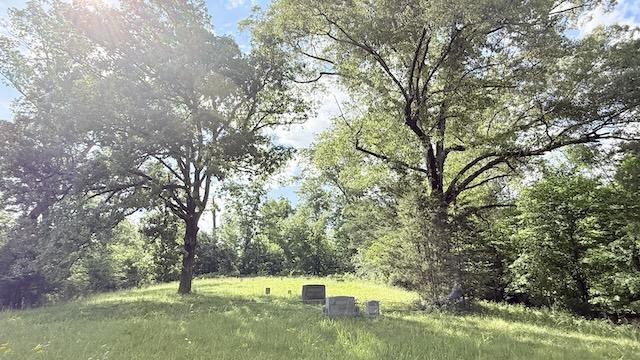
- Another Underwood family cemetery in the Fork, where many of John T. Underwood’s children and descendants are buried
-
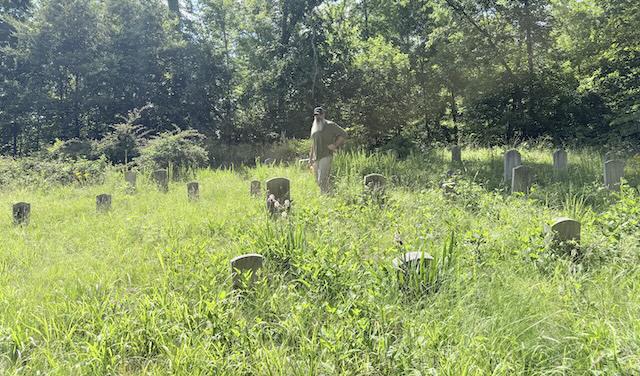
- Chase McSpadden among mid-1800s Underwood stones
John died on March 14, 1858. Some of his descendants inherited the lands along Kodak Road near the McCarty and Deaton families in the area of Manifold Station, once owned by the father of John’s second wife, Elizabeth.
William’s file includes his 1814 will. William’s brothers, Thomas and John, were 83 and 86, respectively, in 1853, and both were living in Sevier County, probably in the Tuckahoe part that was added to the Carter School district in Knox County in 1901.

The white square on the hill in the distance is this sign (2009 photo), at what is reported to be the oldest Underwood cemetery in Tennessee.
In character references in his pension file, William Underwood was said to have “on all occasions conducted himself as an honest man and ever distinguished himself as a true friend to his country.” May his contributions toward the establishment of our country not be forgotten in the Fork.
Jan Loveday Dickens is an educator, historian, and author of Forgotten in the Fork, a book about the Knox County lands between the French Broad and Holston Rivers, obtainable by emailing ForgottenInTheFork@gmail.com.
Follow KnoxTNToday on Facebook and Instagram. Get all KnoxTNToday articles in one place with our Free Newsletter.


Margaret Underwood, a Manifold granddaughter is buried in my Randles cemetery on Thorngrove.