When behavioral health crises intersect with the criminal justice system in Knox County, the first institution many individuals encounter is not a hospital or treatment provider.
It is the jail.
That pattern reflects a broader national reality. Nearly 44% of people incarcerated in local jails in the United States have a history of mental illness, according to federal research on behavioral health and incarceration.
Programs like Knox County’s Criminal Justice Liaison initiative were created to address that intersection.
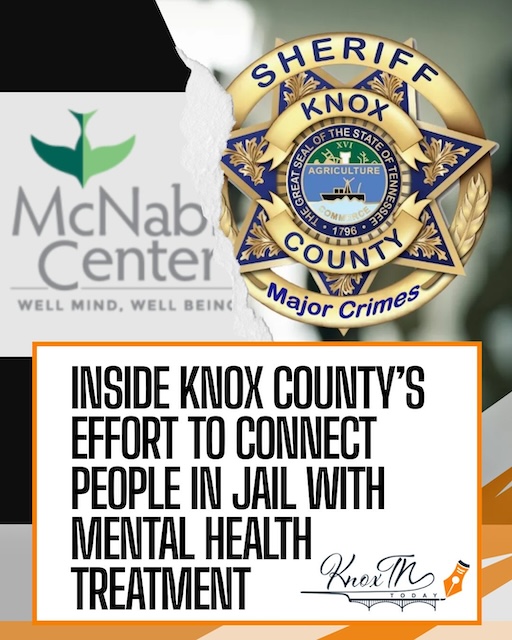
Operated locally through the Helen Ross McNabb Center in partnership with the Tennessee Department of Mental Health and Substance Abuse Services, the program places behavioral health specialists inside the Knox County jail and local courts. Their role is to identify individuals with mental health or substance use disorders and help connect them with treatment services before incarceration becomes prolonged.
The position sits between three systems that frequently encounter the same individuals but historically operate separately: the jail, the courts and the behavioral health network.
Liaisons begin their work inside the Knox County jail, where they conduct mental health and substance use assessments with incarcerated individuals. They coordinate with jail medical staff when medication issues arise and work with attorneys and court officials to develop release or alternative sentencing plans built around treatment.
If the court approves the plan and treatment placement is available, individuals may be directed into services rather than remaining in custody.
The work also requires coordination with community providers across the region. Treatment options may include outpatient mental health services, medication management, substance use treatment, medication-assisted treatment, sober living placements and housing programs for individuals with serious mental illness.
Referrals can originate from many points in the system. Prosecutors, defense attorneys, probation officers, jail staff, treatment providers, advocacy organizations, family members and individuals themselves can all initiate contact with the program.
Diversion, however, is not automatic.
Prosecutors must approve the proposal. Courts must accept the plan. Treatment providers must have available placement, and the individual must agree to participate.
Those conditions reflect a broader challenge facing behavioral health systems across Tennessee. Demand for treatment often exceeds available capacity, limiting the number of individuals who can be placed immediately into services.
Even when diversion is not possible, the liaison program can still assist individuals preparing to leave jail by coordinating appointments, treatment entry and connections to community providers.
Success is typically measured through two outcomes: whether individuals engage in treatment and whether they avoid returning to the criminal justice system.
Programs like Knox County’s Criminal Justice Liaison initiative attempt to bridge the gap between courts, detention facilities and behavioral health providers. When behavioral health crises enter the justice system, the goal is to ensure treatment options are visible before incarceration becomes the default response.
For most Knox County residents, that coordination happens largely out of sight. But when it works, it can mean the difference between repeated jail stays and an opportunity for treatment.
Det. Brandon Burley (Ret.), M.P.A., is a criminal justice educator whose academic work focuses on reducing recidivism through public policy. He has authored several criminal justice books and has been published in national law enforcement publications.
Follow Detective Burley on Facebook.
Follow KnoxTNToday on Facebook and Instagram. Get all KnoxTNToday articles in one place with our Free Newsletter.