
This is the big week for Olympic figure skating and for Team USA. The U.S. enters every discipline with one of its strongest lineups in years, and there’s real reason to believe Americans could land on the podium in all four events. The team was selected at last month’s U.S. Championships in St. Louis, which set the stage for the sport’s biggest spotlight.
Skating began last week with the Ice Dance and the Team events. Still relatively new (debuted in 2014), the Team event hasn’t drawn the ratings of the individual competitions. Traditionally, the largest audiences come for the women’s and men’s events. Men’s gold-medal favorite, Ilia Malinin, is a headline-maker all on his own, and the U.S. women’s group is being described as the strongest since 2002.

Maxim Naumov has overcome overwhelming loss as both parents died in the Potomac River airline crash last year.
Amid the joy and excitement, one skater is dealing with unspeakable grief. A story you will hear often this year is the tragedy that took place last year when Men’s US team member, Maxim Nauvmov’s parents (who were also his coaches) died in the airline crash over the Potomac in Washington, D.C. Maxim has faced a “roller coaster” of a year, as he describes it. He carries a picture of them onto the ice when he competes. Every skater in Milan-Cortina is rooting for him.
The costumes are their own spectacle. Last week’s outfits were a glittering parade of sequins, rhinestones, flash, and elegance — handmade and often costing upward of $10,000. Canadian skater Deanna Stellato-Dudek is expected to wear a costume reported to be an Oscar de la Renta design valued around $100,000, a reminder that skating is equal parts sport, theater and wardrobe.
Drama is always a part of the package in figure skating. It’s already arrived. Along with behind-the-scenes tensions that always swirl around elite coaching camps, one headline has involved French star Gabriella Papadakis, who has been dropped from the NBC commentary team after controversial statements in her new book about her former Ice Dance partner. There will be much more drama to come.
Controversy: the ongoing debate in modern skating – athletic vs. artistry. As the sport has leaned harder into triple and quadruple jumps, some longtime skaters worry that musical interpretation and style are being squeezed out. NPR recently framed the broader tension well: “Figure skating remains uniquely emotional because it blends difficulty with performance — and these Games will test not only athletic precision, but the ability to deliver under the brightest pressure.”
The Olympics won’t settle that argument. If anything, they’ll crank it up. As more triple and quad jumps are being delivered, is the artistry disappearing? For this reason, many people have gravitated to the Ice Dance competition which bans the super jumps. You can decide this week.
What to watch for this week: If you’re a casual viewer, here’s the simplest way to follow the week in one sentence: men bring the fireworks, women bring the intensity, pairs bring the danger, and ice dance brings the precision. The U.S. Team is strong in every category, but the question is whether the Americans can deliver clean programs at the exact moment the pressure peaks. In figure skating, the medals aren’t won by reputation — they’re won by what happens in two to four minutes when the whole world is watching.
The Men
Ilia Malinin (Vienna, Va.; Washington Figure Skating Club- FSC) is the sport’s technical miracle — a four-time U.S. champion, widely known as the “Quad God” for landing multiple types of quadruple jumps, including the elusive quad Axel. A two-time world champion and the favorite for 2026 Olympic gold, he has changed the sport’s ceiling by attempting as many as seven quads in a single program, the maximum allowed. A quad Axel has 3½ rotations in the air, and Malinin has been landing quads in competition since 2022. His parents — former skaters from Uzbekistan — are also his coaches.
Andrew Torgashev (Coral Springs, Fla.; Panthers FSC) brings steadiness and style. He earns points with flow, attack, clean skating skills, and often wins audiences over with his musicality. He is the son of Soviet medalists in pairs and ice dancing.
Maxim Naumov (Norwood, Mass.; Skating Club of Boston) has carried unimaginable grief this season after a January 2025 plane crash near Reagan National Airport claimed the lives of his parents — who were also his coaches — along with 62 others. The emotion caught up with him after his long program at Nationals in St. Louis. He is a powerful skater whose performances can be both athletic and deeply moving.
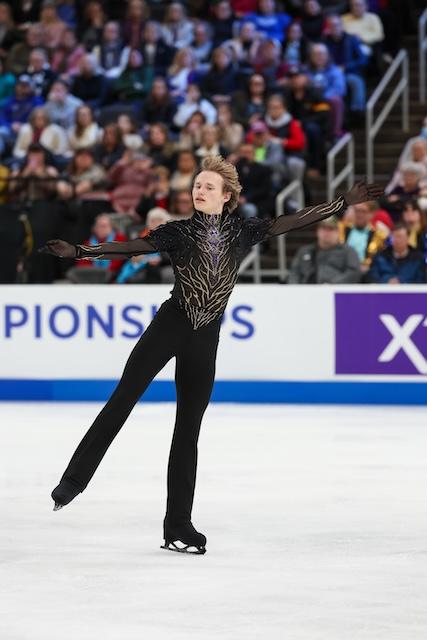
Ilia Malinin — The “Quad God” is the favorite in the men’s event, bringing the biggest technical arsenal in the sport.
The Women
Amber Glenn (Plano, Texas; Dallas FSC) is a three-time national champion who finished first in St. Louis. She skates with fearless ambition, including a clean triple Axel, and she doesn’t shy away from difficult moves. At 26, she’s the oldest of the three U.S. women, and this is her first Olympics.
Alysa Liu (Oakland, Calif.; St. Moritz ISC) brings speed, personality, and a creative spark that jumps off the ice. Her skating is efficient and point-friendly, and when she’s “on,” she stacks technical value quickly. Her story is unusual: she retired at 16, stayed away for two years, then returned — a comeback that many in the sport doubted. When she announced her intentions, her coaches spent an hour on the phone with her. One coach said he consumed, “an entire bottle of red wine” trying to talk her out of it. It has never been done before. She proved him wrong. She is the first woman to throw a quad loop in competition.
Isabeau Levito (Mount Laurel, N.J.; Skating Club of Southern New Jersey) arrives with a built-in hometown storyline: her mother is from Milan, and much of her family lives there. Levito’s skating is known for elegance and softness — an airy style that earned her the nickname “Tinkerbeau.” She’s the kind of skater who can make a crowded arena quickly become quiet.
-
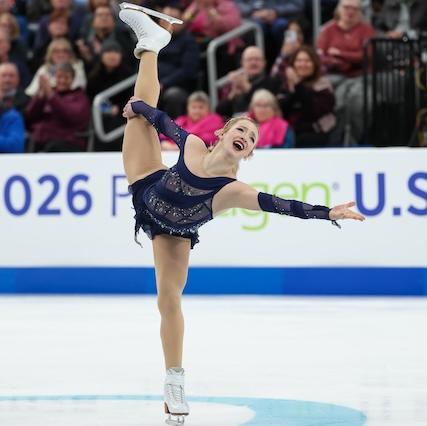
- Amber Glenn — A fearless competitor with a triple Axel, Glenn leads a U.S. women’s team considered the strongest in decades.
-
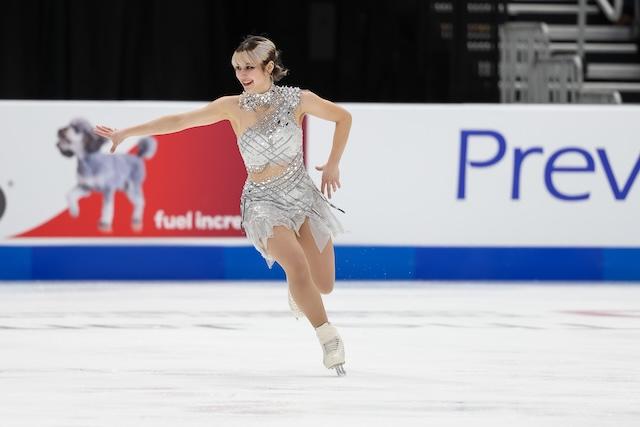
- Alysa Liu — After retiring at 16 and returning two years later, Liu’s comeback has become one of the season’s most surprising stories.
-
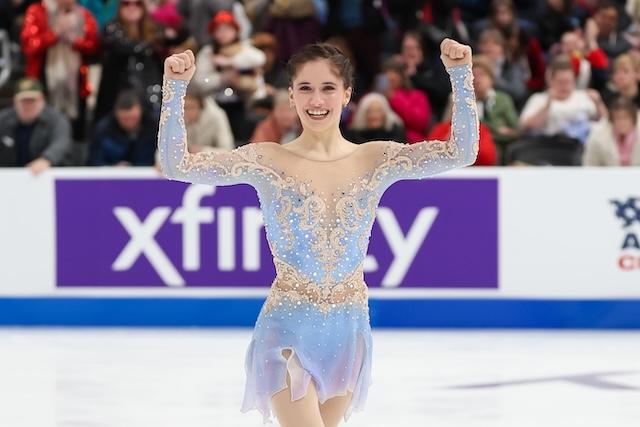
- Isabeau Levito — Nicknamed ”Tinkerbeau,” Levito brings elegance and a family connection to Milan-Cortina.
Pairs and Ice Dance: What’s the Difference?
Pairs skating is best described as two singles skaters plus partnered acrobatics: throw jumps, twist lifts, overhead lifts, and the dramatic “death spiral.” Ice dance is built around rhythm, edges, speed, and unison. It bans big jump content and instead emphasizes dance holds, step sequences, and dance lifts.
The U.S. has only two pairs teams skating this year, due to placement limitations from last season’s international results.
Ellie Kam and Danny O’Shea (Colorado Springs; Thunderbirds FSC / Skating Club of New York) combine big-element ambition with O’Shea’s experience. When they hit, their throws and lifts can score with any team in the field.
Emily Chan and Spencer Akira Howe (Dallas, Texas & Los Angeles, Calif.; Skating Club of Boston) are a momentum team that often strengthens as events go on, especially when their highest-value elements click. Howe is also active-duty U.S. Army, joining in February 2025 through the World Class Athlete Program, with a military role as an 88M Motor Transport Operator.
-
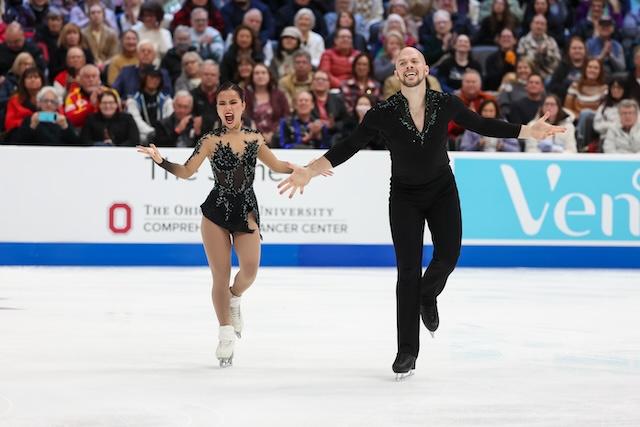
- Ellie Kam and Danny O’Shea — Pairs skating blends jumps with acrobatics, and Kam and O’Shea have the big elements to contend.
-
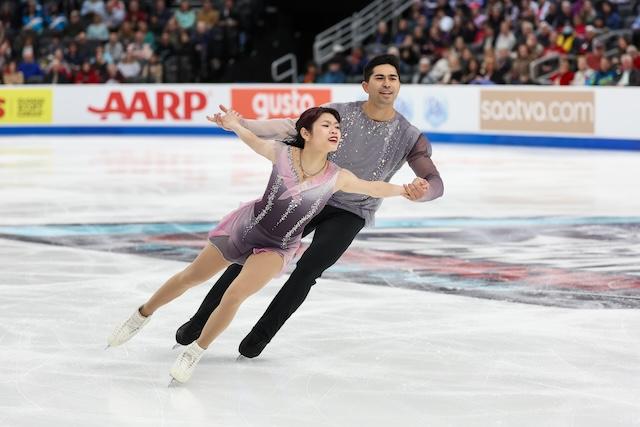
- Howe is both an Olympic pairs skater and an active-duty U.S. Army soldier in the World Class Athlete Program.
Melanie Staten is a public relations consultant
Follow KnoxTNToday on Facebook and Instagram. Get all KnoxTNToday articles in one place with our Free Newsletter.