
One of my great grandmothers, Lucinda Winfrey, did a good chunk of her growing up in Mechanicsville. Her family lived on Dora Street and Calloway Street during the time that her father, the Rev. Willliam Winfrey, was a pastor at the old Deaderick Avenue Baptist Church. Lucinda, born in 1898, was known to most people around Fountain City as Mamaw Payne. We were blessed to have her around until 1991.
I wish she was here so I could get more details on this story from her youth that was relayed to me from another family member. But, when Mamaw was in high school, sometime between 1913 and 1916, she had an interesting part-time job in her neighborhood. She worked as a hostess for a fully electrified house next door to hers.
Now electricity wasn’t new to Knoxville in the mid-1910s. The first glow of electric lights appeared on Gay Street just before Christmas in 1885. Even still, in the ballpark of 30 years later, there were more homes without electricity than there were with. Or even with the addition of electric lighting, perhaps lagging behind the curve on purchasing all the newest electric gadgets available.
Mamaw’s job was to let people into the “model” house to show off all the modern amenities available. Electric washing machines and wringers were already on the market, though it would be years before they were in common use. Toasters, percolators and stand mixers were among the early electric kitchen tools available.
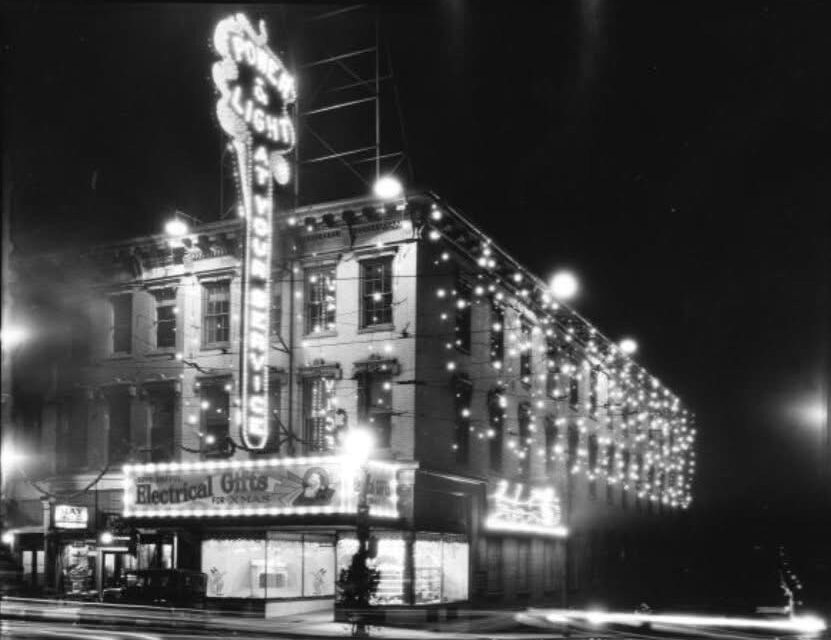
Advertisements at the time encouraged the purchases of practical, electrical gifts like flat irons, fans, cigar lighters, Christmas tree lights, heated blankets, grills, chafing dishes, lamps of every sort and vacuum cleaners (sometimes called carpet renovators). One ad that amused claimed “reduce your weight and restore your figure by the Gardner Electric Roller machine method. Ladies only.” I haven’t sorted out what that means yet, but I imagine something ridiculous.
Those items could be purchased from the city’s various electricity suppliers: Acme, Newman, Reliable, Briscoe, Schenck, Henry, Moses and, of course, the Knoxville Electric Company. Many of the early electric companies were directly tied in with the development of street car lines. The Knoxville Electric Light & Power Company was formed in 1888 and in 1905 merged with Knoxville Railway & Light, and by 1921 was called Knoxville Power & Light. And it was still a privately owned company.
Citizens, smartly, beat the drum for affordable public utilities, and voted for it in 1939, establishing the Knoxville Electric Power & Water Board, what we now call the Knoxville Utilities Board (KUB). KUB acquired the city’s gas system in 1945. And just a few years ago began expanding its services into broadband.
KUB still maintains corporate offices on Gay Street, but anyone whose been around these parts for a while can tell you that for most of their lives, headquarters sat on the northeast corner of Gay Street and Church Avenue. The building still exists, though with a much different façade than it had a century ago. The Tombras Group now resides at 620 S. Gay Street.
With the potential for a winter storm bearing down upon this weekend, here’s hoping the power stays up.
Beth Kinnane writes a history feature for KnoxTNToday.com. It’s published each Tuesday and is one of our best-read features.
Sources: The Knoxville Journal digital archives, McClung digital collection
Follow KnoxTNToday on Facebook and Instagram. Get all KnoxTNToday articles in one place with our Free Newsletter