I spent 36 years in education, including 14 years as a principal, so I know firsthand that some of the most important needs in a school do not always come with a line in the budget.
There are field trips, special classroom projects, student incentives, celebrations, supplies and countless unexpected needs that arise during a school year. Individually, some of those expenses may not sound enormous. Put them together across an entire school, and finding the money can become a constant challenge.
Principals and teachers become pretty creative when something will benefit their students but there simply isn’t money allocated to pay for it.
That’s one reason I appreciate Food City’s School Bucks program. It gives schools an opportunity to raise money without asking families to sell wrapping paper, candy or another product — and without putting another major fundraising project on the shoulders of already-busy teachers and parents.
Families and supporters can link their Food City ValuCard to the school of their choice. Then something they are already doing — buying groceries — can help generate money for that school.
And those everyday purchases can add up.
Just look at Joppa Elementary School.
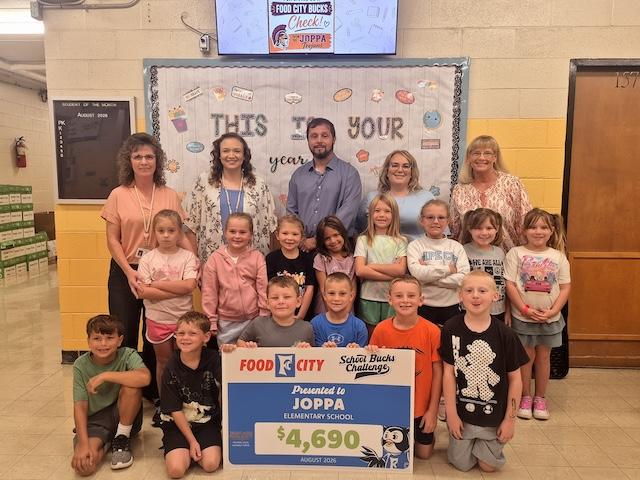
Joppa recently received $4,690 through the Food City School Bucks Challenge. That’s not pocket change for an elementary school. That’s money that can be turned into opportunities and resources for children.
As a former principal, I can tell you that nearly $4,700 in flexible funding can make a difference. It can help cover those needs that don’t fit neatly into a regular budget but can make school more meaningful, engaging and enjoyable for students.
There’s another thing I like about the program: It makes supporting a school easy. You don’t necessarily have to be a parent of a current student. Grandparents, former students, neighbors, staff members and other community supporters can participate.
Schools do have to promote the program and remind their communities to designate them, but compared with many traditional fundraisers, the effort can produce significant results without requiring families to reach into their pockets for an additional purchase.
Joppa Elementary’s $4,690 is a pretty convincing example.
I remember well the challenge of stretching every school dollar and searching for ways to provide something extra for students. Programs that allow businesses and communities to become part of the solution deserve attention.
Sometimes supporting your neighborhood school can be as simple as buying the groceries you were going to buy anyway.
Follow KnoxTNToday on Facebook, Instagram, X, and LinkedIn. Get all KnoxTNToday articles in one place with our free newsletter. Comments may be sent to news@knoxtntoday.com.