
As we continue to move toward our nation’s semiquincentennial, I’m still focusing on elements of the Revolutionary War effort of attaining independence and the related contributions and connections of families of the Fork, the Knox County lands between the French Broad and Holston Rivers.
We like to think of the winter holidays as a joyous time of the year filled with many baking traditions. But what if you’re stuck among diseased and wounded comrades in unbearably cold weather without proper clothing, shelter, food, or supplies during a war? By all accounts, these were the conditions that George Washington and his troop of 12,000 soldiers, along with 400 women and children, faced during the winter of 1777-78 at Valley Forge. People were even eating the leather soles of their shoes.
Because of the cramped conditions and poor sanitation, typhus, typhoid, dysentery, influenza, pneumonia, etc., along with starvation, took the lives of more than 2,000 souls at Valley Forge that winter. However, it was also the opportunity for Prussian officer Baron Friedrich von Steuben to implement military training that bolstered and unified the troops who survived.

Christmas window decoration at Historic Ramsey House
According to Ramsey family historian Frederic R. Ramsey in his book, Ramsey of Swan Pond, the Delaware military archives show that Reynolds Ramsey served during the French and Indian War in Richard McWilliam’s Company of Foot from New Castle County, where Reynolds was born in 1736. He was 21 when he enlisted, and his last name was spelled “Ramsay.” In 1761, he married Naomi Alexander, and they later moved to Marsh Creek in western Pennsylvania, where he ran a merchant mill. His grandson, historian Dr. James Gettys McGready (“J.G.M.”) Ramsey, stated in his autobiography that Reynolds was with General George Washington at Trenton and Princeton.
Washington’s earlier 1776 daring Christmas attack on the British at Trenton was also completed under stark winter conditions. Learning that local Pennsylvania millers didn’t want to sell to his army, he had his quartermasters confiscate flour but provide Continental vouchers in exchange.
J.G.M. remembered how his grandfather Reynolds described the blood on the frozen river and icy roads from where the haggard soldiers walked without shoes. Reynolds provided flour from his mill for the starving Patriots and refused to sell anything to the British or anyone who was believed to support them. He would reflect on how he was as poor at the end of the war as he was at the beginning, but he was proud of his patriotic “sacrifice and self-denial.”
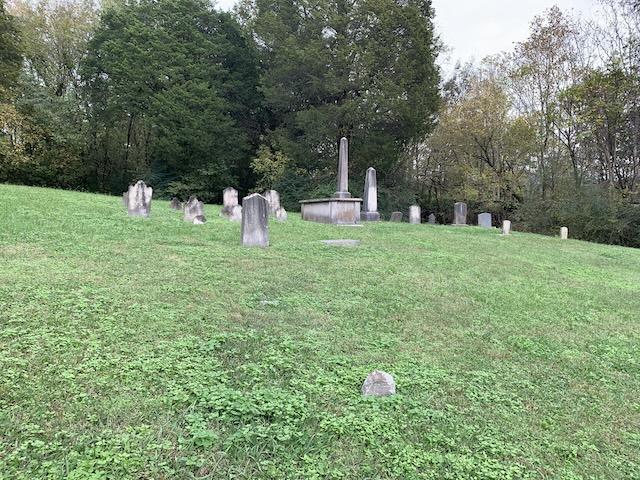
As Reynolds and Naomi aged, they moved with their daughter Amelia to Knox County to be near their sons. After the daughter died, they moved in with son Francis in his stone home now known as Historic Ramsey House, which was constructed in 1797 in the Fork. Naomi and Reynolds passed in 1813 and 1816, respectively, and along with many relatives are buried at Lebanon-in-the-Fork Cemetery, on land Francis gave to the Presbyterian Church. For many, Reynolds’ Pennsylvania mill and blessing of flour for hungry Patriots has been forgotten in the Fork.
Jan Loveday Dickens is an educator, historian, and author of Forgotten in the Fork, a book about the Knox County lands between the French Broad and Holston Rivers, obtainable by emailing ForgottenInTheFork@gmail.com.
Follow KnoxTNToday on Facebook and Instagram. Get all KnoxTNToday articles in one place with our Free Newsletter.

