
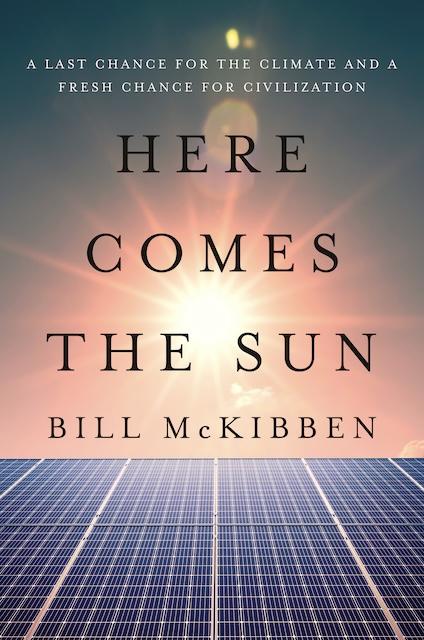
Reading Bill McKibben’s new book, titled Here Comes The Sun, may be the answer to many questions.
Still seeing mixed messages, even myths, pop up about solar energy? Confused about the facts on clean energy versus fossil fuels? Looking for a thoughtful, potentially noncontroversial topic for the next family Thanksgiving gathering, such as ways to lower utility bills. Here Comes The Sun is a great choice.
The acclaimed environmentalist and author who wrote The End of Nature to explain climate change to general audiences back in 1989 is at it again, giving us an easy read with factual context for the case to go solar. McKibben founded the advocacy groups 350.org and Third Act, is helping promote Sun Day events this year, and has been a frequent writer on the environment. So, what’s different this time? He makes note that:
- Solar prices are truly lower now than the cost of fossil fuels or nuclear power
- Global manufacturing capacity can now produce enough solar panels
- Electricity demand is rising at a rate that innovations like solar and storage are needed
McKibben has a way of blending science, history, philosophy, and sociology to explain complicated topics like climate change and the need for renewable energy. He references solid sources for facts, such as 2024 being the hottest year on record for our planet.
“The world has exactly one path available to make the rapid changes that the climate crisis requires, and that path is sun, wind, and batteries,” wrote McKibben. “They are available right now, in scale, at an affordable price. And they can provide almost everything we need. In the future, other technologies may supplement or even replace solar and wind power. It’s possible that someday, for instance, we’ll actually have fusion power, and it will be affordable. But that’s not right now; right now, money and attention spent on these glossy technologies is money and attention diverted from the task at hand.”
Despite the dire consequences the globe already experiences from climate change, this book offers the case that free solar energy still gives us hope. McKibben ends the book, “Convinced that we’ve been given one last chance. Not to stop global warming (too late for that) but perhaps to stop it short of the place where it makes civilization impossible.”
Anne Brock is marketing coordinator for Solar Alliance, which designs solar projects for manufacturers, offices, and nonprofits. She’s at abrock@solaralliance.com or 865-221-8349.

