It’s almost Thanksgiving. Pardon me, while I reminisce about family gatherings in the Fork, the lands between the French Broad and Holston rivers in Knox County.
If you’ve read many of my articles, you might already know I have a lot of first cousins. Both of my parents each were in company of nine surviving siblings, all of whom married, and almost all of whom had at least two children, and some of whom had five or six. And most of them lived in the Fork. Like myself, many of them still do.
Needless to say, it was a grand occasion when either side of my family got together, and on most holidays, my immediate family unit made sure to visit with both sets of grandparents. At either place, there could easily be 30 or more people at any given hour.
Turkey-shoots in the weeks before Thanksgiving were common back in the day, but no, they didn’t shoot at live turkeys. It was usually a paper target at anywhere from 16 to 60 yards, depending on whether rifles, shotguns, or pistols were being used. And lots of times in those days, the prize wasn’t even a turkey; it was a canned ham. Go figure. If the prize was, indeed, a turkey, it was most likely a frozen one from Cas Walker’s.
On Thanksgiving morning, my dad and some of my uncles would go hunting, while each woman in the family was busy making her specialty. I distinctly remember my mother usually made slaw and deviled eggs, among other things, such as spice cake with caramel icing. Multiply such dishes by the number of aunts and add a grandmother’s contributions. It was a feast. As bountiful as a church social.
I asked some friends the other day whether their mothers used an empty can to chop cabbage. The reply? “Yep, it was an evaporated milk can, because it didn’t have a lip around the edge.” Exactly. It must have been a thing for those Depression Era survivors. Anyone else remember that?
-
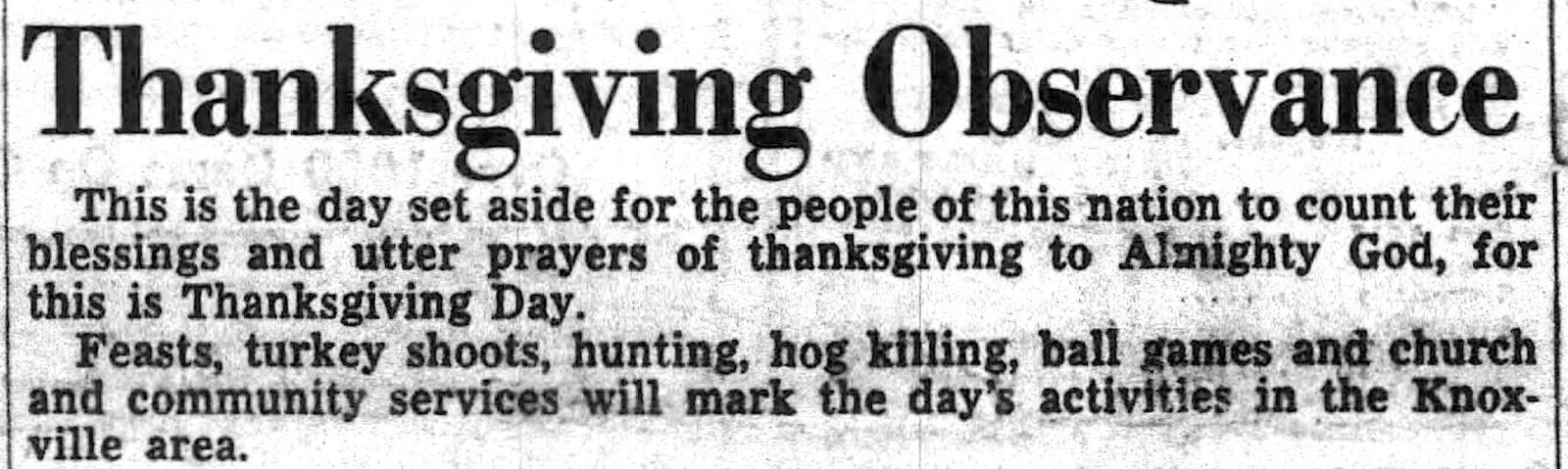
- From the Knoxville Journal, 1954
-
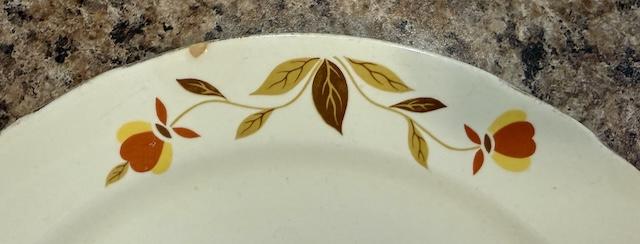
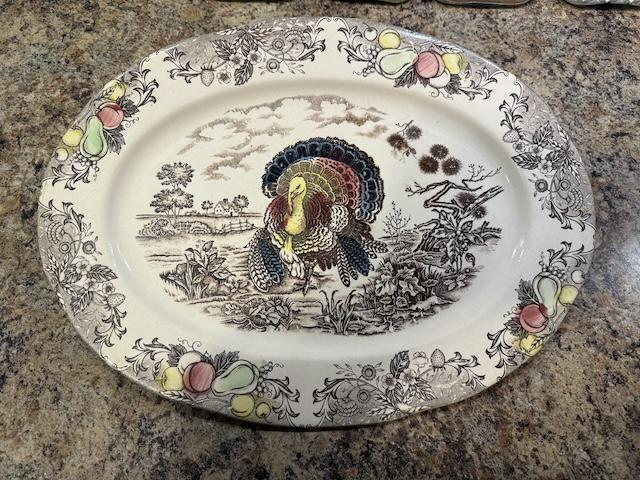
- Jewel Tea “Autumn Leaf” pattern
At my maternal grandparents’ home not many sat at the dining room table on such occasions, for it was covered with meats and side dishes. As I recall, desserts and drinks were usually located on the counter in the kitchen. If you wanted a seat, you had to park yourself on the couch or a chair in the living room or go out to the metal glider and rockers on the front porch. Or just sit on the steps, where there was a convenient place for your drink right beside your feet or your elbow. Maybe even on the ground. We were perched anywhere we could find a spot. Similar seating at my paternal grandparents’ home included a bench swing on the porch. I can still hear the sing-song squeak of it as the chains groaned under the weight.
My maternal grandmother’s Jewel Tea bowls and platters and casserole dishes, with their orange and gold “Autumn Leaf” pattern (created in 1933 and sold door-to-door), were scattered among the other Tupperware, Pyrex, and metal serving pieces. All filled with goodness.
At my paternal grandparents’ home in Tuckahoe in the years before the farmhouse burned, I remember napping on a chenille bedspread. Funny, how textures hold memories. I was only about five years old when their house burned, but I remember seeing the flames, and I remember being left with Reva Farmer while Daddy went to see what he could do to help. (I also remember being attacked by a rooster one summer day there while eating a slice of watermelon out in the yard, but I digress.)
Thanksgiving gatherings were all-day affairs, so what do you do with all that food between meals? You let a tablecloth float down over it, just like one might do over a communion table at church. No one freaked out over whatever had mayonnaise or eggs in it. And no microwave existed to warm up the leftovers. We survived.
In fact, we thrived. As kids, we played ball, tag, hide-and-seek, Red Rover, and if it was raining outside, Rotten Egg. Those were the days.
Indeed, we were thankful. For family, for the food, for the fun, for all the blessings of life that God gives us. And today, I’m thankful for the memories not yet forgotten in the Fork.
Jan Loveday Dickens is an educator, historian and author of Forgotten in the Fork, a book exploring the Knox County lands between the French Broad and Holston rivers. To obtain a copy, email ForgottenInTheFork@gmail.com.
Read more stories by Jan Loveday Dickens about the people, places and history of the Fork community, and learn more about her in her author bio on the same page.
Take a puzzle break! Play WordRow, Sudoku or Crosswords today! Choose your favorite puzzle in the site navigation.
Follow KnoxTNToday on Facebook, Instagram, X, LinkedIn, and TikTok. Get all KnoxTNToday articles in one place with our free newsletter. Comments may be sent to news@knoxtntoday.com.